
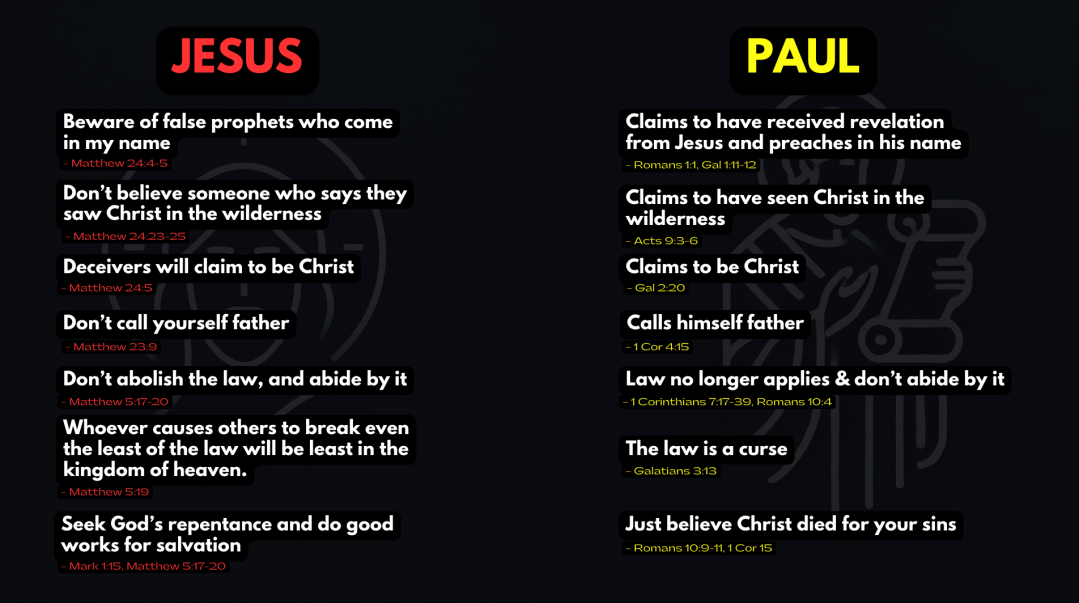
In one of his most striking warnings, Jesus foretold of false prophets and deceivers who would come in his name, claiming to have seen him, or to act on his authority, or to even be him. In Matthew 24, he cautioned:
4 Jesus answered: “Watch out that no one deceives you. 5 For many will come in my name, claiming, ‘I am the Christ,’ and will deceive many. – Matthew 24:4-5
23 At that time, if anyone says to you, ‘Look, here is the Christ!’ or, ‘There he is!’ do not believe it. 24 For false messiahs and false prophets will appear and perform great signs and wonders to deceive, if possible, even the elect. 25 See, I have told you ahead of time. 26 “So if anyone tells you, ‘There he is, out in the wilderness,’ do not go out; or, ‘Here he is, in the inner rooms,’ do not believe it. – Matthew 24:23-25
Jesus also declared that those who teach others to ignore even the least of God’s commandments would be considered the least in the kingdom of heaven
19 Therefore, anyone who sets aside one of the least of these commands and teaches others accordingly will be called least in the kingdom of heaven, but whoever practices and teaches these commands will be called great in the kingdom of heaven. – Matthew 5:19
These warnings become very applicable when juxtaposed with the teachings of Paul of Tarsus, who claimed not only to have seen Christ from whom he said he received divine revelation but also to be Christ.
“I have been crucified with Christ. It is no longer I who live, but Christ who lives in me. And the life I now live in the flesh I live by faith in the Son of God, who loved me and gave himself for me.” – Galatians 2:20
Paul’s assertion that he encountered the risen Christ on the road to Damascus (Acts 9:3-6) and his subsequent teachings that indicate that after the death of Jesus, no one is any longer bound by the law present a theological dilemma.
10 For all who rely on the works of the law are under a curse, as it is written: ‘Cursed is everyone who does not continue to do everything written in the Book of the Law.'” 11 Now it is evident that no man is justified before God by the law; for “He who through faith is righteous shall live”; 12 but the law does not rest on faith, for “He who does them shall live by them.” 13 Christ redeemed us from the curse of the law, having become a curse for us—for it is written, “Cursed be every one who hangs on a tree”— Galatians 3:10-13
Paul not only claimed direct revelation from Christ but also advanced a doctrine of justification by faith that diverged sharply from Jesus’ emphasis on repentance, adherence to the law, and moral transformation.
“For I would have you know, brothers, that the gospel that was preached by me is not man’s gospel. For I did not receive it from any man, nor was I taught it, but I received it through a revelation of Jesus Christ.” – Galatians 1:11-12
As Paul’s writing predates the four gospels, it is problematic that he condemns the teachings of Jesus found in them, as they directly contradict his own teachings.
“But even if we or an angel from heaven should preach to you a gospel contrary to the one we preached to you, let him be accursed. As we have said before, so now I say again: If anyone is preaching to you a gospel contrary to the one you received, let him be accursed.” – Galatians 1:8-9
Since Jesus explicitly stated that his mission was not to abolish the law but to fulfill it (Matthew 5:17-18), then Paul’s theology, which portrays the law as obsolete (Romans 7:6, Galatians 3:10-13), contradicts the very foundation of Jesus’ teachings.
This tension between Jesus’ warnings and Paul’s assertions is more than a theological footnote; it strikes at the core of Christian doctrine. If Paul’s teachings lead believers away from upholding the law, as Jesus warned against, then his influence warrants critical examination. The following exploration delves into the heart of this conflict, contrasting Jesus’ call for repentance and adherence to the law with Paul’s radical departure toward justification by faith alone that Jesus died for the sins of mankind.
John the Baptist: Repentance Through Baptism
Before Jesus’ arrival, John the Baptist emerged as a prophetic voice calling the people of Israel to repentance. His ministry was revolutionary in its focus on baptism as a means of spiritual renewal rather than sacrifice. As recorded in Mark 1:4, John’s message was clear:
“John appeared, baptizing in the wilderness and proclaiming a baptism of repentance for the forgiveness of sins.” – Mark 1:4
This marked a significant shift from the traditional Jewish reliance on the sacrificial system for atonement.
John’s baptism symbolized a public declaration of repentance and a commitment to turn away from sin. It was an outward sign of an inward transformation, emphasizing personal accountability and a direct relationship with God. John underscored the insufficiency of ritual sacrifices to achieve true spiritual renewal by calling people to repentance through baptism. His fiery proclamations, such as “Bear fruit in keeping with repentance” (Matthew 3:8), further emphasized that a changed heart and righteous actions were the evidence of genuine repentance.
Jesus, a Follower of John
Jesus followed in John’s footsteps, beginning His ministry with the same call:
“Repent, for the kingdom of heaven is at hand.” – Matthew 4:17
Like John, Jesus prioritized repentance and transformation over ritual sacrifice. His teachings and parables consistently highlighted the importance of turning away from sin and aligning one’s life with God’s will. For instance, in the parable of the Pharisee and the tax collector, Jesus commends the repentant tax collector over the self-righteous Pharisee, illustrating that humility and repentance are more valuable to God than outward religious observance.
9 He also told this parable to some who trusted in themselves that they were righteous and despised others: 10 “Two men went up into the temple to pray, one a Pharisee and the other a tax collector. 11 The Pharisee stood and prayed thus with himself, ‘God, I thank thee that I am not like other men, extortioners, unjust, adulterers, or even like this tax collector. 12 I fast twice a week, I give tithes of all that I get.’ 13 But the tax collector, standing far off, would not even lift up his eyes to heaven, but beat his breast, saying, ‘God, be merciful to me a sinner!’ 14 I tell you, this man went down to his house justified rather than the other; for every one who exalts himself will be humbled, but he who humbles himself will be exalted.” – Luke 18:9-14
Moreover, Jesus affirmed John’s ministry as divinely ordained, declaring:
“Truly, I say to you, among those born of women there has arisen no one greater than John the Baptist.” – Matthew 11:11
This endorsement underscores the continuity between John’s message and Jesus’ mission. Together, they presented a unified call to repentance and spiritual renewal that bypassed the temple-centric sacrificial system.
By shifting the focus from sacrifice to repentance, John and Jesus paved the way for a more personal and transformative understanding of redemption. This approach starkly contrasts Paul’s later emphasis on faith in the death and resurrection of Christ as the sole means of justification, raising questions about the compatibility and coherence of the two theologies.
The Ministry of Jesus and John: Repentance and Redemption Through Action
Both Jesus and John the Baptist preached a message of repentance that was deeply rooted in action and accountability. John, the enigmatic prophet in the wilderness, declared a baptism of repentance for the forgiveness of sins (Mark 1:4). His call was simple yet profound: turn from sin, embrace righteousness, and demonstrate that repentance through a public act of submission to God. Baptism, in John’s hands, was no mere ritual but a tangible sign of a transformed heart to wipe one’s slate clean from sin.
Jesus, too, emphasized repentance as the cornerstone of His ministry. His opening salvo in the Gospel of Mark is unequivocal:
“The time is fulfilled, and the kingdom of God is at hand; repent and believe in the gospel.” – Mark 1:15
Time and again, he exhorted individuals to amend their lives as a prerequisite for entering the kingdom of heaven. For instance, when confronting the Pharisees, Jesus does not merely denounce their hypocrisy but points them toward the fruit of repentance, urging them to align their actions with the law’s deeper moral imperatives.
“Either make the tree good and its fruit good, or make the tree bad and its fruit bad, for the tree is known by its fruit. You brood of vipers! How can you speak good, when you are evil? For out of the abundance of the heart the mouth speaks. The good person out of his good treasure brings forth good, and the evil person out of his evil treasure brings forth evil. I tell you, on the day of judgment people will give account for every careless word they speak, for by your words you will be justified, and by your words you will be condemned.” – Matthew 12:33-37
Importantly, neither Jesus nor John framed sacrifice as central to forgiveness. While Jesus spoke of his impending death, he rarely equated it with the transactional forgiveness of sins. Instead, he focused on the restoration of the sinner through a life of righteousness, justice, and humility before God. The parable of the Prodigal Son (Luke 15:11-32) underscores this emphasis: the wayward son is welcomed back not because of a sacrifice but because of his heartfelt repentance and return to the father. Redemption, in the teachings of Jesus and John, was intimately tied to the human capacity for change—a profound, soul-deep realignment of one’s life, and not blood sacrifice.
11 And he said, “There was a man who had two sons; 12 and the younger of them said to his father, ‘Father, give me the share of property that falls to me.’ And he divided his living between them. 13 Not many days later, the younger son gathered all he had and took his journey into a far country, and there he squandered his property in loose living. 14 And when he had spent everything, a great famine arose in that country, and he began to be in want. 15 So he went and joined himself to one of the citizens of that country, who sent him into his fields to feed swine. 16 And he would gladly have fed on the pods that the swine ate; and no one gave him anything. 17 But when he came to himself he said, ‘How many of my father’s hired servants have bread enough and to spare, but I perish here with hunger! 18 I will arise and go to my father, and I will say to him, “Father, I have sinned against heaven and before you; 19 I am no longer worthy to be called your son; treat me as one of your hired servants.”’ 20 And he arose and came to his father. But while he was yet at a distance, his father saw him and had compassion, and ran and embraced him and kissed him. 21 And the son said to him, ‘Father, I have sinned against heaven and before you; I am no longer worthy to be called your son.’ 22 But the father said to his servants, ‘Bring quickly the best robe, and put it on him; and put a ring on his hand, and shoes on his feet; 23 and bring the fatted calf and kill it, and let us eat and make merry; 24 for this my son was dead, and is alive again; he was lost, and is found.’ And they began to make merry. 25 “Now his elder son was in the field; and as he came and drew near to the house, he heard music and dancing. 26 And he called one of the servants and asked what this meant. 27 And he said to him, ‘Your brother has come, and your father has killed the fatted calf, because he has received him safe and sound.’ 28 But he was angry and refused to go in. His father came out and entreated him, 29 but he answered his father, ‘Lo, these many years I have served you, and I never disobeyed your command; yet you never gave me a kid, that I might make merry with my friends. 30 But when this son of yours came, who has devoured your living with harlots, you killed for him the fatted calf!’ 31 And he said to him, ‘Son, you are always with me, and all that is mine is yours. 32 It was fitting to make merry and be glad, for this your brother was dead, and is alive; he was lost, and is found.’” – Luke 15:11-32
Paul’s Radical Shift: Faith Alone as the Basis for Justification
Enter Paul of Tarsus, whose letters would go on to shape the trajectory of Christian theology more than any other figure. Paul’s doctrine of justification by faith alone (sola fide) is the lynchpin of his theological framework. To Paul, it is not human effort, repentance, or adherence to the law that secures redemption, but faith in the death and resurrection of Jesus Christ.
“For we hold that one is justified by faith apart from works of the law.” – Romans 3:28
This assertion marks a stark departure from the teachings of Jesus and John. Where they demanded active repentance as evidence of a contrite heart, Paul relegates human effort to the margins. In his worldview, faith is not merely a component of salvation; it is the sole determinant. Even repentance, so central to Jesus’ message, becomes conspicuously absent from Paul’s epistles. In fact, Paul’s theology risks rendering repentance irrelevant, as his emphasis on grace and faith shifts the locus of redemption entirely to divine action, leaving little room for human participation.
The Theological Dissonance
This divergence raises profound questions about the coherence of the Christian message. If Jesus and John insist on repentance as a prerequisite for entering the kingdom of God, how can Paul’s emphasis on faith alone harmonize with their teachings? Is it possible to reconcile a theology rooted in active moral transformation with one that elevates belief over action?
[9] because, if you confess with your lips that Jesus is Lord and believe in your heart that God raised him from the dead, you will be saved. [10] For man believes with his heart and so is justified, and he confesses with his lips and so is saved. [11] The scripture says, “No one who believes in him will be put to shame.” – Romans 10:9-11
Critics of Pauline theology have long pointed to this tension. While Paul’s letters are deeply reflective and intellectually rigorous, they often seem detached from the ethical demands articulated by Jesus. Where Jesus calls His followers to a higher righteousness (Matthew 5:20), Paul appears to diminish the significance of ethical conduct, instead portraying the law as a burdensome relic superseded by grace (Romans 7:6). This theological pivot risks undermining the very heart of Jesus’ message, reducing the call to discipleship to a mere intellectual assent.
[20] For no human being will be justified in his sight by works of the law, since through the law comes knowledge of sin. [21] But now the righteousness of God has been manifested apart from law, although the law and the prophets bear witness to it, [22] the righteousness of God through faith in Jesus Christ for all who believe. For there is no distinction; [23] since all have sinned and fall short of the glory of God, [24] they are justified by his grace as a gift, through the redemption which is in Christ Jesus, [25] whom God put forward as an expiation by his blood, to be received by faith. This was to show God’s righteousness, because in his divine forbearance he had passed over former sins; [26] it was to prove at the present time that he himself is righteous and that he justifies him who has faith in Jesus. [27] Then what becomes of our boasting? It is excluded. On what principle? On the principle of works? No, but on the principle of faith. [28] For we hold that a man is justified by faith apart from works of law. – Romans 3:20-28
Mercy Not Sacrifice
A central theme in Jesus’ teachings is encapsulated in his repeated quotation of Hosea 6:6: “I desire mercy, and not sacrifice.” This phrase appears prominently in Matthew 9:13 and Matthew 12:7, where Jesus critiques the Pharisees for their legalistic focus on ritual observance at the expense of compassion and justice.
“Go and learn what this means: ‘I desire mercy, and not sacrifice.’ For I came not to call the righteous, but sinners.” – Matthew 9:13
Here, Jesus addresses the Pharisees’ criticism of his association with tax collectors and sinners, emphasizing that God prioritizes the transformation of hearts and relationships over ritual offerings. Similarly, in Matthew 12:7, Jesus rebukes the Pharisees for condemning his disciples for plucking grain on the Sabbath, declaring:
“If you had known what this means, ‘I desire mercy, and not sacrifice,’ you would not have condemned the guiltless.” – Matthew 12:7
The underlying message is clear: God’s true desire is not for ritual compliance for compliance’s sake but for one’s heart and actions to be attuned to mercy, justice, and humility. Sacrificial offerings, central to the Jewish religious system, are rendered secondary to the ethical and relational demands of a righteous life. This teaching aligns closely with the prophetic tradition of the Hebrew Scriptures, where figures like Micah and Isaiah echo the primacy of justice and mercy over ritual.
To do righteousness and justice is more acceptable to the LORD than sacrifice – Proverbs 21:3
6 “With what shall I come before the Lord,
and bow myself before God on high?
Shall I come before him with burnt offerings,
with calves a year old?
7 Will the Lord be pleased with thousands of rams,
with ten thousands of rivers of oil?
Shall I give my first-born for my transgression,
the fruit of my body for the sin of my soul?”
8 He has showed you, O man, what is good;
and what does the Lord require of you
but to do justice, and to love kindness,
and to walk humbly with your God? – Micah 6:6-8
10 Hear the word of the Lord,
you rulers of Sodom!
Give ear to the teaching of our God,
you people of Gomor′rah!
11 “What to me is the multitude of your sacrifices?
says the Lord;
I have had enough of burnt offerings of rams
and the fat of fed beasts;
I do not delight in the blood of bulls,
or of lambs, or of he-goats.
12 “When you come to appear before me,
who requires of you
this trampling of my courts?
13 Bring no more vain offerings;
incense is an abomination to me.
New moon and sabbath and the calling of assemblies—
I cannot endure iniquity and solemn assembly.
14 Your new moons and your appointed feasts
my soul hates;
they have become a burden to me,
I am weary of bearing them.
15 When you spread forth your hands,
I will hide my eyes from you;
even though you make many prayers,
I will not listen;
your hands are full of blood.
16 Wash yourselves; make yourselves clean;
remove the evil of your doings
from before my eyes;
cease to do evil,
17 learn to do good;
seek justice,
correct oppression;
defend the fatherless,
plead for the widow. – Isaiah 1:11-17
However, this emphasis on mercy and repentance stands in sharp contrast to Paul’s theology, where sacrificial atonement—specifically, the sacrifice of Jesus—becomes the cornerstone of redemption. Paul’s writings portray Jesus’ death as the ultimate and necessary means of atonement, fulfilling the requirements of the law and rendering further sacrifices obsolete (Romans 3:25, Hebrews 10:10-14). Yet, in doing so, Paul’s framework contradicts the transformative call to mercy and repentance that Jesus prioritized.
Moreover, Paul’s emphasis on justification by substitutionary atonement, faith that Jesus died on the cross to pay the penalty for humanity’s sins (Romans 5:1), diverges from Jesus’ insistence on ethical action as a manifestation of true faith. While Jesus’ teachings consistently call for a lived faith marked by mercy and justice, Paul’s focus on faith as the sole requirement for salvation diminishes the necessity of such actions. This creates a stark contrast between Jesus and Paul: while Jesus emphasized mercy over sacrifice, Paul’s theology centers on the belief that Jesus’ crucifixion was a necessary sacrifice to absolve people of the law, with sin and redemption attainable solely through faith in this act.
Final Thoughts
By focusing so heavily on faith in this one act of salvation, Paul contradicts Jesus’ teachings of repentance and the importance of abiding by the law. In Jesus’ teachings, redemption is not a passive state conferred upon the believer but an active journey marked by repentance and doing good works. Paul’s doctrine of justification by faith nullifies this dynamic.
Moreover, Paul’s sidelining of repentance creates a theological rift with the Jewish tradition from which Christianity emerged. The Hebrew Scriptures consistently emphasize repentance as the path to forgiveness (e.g., 2 Chronicles 7:14; Ezekiel 18:21-23). By severing this continuity, Paul’s theology not only diverges from Jesus and John but also from the broader biblical narrative.
Additional Readings:
https://qurantalk.gitbook.io/problems-in-christianity

 Quran Talk Blog
4 thoughts on “Jesus vs. Paul: Repentance & Good Works vs. Substitutionary Atonement”