
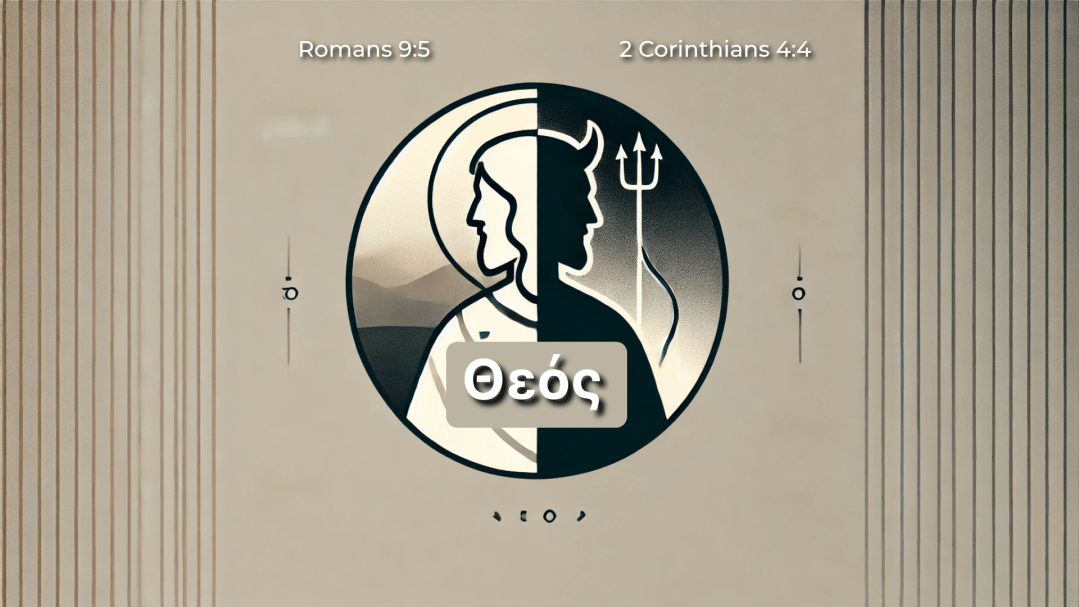
The New Testament’s use of the Greek term theos (θεός) is more nuanced than most Christians would want people to believe. For centuries, this term—translated as “God” in most English Bibles—has served as a cornerstone for Christian doctrinal claims about the divinity of Jesus based on a few passages where the term can be argued to be about Jesus. However, a closer examination of its application in the New Testament reveals this is a deviation from the truth.
Definition
In Ancient Greek, the word theos (θεός) means “god” and has multiple meanings based on the context, including:
- A god or goddess: A general term for deities or divinities, especially the great gods
- The Godhead or trinity: The term can refer to the Godhead, or the trinity of God the Father, Christ, and the Holy Spirit
- The only and true God: The term can refer to the one supreme God
- Things of God: The term can refer to God’s counsels, interests, or things due to him
- God’s representative: The term can refer to God’s representative or viceregent, or to magistrates and judges
- False gods or humans: The term can also refer to false gods or even humans, depending on the context
Theos in the Gospels: An Ambiguous Application to Jesus
The use of theos in reference to Jesus in the Gospels is sparse and indirect. For example, in the prologue of John’s Gospel, we read: “In the beginning was the Word, and the Word was with God, and the Word was God” (theos). While this passage is often cited as evidence of Jesus’ divinity, the grammatical structure—specifically the anarthrous use of theos (“God” without the definite article)—has long been debated among scholars. Some argue that it signifies a qualitative sense of divinity, rather than an identification with the one true God.
Elsewhere in the Gospels, Jesus is referred to in ways that imply a unique relationship with God but stop short of explicitly identifying him as theos. In John 20:28, Thomas declares to the resurrected Jesus, “My Lord and my God!” While this appears to be a direct attribution of theos to Jesus, it is important to note the context. Thomas’ exclamation could be interpreted as a confession of Jesus’ divine mission rather than a statement of metaphysical equality with God.
In Paul’s epistles, the application of theos to Jesus is even more restrained. In texts like Philippians 2:6-7, Paul describes Jesus as existing “in the form of God” but emphasizes his humility and obedience to the Father. This suggests a role of divine representation rather than direct equivalence with the one true God.
“Who, being in the form of God, did not consider equality with God something to be used to his own advantage…”
(ὃς ἐν μορφῇ Θεοῦ ὑπάρχων, οὐχ ἁρπαγμὸν ἡγήσατο τὸ εἶναι ἴσα Θεῷ…)
The most direct usage of the term god for Jesus in the seven letters of Paul found in the New Testament is in Romans 9:5.
“…to them belong the patriarchs, and from them, according to the flesh, comes the Messiah, who is God over all, blessed forever. Amen.”
(…ἐξ ὧν ὁ Χριστὸς τὸ κατὰ σάρκα, ὁ ὢν ἐπὶ πάντων Θεὸς εὐλογητὸς εἰς τοὺς αἰῶνας. Ἀμήν.)
This verse could be read as calling Jesus God over all. However, some translations and interpretations render it differently, separating the reference to God from Christ. For example, some translations might say, “Christ is over all; God be blessed forever,” thus attributing theos to God the Father, not Jesus.
However, even if it is conceded that Paul is calling Jesus “God over all,” it doesn’t mean that Paul viewed Jesus as the one true God. Paul, throughout his writings, makes a clear delineation between God and Christ. He does this most explicitly by using the term Lord for Christ when he speaks of him in conjunction with God. For example in 1 Corinthians 8:6, Paul writes:
“For us there is but one God, the Father, from whom all things came and for whom we live; and there is but one Lord, Jesus Christ, through whom all things came and through whom we live.”
Here, Paul’s separation between “one God, the Father” and “one Lord, Jesus Christ” reinforces the idea that according to Paul, Jesus’ role was distinct and subordinate to that of the Father.
Paul’s Direct Application of Theos to Satan
Additionally, Paul also unambiguously and directly uses the term god (theos) for Satan as seen in 2 Corinthians 4:4:
“The god of this age has blinded the minds of unbelievers, so that they cannot see the light of the gospel that displays the glory of Christ, who is the image of God.” (NIV)
ἐν οἷς ὁ θεὸς τοῦ αἰῶνος τούτου ἐτύφλωσεν τὰ νοήματα τῶν ἀπίστων, εἰς τὸ μὴ αὐγάσαι τὸν φωτισμὸν τοῦ εὐαγγελίου τῆς δόξης τοῦ Χριστοῦ, ὅς ἐστιν εἰκὼν τοῦ θεοῦ.Comment
| Greek | Transliteration | English Meaning |
| ἐν | en | in |
| οἷς | hois | in whom |
| ὁ | ho | the |
| θεὸς | theos | god |
| τοῦ | tou | of the |
| αἰῶνος | aiōnos | age or world |
| τούτου | toutou | this |
| ἐτύφλωσεν | etyphlōsen | has blinded |
| τὰ | ta | the |
| νοήματα | noēmata | minds or thoughts |
| τῶν | tōn | of the |
| ἀπίστων | apistōn | unbelievers |
| εἰς | eis | to or so that |
| τὸ | to | the |
| μὴ | mē | not |
| αὐγάσαι | augasai | shine or see clearly |
| τὸν | ton | the |
| φωτισμὸν | phōtismon | light or illumination |
| τοῦ | tou | of the |
| εὐαγγελίου | euangeliou | gospel or good news |
| τῆς | tēs | of the |
| δόξης | doxēs | glory |
| τοῦ | tou | of the |
| Χριστοῦ | Christou | Christ |
| ὅς | hos | who |
| ἐστιν | estin | is |
| εἰκὼν | eikōn | image |
| τοῦ | tou | of the |
| θεοῦ | theou | God |
Implications for Understanding Jesus as Theos
Paul’s reference to Satan as “the god of this age” in 2 Corinthians 4:4 highlights the significant influence Paul attributed to Satan over the present world order. Unlike the debated and contextual uses of theos for Jesus, Paul’s application of theos to Satan is unambiguous and direct. However, this designation does not imply that Satan possesses divinity comparable to the one true God but rather reflects his authority and influence in a limited context.
This usage prompts a critical reevaluation of the term theos when applied to Jesus. If theos can be used for Satan without ascribing intrinsic divinity, the same principle may apply to its use for Jesus. In the New Testament, theos often denotes authority, representation, or function, rather than absolute deity. Furthermore, the broader theological framework consistently distinguishes Jesus from the one true God, frequently identified as the Father.
The shared use of theos for both Jesus and Satan underscores that the term does not inherently equate its subject with the one true God. Instead, theos in the New Testament is context-dependent, applied sparingly to Jesus, often in a representative or functional sense. In contrast, Paul’s attribution of theos to Satan in 2 Corinthians 4:4 is clear and direct. This comparison highlights that being called theos in the New Testament does not automatically confer the status of ultimate divinity, challenging claims that Jesus’ occasional designation as theos establishes his equality with God.

 Quran Talk Blog