
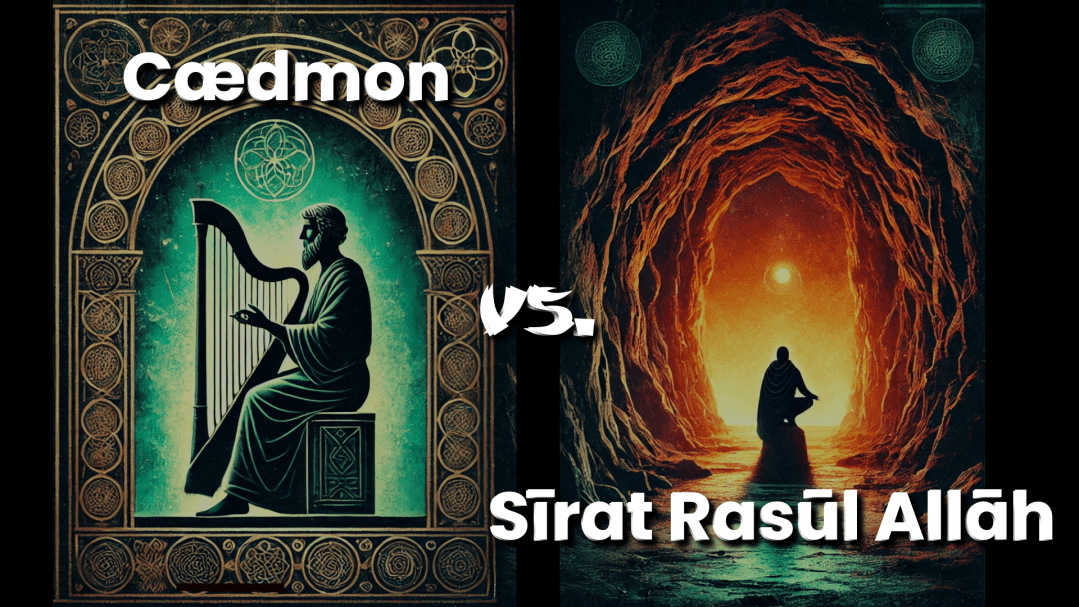
Cædmon, often regarded as the first known English poet, lived during the 7th century in the Anglo-Saxon Kingdom of Northumbria. He was a monk or lay brother associated with the monastery at Whitby, led by the abbess St. Hilda. His story comes to us primarily through the Ecclesiastical History of the English People, written by the Venerable Bede.
According to Bede, Cædmon was an illiterate herdsman who worked at the monastery. He had no formal training in poetry or music and was shy about singing or composing. During feasts at the monastery, it was customary for people to entertain each other with songs and music. Cædmon, feeling unskilled and ashamed of his inability to sing, would often leave the hall when it was his turn to perform.
One night, after leaving the feast, Cædmon went to the stables to care for the animals. While there, he fell asleep and had a remarkable dream. In the dream, an angelic figure appeared to him and asked him to sing. Cædmon protested, saying he could not sing, but the figure insisted. When Cædmon asked what he should sing about, the figure told him to sing about the creation of the world.
In the dream, Cædmon composed a hymn praising God as the Creator of heaven and earth. Upon waking, he remembered the hymn and found that he could compose other religious songs as well.
Translation from Bede’s Ecclesiastical History (Book IV, Chapter 24)
Here is the relevant portion of Bede’s Ecclesiastical History (translated from Latin into modern English), describing Cædmon’s vision and divine gift:
“There was in this abbess’s monastery a certain brother specially marked by the grace of God, so that he was accustomed to make fitting songs for the glory of God out of the sacred Scripture. Whatever he learned of holy Scripture with the aid of interpreters, he quickly turned into the sweetest and most moving poetry in his own tongue, which was English. By his songs, the minds of many were often inspired to despise the world and aspire to heavenly things. Others after him tried to compose religious poems, but none could compare with him, for he did not learn the art of poetry from men, but from God. For this reason, he could never compose any vain or profane songs; but only those which were concerned with religion suited his religious tongue.
He had lived as a layman until well advanced in years and had never learned anything about poetry. For this reason, sometimes at feasts, when all took turns singing to the accompaniment of the harp for the sake of entertainment, he would get up from the table and go home when he saw the harp approaching him, for he could not sing. One day he left the feast in this way and went out to the stable, where it was his turn to look after the beasts that night. There, when he had lain down and fallen asleep, someone appeared to him in a dream and greeted him, calling him by name, and said, ‘Cædmon, sing me something.’
He answered, ‘I cannot sing; that is why I left the feast and came here.’
The one who spoke to him said again, ‘But you shall sing to me.’
‘What shall I sing?’ he replied.
‘Sing about the beginning of created things,’ said the heavenly voice.
At once he began to sing verses in praise of God the Creator that he had never heard before, and their theme ran thus: ‘Now we ought to praise the Maker of the heavenly kingdom, the power of the Creator, and His purpose, the deeds of the Father of glory. He made the beginning of each and every created thing, the heavenly kingdom as a roof for the children of men, and then the earth beneath to be their dwelling place.’ This is the general sense, but not the actual words which he sang in his dream; for however excellent they may be, no translation can do full justice to the beauty of the original.”
Story of Muhammad Receiving The First Revelation
The parallels between the story of Cædmon and the story attributed to how Muhammad received the first revelation are uncanny. We find a narration of this event in Sahih Bukhari (d. 870 CE/256 AH), where it states:
Narrated ‘Aisha (the mother of the faithful believers): The commencement of the Divine Inspiration to Allah’s Messenger (ﷺ) was in the form of good dreams which came true like bright daylight, and then the love of seclusion was bestowed upon him. He used to go in seclusion in the cave of Hira, where he used to worship (Allah alone) continuously for many days before his desire to see his family. He used to take with him the journey food for the stay and then come back to (his wife) Khadija to take his food likewise again till suddenly the Truth descended upon him while he was in the cave of Hira.
The angel came to him and asked him to read. The Prophet (ﷺ) replied, “I am not a reciter.” The Prophet (ﷺ) added, “The angel caught me (forcefully) and pressed me so hard that I could not bear it any more. He then released me and again asked me to read and I replied, ‘I am not a reciter.’ Thereupon he caught me again and pressed me a second time till I could not bear it any more. He then released me and again asked me to read but again I replied, ‘I am not a reciter?’ Thereupon he caught me for the third time and pressed me, and then released me and said, ‘Read in the name of your Lord, who has created (all that exists), created man from a clot. Read! And your Lord is the Most Generous.” (96.1, 96.2, 96.3)…حَدَّثَنَا يَحْيَى بْنُ بُكَيْرٍ، قَالَ حَدَّثَنَا اللَّيْثُ، عَنْ عُقَيْلٍ، عَنِ ابْنِ شِهَابٍ، عَنْ عُرْوَةَ بْنِ الزُّبَيْرِ، عَنْ عَائِشَةَ أُمِّ الْمُؤْمِنِينَ، أَنَّهَا قَالَتْ أَوَّلُ مَا بُدِئَ بِهِ رَسُولُ اللَّهِ صلى الله عليه وسلم مِنَ الْوَحْىِ الرُّؤْيَا الصَّالِحَةُ فِي النَّوْمِ، فَكَانَ لاَ يَرَى رُؤْيَا إِلاَّ جَاءَتْ مِثْلَ فَلَقِ الصُّبْحِ، ثُمَّ حُبِّبَ إِلَيْهِ الْخَلاَءُ، وَكَانَ يَخْلُو بِغَارِ حِرَاءٍ فَيَتَحَنَّثُ فِيهِ ـ وَهُوَ التَّعَبُّدُ ـ اللَّيَالِيَ ذَوَاتِ الْعَدَدِ قَبْلَ أَنْ يَنْزِعَ إِلَى أَهْلِهِ، وَيَتَزَوَّدُ لِذَلِكَ، ثُمَّ يَرْجِعُ إِلَى خَدِيجَةَ، فَيَتَزَوَّدُ لِمِثْلِهَا، حَتَّى جَاءَهُ الْحَقُّ وَهُوَ فِي غَارِ حِرَاءٍ،
فَجَاءَهُ الْمَلَكُ فَقَالَ اقْرَأْ. قَالَ ” مَا أَنَا بِقَارِئٍ ”. قَالَ ” فَأَخَذَنِي فَغَطَّنِي حَتَّى بَلَغَ مِنِّي الْجَهْدَ، ثُمَّ أَرْسَلَنِي فَقَالَ اقْرَأْ. قُلْتُ مَا أَنَا بِقَارِئٍ. فَأَخَذَنِي فَغَطَّنِي الثَّانِيَةَ حَتَّى بَلَغَ مِنِّي الْجَهْدَ، ثُمَّ أَرْسَلَنِي فَقَالَ اقْرَأْ. فَقُلْتُ مَا أَنَا بِقَارِئٍ. فَأَخَذَنِي فَغَطَّنِي الثَّالِثَةَ، ثُمَّ أَرْسَلَنِي فَقَالَ {اقْرَأْ بِاسْمِ رَبِّكَ الَّذِي خَلَقَ * خَلَقَ الإِنْسَانَ مِنْ عَلَقٍ * اقْرَأْ وَرَبُّكَ الأَكْرَمُ}Sahih al-Bukhari 3
https://sunnah.com/bukhari:3
In the above narration, when the prophet is commanded to “read” (iqra’ / اقْرَأ ), he responds with the statement that translates to “I am not a reader/reciter” ( ma ana biqāri’ / مَا أَنَا بِقَارِئٍ ). This statement doesn’t indicate that he cannot read like most traditionalists claim, but simply that he is not a reciter/reader. This implies that he was not skilled in reciting and not necessarily incapable of reading. It is like asking someone to paint a fence and the person responding that they are not a painter. This does not mean that they are incapable of painting the fence, but just that is not their profession.
Parallels between Caedman and Hadith
The stories of Cædmon receiving the divine song and Muhammad receiving the divine revelation share a number of notable similarities. Both were ordinary individuals—Both Cædmon and Muhammad are attributed by tradition as illiterate herdsmen (Muslim 2050). Both initially resisted or expressed inability to fulfill the divine command when prompted. Cædmon was commanded to “sing” in a dream by a divine figure, while Muhammad was told to “read/recite” by the angel Gabriel. In both cases, the command was repeated multiple times, accompanied by a sense of intense pressure: Cædmon felt compelled despite his perceived inability, and Muhammad was physically pressed to the point of great discomfort. After their experiences, both men emerged transformed, possessing a unique ability to convey divine messages. Cædmon began composing sacred poetry in praise of God’s creation, while Muhammad began to receive and recite the Qur’anic revelations.
There is another parallel regarding the request to write about God’s creation when Cædmon is commanded to “Sing about the beginning of created things.” The revelation following the first revelation found in Sura 96, The Embryo (Al-‘Alaq), was Sura 68: The Pen (Al-Qalam), and the following verse “Nun, the pen, and what they (the people) write.” If we go to the most revered Tafsir of many Sunnis, that of Ibn Kathir (d.1373 CE/774 AH), regarding the meaning of this verse, it gives the following narration paralleling this verse with the beginning of what they ascribe to be the beginning of the creation of the heavens and the earth. However, as Cædmon wrote about God, the Tafsir attributes much focus to a whale. Nevertheless, it is striking that the Sunni sources ascribe their understanding to the next revelation to the beginning of created things.
“As The Imam Abu Ja’afar ibn Jareer told said (so) told user ibn Bashaar, so told us Yahya so told us Sufyaan al-Thawri so told use Sulimaan who is the sticky-eyed (al-a’mash) from Abi Zabyaan from ibn ‘Abbaas who said “The first thing that Allah created is the pen, it said “What do I write,” Allah said “write the fate of existence all that will happen from this day until the day of judgment, then Allah created the “Whale (Nun)” and raised the mist of the water and rent it from the sky and spread the earth on the back of the Whale (Nun). The Whale (Nun) was disturbed, and the earth was extended, and earth was fixed in place with the mountains, verily they are the pride (of Allah) upon the earth.”
كَمَا قَالَ الْإِمَام أَبُو جَعْفَر بْن جَرِير حَدَّثَنَا اِبْن بَشَّار حَدَّثَنَا يَحْيَى حَدَّثَنَا سُفْيَان هُوَ الثَّوْرِيّ حَدَّثَنَا سُلَيْمَان هُوَ الْأَعْمَش عَنْ أَبِي ظَبْيَان عَنْ اِبْن عَبَّاس قَالَ : أَوَّل مَا خَلَقَ اللَّه الْقَلَم قَالَ اُكْتُبْ قَالَ وَمَاذَا أَكْتَب ؟ قَالَ اُكْتُبْ الْقَدَر فَجَرَى بِمَا يَكُون مِنْ ذَلِكَ الْيَوْم إِلَى قِيَام السَّاعَة ثُمَّ خَلَقَ النُّون وَرَفَعَ بُخَار الْمَاء فَفُتِقَتْ مِنْهُ السَّمَاء وَبُسِطَتْ الْأَرْض عَلَى ظَهْر النُّون فَاضْطَرَبَ النُّون فَمَادَتْ الْأَرْض فَأُثْبِتَتْ بِالْجِبَالِ فَإِنَّهَا لَتَفْخَر عَلَى الْأَرْض
– Tafsir of Ibn Kathir on the verse 68:1
Additional sources: 1, 2, 3, 4, 5
Which Came First?
Dating of Hadith Regarding Muhammad’s First Revelation
While Muhammad is believed to have been born in 570 CE and received the revelation in the year 610 CE, the earliest account of the narration of the account of how the prophet supposedly received the first divine revelation can be found in the book The Life of the Prophet (Sīrat Rasūl Allāh / سيرة رسول الل ). This book was initially written by the biographer of the prophet Ibn Ishaq (d. 767CE/150AH). However, we do not have Ibn Ishaq’s original work, we have a version transmitted by Ibn Hisham (d. 833CE/218AH) some sixty years after the death of Ibn Ishaq.
The oldest known manuscript of Ibn Hisham’s Sīrat Rasūl Allāh is the papyrus labeled PERF No. 665. This manuscript, measuring 11 by 13 centimeters, contains 16 lines of early Arabic cursive script characterized by marked angularity. Scholars date it to the first half of the 3rd century AH (9th century CE), suggesting it was transcribed by students of Ibn Hisham shortly after his death in 218 AH (834 CE). Yet, this is only a single page of the Sīrat Rasūl Allāh and does not contain the account we are interested in. Historically, we know that this Sirat was in circulation, but the actual compiling of the Sīrat Rasūl Allāh as we have it today did not occur until it was first published by the German orientalist Ferdinand Wüstenfeld, in Göttingen (1858-1860).
As this narration is also found in Bukhari, the oldest Arabic manuscript of Bukhari is dated 1017 CE and only contains books 65 through 69, with book 65 being incomplete. This manuscript is kept at the National Library of Bulgaria, and can be viewed online at World Digital Library‘s official website. Unfortunately, these books (65-69) do not contain the narration of interest.
The oldest full manuscript that contains this narration is a version narrated by Abu Dharr al-Heravi (d. 1043CE), kept at the Süleymaniye Library in Istanbul, and dated 1155 CE / 550 AH. Another complete manuscript is kept at Chester Beatty Library in Dublin, Ireland (no. 4176). It was copied by Ahmad bin Ali bin Abdul Wahhab and was dated 28 November 1294 CE / 8 Muharram 694 AH.
Therefore, the oldest believed narration can be attributed to Ibn Ishaq (d. 767CE), except we only have this narrated by Ibn Hisham (d. 833CE), whose text was not even compiled till the 19th century. Therefore, the oldest written proof of this narration is from 1155 CE.
Dating of Caedmon
Cædmon is thought to have lived in the 7th century, and his divine vision likely occurred sometime in the later part of that century. The monastery at Whitby, where Cædmon worked and later lived as a monk, was founded in 657 CE under the abbess St. Hilda. The events surrounding Cædmon’s life likely took place during Hilda’s tenure as abbess, which ended with her death in 680 CE. This places the time of Cædmon’s vision and subsequent poetic output before that date, most likely in the 660s or 670s CE.
The earliest and most authoritative account of Cædmon’s story is found in the Ecclesiastical History of the English People by the Venerable Bede, completed in 731 CE. Bede, a monk and historian, relied on earlier oral traditions and written records to compile his account. Although Bede himself never met Cædmon, his work preserves what was known about Cædmon a few decades after his death.
The oldest known manuscript of Bede’s Ecclesiastical History of the English People is the Moore Bede, housed at Cambridge University Library under the shelfmark MS Kk.5.16. This manuscript is believed to have been produced around 737 CE, within a few years of Bede’s death in 735 CE. Scholars suggest it may have been copied at Bede’s own monastery in Wearmouth or Jarrow, making it a near-contemporary witness to his work.
Another significant early manuscript is the St. Petersburg Bede, held in the National Library of Russia. This manuscript is traditionally dated to between 731 and 746 CE, based on marginal notes known as the “Memoranda.” While the exact dating is debated, it is generally considered to have been copied not long after Bede completed his work.
Additionally, the Tiberius Bede, cataloged as British Library MS Cotton Tiberius C. II, is an 8th-century manuscript of Bede’s Historia ecclesiastica. It is one of only four surviving 8th-century manuscripts of Bede’s work and is considered one of the closest texts to Bede’s autograph.
Summary
The story of Cædmon, as preserved by Bede in his Ecclesiastical History of the English People, holds a historically verifiable place in early medieval literature and predates the Sīrat Rasūl Allāh, the biography of Muhammad, both in terms of authorship and extant manuscripts. Bede completed his Ecclesiastical History in 731 CE, making it an early and well-documented source from Anglo-Saxon England. The oldest manuscript of Bede’s work, the Moore Bede (circa 737 CE), is a near-contemporary copy, offering strong historical authenticity. In contrast, the Sīrat Rasūl Allāh by Ibn Hisham, based on the earlier but now lost work of Ibn Ishaq, was finalized around 833 CE, more than a century later. The earliest manuscripts of the Sīrah appear significantly later, in the 9th to 10th centuries CE, meaning the story of Cædmon predates the Sirat both in literary composition and manuscript evidence by over 100 years.
Given the striking similarities between the two narratives—both featuring an unlearned figure who initially resists a divine command to “sing” or “read,” only to receive a transformative ability through divine intervention—it is natural to question the origins and connections between the stories. There are three primary possibilities to explain these parallels. The first is coincidence, suggesting that the similarities arose independently within their respective cultural and religious contexts. The second option is that the story of Cædmon was influenced by the story of Muhammad, though this is unlikely considering the earlier composition and documented manuscript tradition of Bede’s work compared to the later recording of the Sīrah. The third possibility is that the story of Cædmon, recorded and disseminated across Christendom through Bede’s widely read Ecclesiastical History, reached the regions of Arabia and influenced the narrators of Muhammad’s story during the development of the Sīrah. This is the most plausible of the three scenarios, given the widespread cultural and theological exchanges between the Christian and emerging Islamic worlds in the Late Antique period.
The historical timeline and manuscript evidence overwhelmingly favor the third possibility—that the authors of the Sīrah most likely drew inspiration, directly or indirectly, from the story of Cædmon. Bede’s Ecclesiastical History was a foundational text in the Christian world, widely copied and distributed, making its stories accessible to many regions through trade, conquest, and intellectual exchange. As such, the story of Cædmon most likely influenced the narrators of Muhammad’s biography, particularly during the formative period of Islamic historiography in the 8th and 9th centuries. This historical precedence challenges the notion of coincidence and positions Bede’s account as a possible source for the narrative structure and themes later found in the Sīrah.
Additional Readings:

 Quran Talk Blog