

Christmas, widely cherished as a celebration of Jesus Christ’s birth, is among the most beloved holidays in the Christian calendar. Yet beneath its festive veneer lies a rich, complex tapestry of history—one that intertwines Christian theology with the ancient practices of paganism. Far from a purely Christian invention, Christmas owes much of its origin, timing, and traditions to pagan festivals. The political influence of Emperor Constantine and the Church’s calculated strategy of syncretism further solidified this fusion, ensuring that December 25 would resonate across both pagan and Christian communities.
Nativity Confusion
The Bible is not only silent on the exact date of Jesus’ birth, but the two Gospel accounts in Matthew and Luke present highly contradictory narratives of the Nativity. While foundational to Christian tradition, these accounts are riddled with inconsistencies that complicate efforts to establish a coherent historical account.
Matthew’s Gospel portrays Jesus as the fulfillment of Old Testament prophecy, emphasizing His role as a new Moses. It includes the visit of the Magi (Zoroastrian wise men), guided by a star, but makes no mention of shepherds. Matthew places Jesus’ birth during the reign of Herod the Great, who died in 4 BCE, and describes dramatic events such as Herod’s massacre of infants and the flight into Egypt to escape persecution. However, these events lack corroboration outside of Matthew’s account, raising questions about their historical accuracy.
In contrast, Luke’s Gospel emphasizes Jesus’ humility and connection to the poor, featuring shepherds visiting Jesus after angels announce His birth, but omitting the Magi entirely. Luke situates the birth during a Roman census conducted under Quirinius, the governor of Syria, which occurred in 6 CE—at least a decade after Herod’s death. Luke also describes Mary and Joseph’s journey to Bethlehem for this census, but makes no mention of a flight to Egypt. These conflicting details create an irreconcilable timeline: if Jesus was born during Herod’s reign as Matthew asserts, He could not have been born during the census under Quirinius as Luke claims. Scholars widely recognize these contradictions, further casting doubt on attempts to pinpoint the exact circumstances of Jesus’ birth.
Adding to this complexity is the complete absence of the Nativity story in Mark and John, the other two Gospels. Neither mentions Jesus’ birth at all, focusing instead on His public ministry, death, and resurrection. This suggests that early Christian communities may not have considered the details of Jesus’ birth central to their faith. The celebration of Christmas, therefore, appears to be a later development, shaped more by theological interpretation and cultural adaptation than by historical accuracy.
Why December 25th
The fixation on December 25 emerged centuries after Christ’s death, chosen as a convenient point of convergence between Christian theology and the pagan world it sought to convert. In the early centuries of Christianity, celebrating birthdays, including that of Jesus, was initially viewed with suspicion by early Christians, as such practices were associated with pagan customs. Church figures like Origen of Alexandria (c. 184–253) explicitly criticized birthday celebrations as unworthy of Christian focus.
Central to this convergence was the winter solstice, which occurs around December 21 or 22 and is the shortest day and longest night of the year, marking the point when the sun reaches its lowest elevation in the sky. By December 25, daylight has begun to noticeably lengthen, symbolizing the “rebirth” of the sun as it gradually overtakes the darkness, a theme that resonated deeply in ancient solstice celebrations. Festivals like Yule among the Norse and the Dies Natalis Solis Invicti (the Birthday of the Unconquered Sun) among the Romans honored the return of longer days. These celebrations, filled with light, feasting, and merriment, laid the groundwork for what would become Christmas.
In 274 CE, Emperor Aurelian declared December 25 as the feast day of Sol Invictus (Unconquered Sun), a unifying symbol of the Roman Empire. When the Church later adopted this date for Christ’s birth, it was not a coincidence but a calculated act. Aligning the celebration of Jesus’ nativity with an already widespread pagan festival smoothed the transition for converts and lent legitimacy to the burgeoning Christian faith.
Constantine: The Architect of Christian-Pagan Fusion
Emperor Constantine was the pivotal figure in this cultural amalgamation. According to tradition, his journey toward Christianity began in 312 CE on the eve of the Battle of the Milvian Bridge, where Constantine reportedly experienced a divine vision. He saw a cross of light in the sky, accompanied by the words, “In this sign, conquer” (In hoc signo vinces). That night, he dreamed of Christ instructing him to place the Christian symbol—the Chi-Rho—on his soldiers’ shields. Interpreting this as a sign of divine favor, Constantine did so, leading his troops to a decisive victory. Following this event, Constantine openly embraced Christianity, though his conversion was gradual and pragmatic, deeply intertwined with his political ambitions.
From this victory over Maxentius at the Battle of the Milvian Bridge in 312 CE, the Roman Senate built The Arch of Constantine (Arco di Costantino) dedicated to the emperor Constantine. It was carefully positioned to align with the colossal statue of the Roman god Sol by the Colosseum so that Sol formed the dominant backdrop when seen from the direction of the main approach towards the arch, with Constantine and his horses perfectly positioned in front of this statue of their Roman god.
Constantine’s conversion, however, was not without complexity; he retained certain pagan influences, such as his association with Sol Invictus. He was only baptized on his deathbed in 337 CE, possibly reflecting both political considerations and personal convictions. Even after his conversion, coins minted during his reign bore the image of the sun god alongside his own. Constantine’s vision for the empire was one of unity—religiously, culturally, and politically.
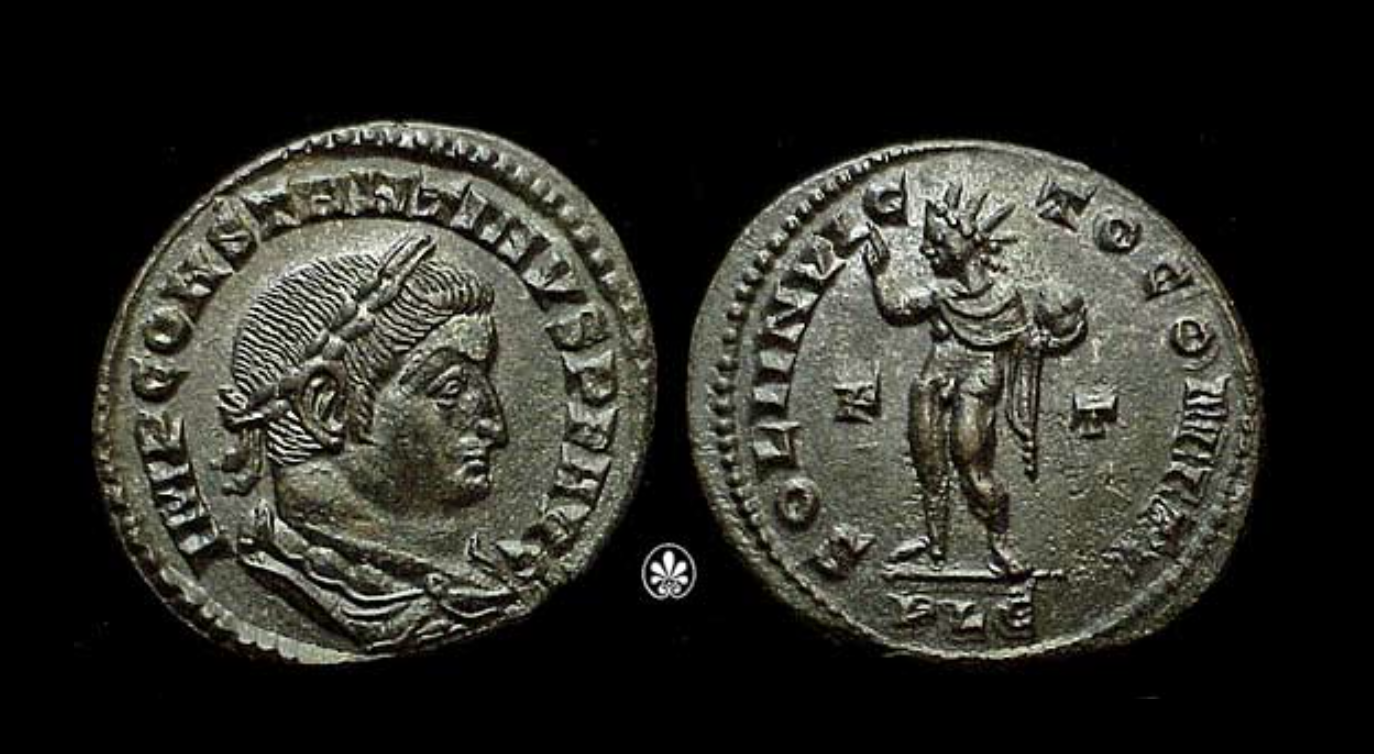
On March 7, 321, Constantine decreed DIES SOLIS – the day of the Sun, “Sunday” – as the Roman day of rest.
On the venerable day of the Sun let the magistrates and people residing in cities rest, and let all workshops be closed. In the country however persons engaged in agriculture may freely and lawfully continue their pursuits because it often happens that another day is not suitable for grain-sowing or vine planting; lest by neglecting the proper moment for such operations the bounty of heaven should be lost.
This fusion was further reinforced during the Council of Nicaea in 325 CE, convened by Constantine to unify Christian doctrine. The Council of Nicaea in 325 CE is widely regarded as the first ecumenical council in Christian history. It was the first gathering of bishops from across the Christian world convened to address issues of doctrine and church unity on a global scale. While earlier regional councils had taken place, such as the Council of Jerusalem (described in Acts 15), Nicaea was the first to involve representatives from nearly all parts of the Roman Empire and beyond, earning it the title of “ecumenical” (meaning “worldwide”).
The Council was convened to address theological disputes threatening the unity of the Church, particularly the controversy surrounding Arianism, which questioned the divine nature of Jesus. The council affirmed the doctrine of Jesus as fully divine and consubstantial (homoousios) with the Father, resulting in the formulation of the Nicene Creed, a statement of faith that became foundational for Christian orthodoxy.
Many Christians attempt to downplay Constantine’s influence on the outcome of the Council of Nicaea. Still, as Ibn Khaldun observed in The Muqaddimah, “The common people follow the religion of the ruler,” reflecting how authority molds collective beliefs to align with its interests. Or as the Romans would say, ‘Falsum etiam est veum quod constituit superior.” (False becomes true when the boss decides it is.) A critical example of this was the adoption of the term consubstantial (homoousios).
Homoousia is a Greek term meaning “of the same substance” or “of the same essence.” It became a central concept in the Nicene Creed. The term is not found in scripture and originates from Gnostics and Paganists. Emperor Constantine specifically championed this term to be included in the creed. The irony was that the Council of Antioch in 268 CE explicitly condemned the term in reference to God and Jesus.
“It must be regarded as certain that the council rejected the term homoousios.”
– John Chapman, “Paul of Smosata,” Catholic Encyclopedia.
The primary function of the Council of Antioch was to address and condemn the teachings of Paul of Samosata, the bishop of Antioch at the time. Paul of Samosata championed an adoptionist theology, suggesting that Jesus was born a mere man and became divine through his actions and virtues later in life.
Constantine wanted to have this council and establish the creed that Jesus was “begotten, not made, of one substance (homoousios) with the Father” for two reasons. First, he wanted theological consensus among the church to stabilize and unify members, and second, he wanted the creed to create a bridge between not only the Christian sects but also between the Christian religion and the cult of Sol Invictus.
While the Council primarily addressed theological disputes like Arianism, the view that Jesus was the created Son of God and not co-eternal, co-substantial, or co-equal with God, it also marked a turning point in the institutionalization of Christian celebrations. The Church, under Constantine’s influence, adopted strategies to make Christianity more palatable to pagan converts, including the rebranding of significant pagan dates.
By promoting December 25 as the birth of Christ, Constantine effectively married his devotion to Sol Invictus with his newfound Christian faith, creating a bridge between disparate traditions. So it shouldn’t be a surprise that it wasn’t until the mid-4th century that December 25 was selected as the Feast of the Nativity, and the earliest recorded celebration of Christmas on this date occurred in Rome around 336 CE, during the reign of Emperor Constantine.
Saturnalia and Christmas Traditions
No discussion of Christmas’s pagan roots is complete without examining Saturnalia, the Roman festival dedicated to Saturn, the god of agriculture. Celebrated from December 17 to 23, Saturnalia was marked by extravagant feasting, gift-giving, and a dramatic reversal of societal norms. Slaves were temporarily treated as equals, dining alongside their masters in a symbolic gesture of role reversal. The streets were alive with revelry as Romans indulged in raucous celebrations that often included excessive drinking, gambling, and public displays of debauchery. This period of uninhibited merriment was seen as a necessary release before the return to order and discipline.
Many Christmas customs bear striking resemblances to Saturnalia traditions. The exchange of gifts, festive meals, and communal joy reflect the spirit of this Roman holiday. Even the candles and decorations that brighten modern Christmas celebrations echo Saturnalia’s focus on light and warmth amid the year’s darkest days. These parallels underscore how elements of Saturnalia were reinterpreted and absorbed into the Christian observance of Christmas, blending pagan revelry with the sacred.
The Symbols of Christmas: Pagan Echoes
Beyond its date, Christmas is replete with symbols that predate Christianity. The evergreen tree, now a ubiquitous Christmas decoration, was a potent symbol of life and renewal in pagan solstice rituals. This practice is even depicted in the Old Testament in Jeremiah 10.
10 Hear what the Lord says to you, people of Israel. 2 This is what the Lord says:
“Do not learn the ways of the nations
or be terrified by signs in the heavens,
though the nations are terrified by them.
3 For the practices of the peoples are worthless;
they cut a tree out of the forest,
and a craftsman shapes it with his chisel.
4 They adorn it with silver and gold;
they fasten it with hammer and nails
so it will not totter.
5 Like a scarecrow in a cucumber field,
their idols cannot speak;
they must be carried
because they cannot walk.
Do not fear them;
they can do no harm
nor can they do any good.”
Ancient Norse traditions celebrated Yule with evergreen branches, a precursor to the modern Christmas tree. Similarly, the Yule log—burned to honor the sun and ensure its return—was another feature of pre-Christian winter festivals. The Church absorbed these customs, reinterpreting them in Christian terms while preserving their popular appeal.
Mistletoe, revered by Druids, and holly, sacred in Roman and Celtic traditions, also found their way into Christmas. While Christians later imbued these plants with religious meaning, their origins lie in pagan fertility and protection rituals.
Santa Claus: The Evolution of a Myth
Even the figure of Santa Claus has pagan antecedents. Though inspired by St. Nicholas, a 4th-century bishop known for his generosity, Santa owes much to older mythologies. The Norse god Odin, who rode through the sky on his eight-legged horse Sleipnir during the winter solstice, bears a striking resemblance to the modern image of Santa with his flying reindeer and sleigh. These mythical elements, layered over centuries, reveal the deep entanglement of pagan lore in the fabric of Christmas.
The Church’s Strategy of Syncretism
The adoption of pagan customs was not accidental but strategic. Faced with the monumental task of converting a pagan empire, the Church found it expedient to incorporate familiar symbols and practices. This process, known as syncretism, allowed the Church to Christianize existing traditions rather than erase them outright. The rebranding of Sol Invictus as “the Sun of Righteousness” (Malachi 4:2) is one such example, positioning Christ as the true source of light and life.
Conclusion
The origins of Christmas are undeniably rooted in paganism. From its adoption of December 25 to align with solstice celebrations like Saturnalia and Sol Invictus to its incorporation of symbols such as evergreen trees, mistletoe, and feasting, the holiday was deliberately constructed from ancient pagan customs. Even the Christian narrative tied to Christmas was shaped by contradictions and cultural adaptations rather than historical certainty, as seen in the conflicting Nativity accounts of Matthew and Luke. The role of figures like Emperor Constantine, who blended pagan traditions with Christianity for political expediency, underscores how deeply intertwined Christmas is with non-Christian practices. As the renowned historian Will Durant famously stated,
“Christianity did not destroy paganism; it adopted it.”
Acknowledging this history should lead us to reclaim the truth: Christmas is a fundamentally pagan holiday dressed in Christian symbolism for convenience. Its foundations are all pagan, and it is time that Christians rid themselves of this holiday and Make Christmas Pagan Again.

 Quran Talk Blog
“Christmas is a fundamentally pagan holiday dressed in Christian symbolism”
There is NO Christian symbolism in christmas. All symbolism connected to christmas is of purely pagan origins. The Roman Catholic church simply rebranded the symbols, they did not replace them with anything closely resembling the Way that Christ taught. If we are to worship our God in spirit and TRUTH, how can we even tolerate Christmas? Jn 4:24 God is Spirit, and those who worship Him must worship in spirit and truth.” The bible tells us when the Messiah was born. Rev 12:1-6.
LikeLike