
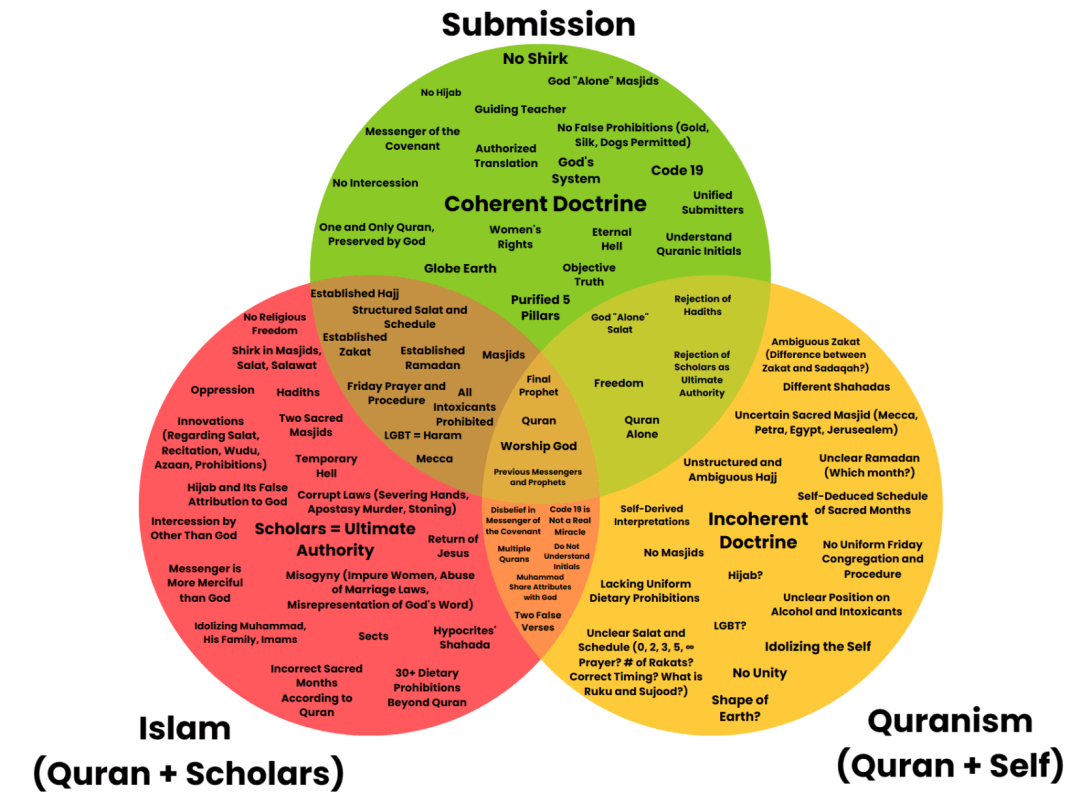
A steadfast foundation rooted in unwavering principles and beliefs is crucial to religious growth. The teachings and values upon which a faith is built must be consistent and reliable. If these core tenets were subject to frequent change, not only would an individual not be able to build their house of faith, but the trust and progress nurtured within the community of believers would also crumble, much like a building on an unstable foundation. Thus, just as a builder must ensure the ground is firm before erecting a structure, so must a community or individual ensure their foundational beliefs are solid and enduring, for without such a base, all subsequent development risks being in vain.
For Submitters, the foundation of our religion is firmly rooted in the teachings of the Quran alone, which we regard as our only source of religious law (6:114-115, 4:105). This serves as the cornerstone for building our religious understanding. However, Submitters are not alone in this claim; Quranists also assert that they follow the Quran exclusively. So, what distinguishes a Submitter from a Quranist?
While Quranists claim to adhere to the Arabic Quran, unlike Submitters, they lack a consistent methodology for interpreting its meaning. Since the devil cannot alter the text of the Quran, he deceives Quranists into redefining the meanings of its words, stripping them of their original significance. Without clear guidelines for the range of meanings any word can have, Quranists have free reign to stretch interpretations to the point that they lose their intended essence. This lack of consistency and fidelity to the original meanings is what fundamentally differentiates Quranists from Submitters.
This manipulation becomes evident in the distortion of foundational concepts in the Quran. For many Quranists, Salat does not mean the ritual Contact Prayer but merely following closely; Zakat does not signify the 2.5% Obligatory Charity but just the act of purification; Hajj pilgrimage is interpreted as people getting together to argue; and fasting during Ramadan is seen as abstaining from talking during the Summer equinox. It extends even to basic terms, with some claiming that words commonly understood to mean man, woman, swine, sun, and moon actually have fundamentally different meanings. Some even argue that the messengers named in the Quran do not correspond to the same individuals found in previous scriptures but are instead code names decipherable only by those who possess the supposed true understanding.
Such reinterpretations transform the Quran, a clear and accessible book, into a confusing collection of esoteric meanings, devoid of consistency. Despite these wildly varying interpretations, each Quranist claims to follow the Quran alone and asserts that they alone have extracted its true meaning. This inconsistent and often contradictory approach underscores the importance of a stable and coherent methodology in understanding the Quran, distinguishing true Submitters from those who distort its message.
However, this drift in the Quranists’ understanding of the Quran did not happen overnight. This progression took decades, during which human and jinn devils diligently worked to push the Quranists’ understanding further and further into obscurity, driving them away from the truth of the Quran yet making them think that they are guided.
The gradual shift in foundational understandings among Quranists has led to significant splintering and division within their community, making it nearly impossible to form a lasting congregation. Initially united by the common belief in following the Quran alone, without the Hadith or Sunnah, the absence of a consistent methodology for interpreting the Quran has led to increasingly divergent views on fundamental concepts. These varying interpretations create confusion and inconsistency, as there are no agreed-upon guidelines or frameworks to anchor their beliefs.
As these differences deepen, each subgroup claims to hold the true understanding of the Quran, leading to further divisions. This has created an environment where the Quranists are constantly splintering, as members leave to form new groups whenever disagreements arise. The lack of a unified foundation means there is no stable basis for a cohesive and enduring community.
Moreover, this constant fragmentation undermines the possibility of establishing lasting congregations. Without a shared and stable understanding of the Quran, it becomes challenging to build the trust and mutual respect necessary for a thriving community. The persistent divisions and the resulting lack of unity prevent the Quranist movement from forming solid, enduring congregations, thereby hampering its growth and stability.
We now have over 30 years of data to observe the Quranist movement’s progression. Despite having increased the strength of their arguments against upholding Hadith and for following the Quran alone, there is yet to be a physical Quranist masjid, despite their large numbers. Rather than seeing this as a sign to reflect and reconsider, many Quranists view it as a badge of honor, with each of them believing they are the only individual in history with the correct understanding.
In essence, the Quranists’ shifting foundational understandings have led to continuous splintering, making it impossible to establish lasting congregations. This fragmentation highlights the critical need for a consistent and coherent methodology in interpreting religious texts to maintain unity and foster the growth of any religious community.
Consider the evolution of Quranist debates regarding their understanding of Salat over the years. Initially, their main debate regarding Salat was whether one should face slightly south-east from the United States or north-east to face the Kaaba in Mecca. This debate then shifted to whether they should say “Allahu Akbar” or “Allahu Kabir.” Further disputes led to changing the number of Salat from five to three, then to facing Petra or Jerusalem instead of the Kaaba in Mecca, and eventually to not performing Salat at all. Each time their foundational understanding shifted, it caused perpetual rifts among followers, leading each to follow their own path with no unification amongst them.
This constant redefinition and reinterpretation of core practices have led to fragmentation rather than cohesion. Without a consistent methodology and a firm foundation, the Quranists’ community has been unable to maintain unity. This highlights the importance of a stable foundation and consistent interpretative framework to prevent division and ensure lasting unity within a religious community.
The Quran informs us that if we ever find ourselves in the majority, we should stop and reflect. This is because, according to the Quran, the majority of people follow only conjecture, the majority do not believe, and among those who do believe, the majority do so while committing idol worship.
[6:116] If you obey the majority of people on earth, they will divert you from the path of GOD. They follow only conjecture; they only guess.
وَإِن تُطِعْ أَكْثَرَ مَن فِى ٱلْأَرْضِ يُضِلُّوكَ عَن سَبِيلِ ٱللَّهِ إِن يَتَّبِعُونَ إِلَّا ٱلظَّنَّ وَإِنْ هُمْ إِلَّا يَخْرُصُونَ
[12:103] Most people, no matter what you do, will not believe.
وَمَآ أَكْثَرُ ٱلنَّاسِ وَلَوْ حَرَصْتَ بِمُؤْمِنِينَ
[12:106] The majority of those who believe in GOD do not do so without committing idol worship.
وَمَا يُؤْمِنُ أَكْثَرُهُم بِٱللَّهِ إِلَّا وَهُم مُّشْرِكُونَ
Yet, there is another extreme that the Quran warns us about: worshiping our own egos. One way to test if we have fallen into this trap is if we believe that we alone have found the truth and that everyone else on the planet and throughout history is misguided, except for the prophets and messengers. This would indicate that we are worshiping our egos.
[25:43] Have you seen the one whose god is his own ego? Will you be his advocate?
أَرَءَيْتَ مَنِ ٱتَّخَذَ إِلَـٰهَهُۥ هَوَىٰهُ أَفَأَنتَ تَكُونُ عَلَيْهِ وَكِيلًا
[45:23] Have you noted the one whose god is his ego? Consequently, GOD sends him astray, despite his knowledge, seals his hearing and his mind, and places a veil on his eyes. Who then can guide him, after such a decision by GOD? Would you not take heed?
أَفَرَءَيْتَ مَنِ ٱتَّخَذَ إِلَـٰهَهُۥ هَوَىٰهُ وَأَضَلَّهُ ٱللَّهُ عَلَىٰ عِلْمٍ وَخَتَمَ عَلَىٰ سَمْعِهِۦ وَقَلْبِهِۦ وَجَعَلَ عَلَىٰ بَصَرِهِۦ غِشَـٰوَةً فَمَن يَهْدِيهِ مِنۢ بَعْدِ ٱللَّهِ أَفَلَا تَذَكَّرُونَ
Just as we should reflect and reconsider our beliefs if we find ourselves in the majority, we should similarly reflect if we find ourselves in the camp of only ourselves. Being isolated in our understanding can be a sign that we need to correct our course and return to the path of righteousness. True submission requires humility and the acknowledgment that the wisdom of the Quran is meant to guide us collectively, not to elevate any individual’s ego.
The Quranist approach to understanding the Quran often leads to infinite permutations of interpretations, resulting in division and fragmentation. Without a consistent methodology, Quranists frequently reinterpret fundamental concepts, causing perpetual rifts among followers as each person or subgroup follows their own path, with no unification.
In contrast, Submitters employ a consistent methodology in understanding the Quran. For one, they have an Authorized English Version of the Quran left by Dr. Rashad Khalifa, God’s Messenger of the Covenant, to which they can always refer. While Submitters are not mandated to study the Arabic Quran, they are free to study it and understand the meanings of words and verses in their original language to gain a deeper understanding and appreciation for the Arabic Quran. However, if their understanding contradicts the messenger’s teachings, they are expected to kill their egos and adhere to the messenger’s role in settling disputes and clarifying the scripture (4:65 & 5:19).
When a dispute arises between Submitters regarding religious understanding or the meaning of a verse, they refer to the conclusions made by God’s messenger, if available (4:80). If no ruling exists and neither side can convince the other, Submitters should agree to disagree, and the community works to maintain peace between the differing groups. This approach guarantees unity among Submitters, provides a common framework for growth, and offers a method for resolving disputes.
By maintaining a stable foundation and a consistent interpretative framework, Submitters can ensure cohesion and prevent the fragmentation seen in the Quranist approach. This structured methodology allows for a unified and harmonious community, fostering sustainable growth and mutual understanding.
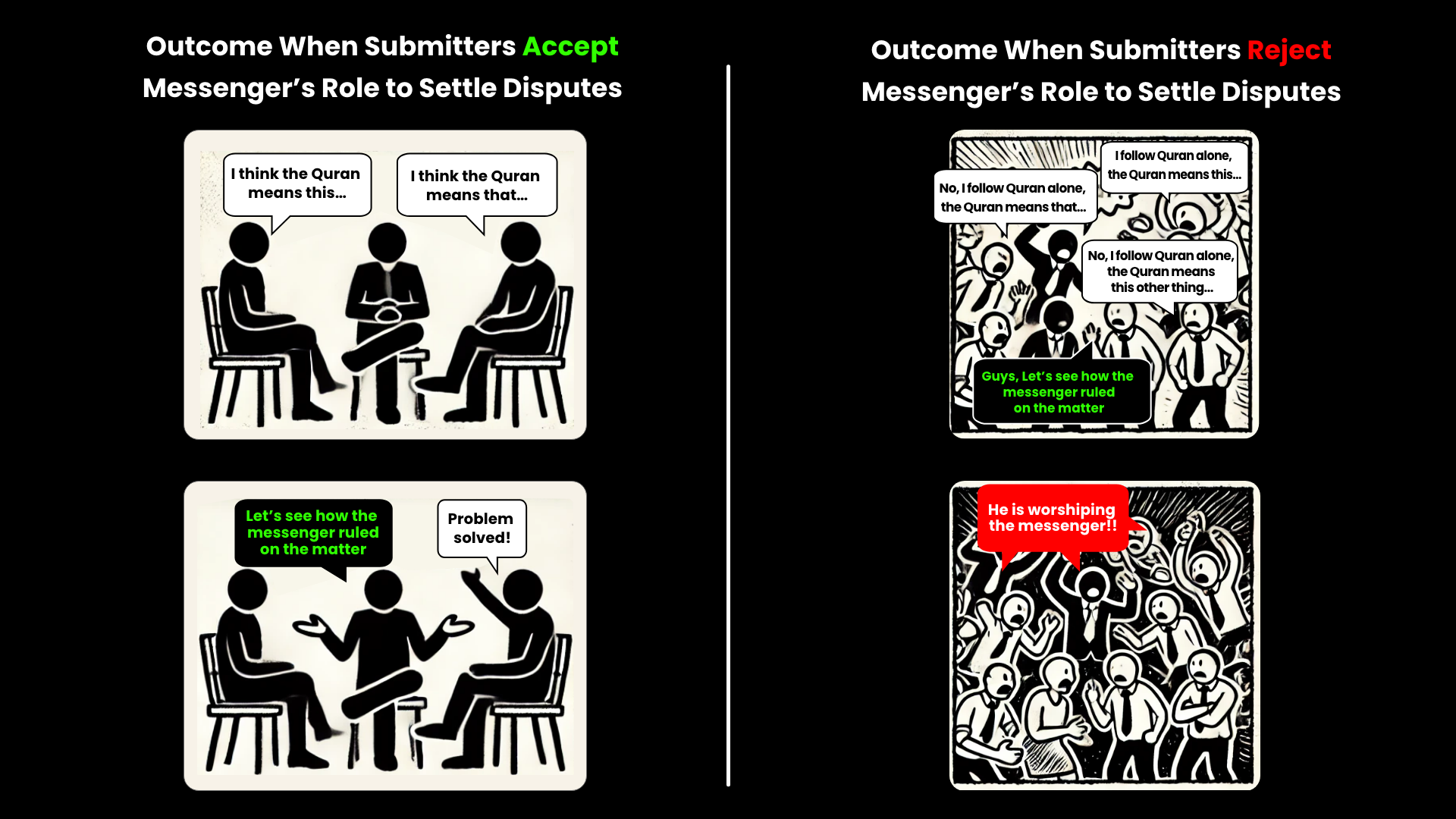
As stated by God’s messenger, Dr. Rashad Khalifa, at the end of Appendix 2 of the Quran, he wrote the following under the title “Mercy from God (2:107):”
When the believers are faced with a problem, they develop a number of possible solutions, and this invariably leads to considerable bickering, disunity, and disarray. We learn from 2:151, 3:164, and 21:107 that it is but mercy from God that He sends to us messengers to provide the final solutions to our problems. We learn from 42:51 that God sends His messengers to communicate with us, and to disseminate new information. Hence the strong injunction in 4:65, 80 to accept, without the slightest hesitation, the teachings delivered to us through God’s messengers.
And for reference here are the verses from the excerpt mentioned above:
[2:151] (Blessings) such as the sending of a messenger from among you to recite our revelations to you, purify you, teach you the scripture and wisdom, and to teach you what you never knew.
كَمَآ أَرْسَلْنَا فِيكُمْ رَسُولًا مِّنكُمْ يَتْلُوا۟ عَلَيْكُمْ ءَايَـٰتِنَا وَيُزَكِّيكُمْ وَيُعَلِّمُكُمُ ٱلْكِتَـٰبَ وَٱلْحِكْمَةَ وَيُعَلِّمُكُم مَّا لَمْ تَكُونُوا۟ تَعْلَمُونَ
[3:164] GOD has blessed the believers by raising in their midst a messenger from among them, to recite for them His revelations, and to purify them, and to teach them the scripture and wisdom. Before this, they had gone totally astray.
لَقَدْ مَنَّ ٱللَّهُ عَلَى ٱلْمُؤْمِنِينَ إِذْ بَعَثَ فِيهِمْ رَسُولًا مِّنْ أَنفُسِهِمْ يَتْلُوا۟ عَلَيْهِمْ ءَايَـٰتِهِۦ وَيُزَكِّيهِمْ وَيُعَلِّمُهُمُ ٱلْكِتَـٰبَ وَٱلْحِكْمَةَ وَإِن كَانُوا۟ مِن قَبْلُ لَفِى ضَلَـٰلٍ مُّبِينٍ
[21:107] We have sent you out of mercy from us towards the whole world.
وَمَآ أَرْسَلْنَـٰكَ إِلَّا رَحْمَةً لِّلْعَـٰلَمِينَ
How God Communicates With Us
[42:51] No human being can communicate with GOD except through inspiration, or from behind a barrier, or by sending a messenger through whom He reveals what He wills. He is the Most High, Most Wise.
وَمَا كَانَ لِبَشَرٍ أَن يُكَلِّمَهُ ٱللَّهُ إِلَّا وَحْيًا أَوْ مِن وَرَآئِ حِجَابٍ أَوْ يُرْسِلَ رَسُولًا فَيُوحِىَ بِإِذْنِهِۦ مَا يَشَآءُ إِنَّهُۥ عَلِىٌّ حَكِيمٌ
[4:65] Never indeed, by your Lord; they are not believers unless they come to you to judge in their disputes, then find no hesitation in their hearts whatsoever in accepting your judgment. They must submit a total submission.
فَلَا وَرَبِّكَ لَا يُؤْمِنُونَ حَتَّىٰ يُحَكِّمُوكَ فِيمَا شَجَرَ بَيْنَهُمْ ثُمَّ لَا يَجِدُوا۟ فِىٓ أَنفُسِهِمْ حَرَجًا مِّمَّا قَضَيْتَ وَيُسَلِّمُوا۟ تَسْلِيمًا
[4:80] Whoever obeys the messenger is obeying GOD. As for those who turn away, we did not send you as their guardian.
مَّن يُطِعِ ٱلرَّسُولَ فَقَدْ أَطَاعَ ٱللَّهَ وَمَن تَوَلَّىٰ فَمَآ أَرْسَلْنَـٰكَ عَلَيْهِمْ حَفِيظًا

Related Articles:

 Quran Talk Blog