
On January 31, 1990, God’s Messenger of the Covenant, Dr. Rashad Khalifa, was blessed with martyrdom. Since his death, while more individuals have embraced the religion of Submission, the overall Submitter movement has stagnated. Few new communities have emerged, and many existing ones have struggled to expand their congregations. In fact, many of these communities have fewer members now than they did years ago.
If Submitters were doing everything right, we whould be prospering in our efforts. The fact that we are not warrants an evaluation of where we might have gone wrong.
[10:98] Any community that believes will surely be rewarded for believing. For example, the people of Jonah: when they believed, we relieved the humiliating retribution they had been suffering in this world, and we made them prosperous.
فَلَوْلَا كَانَتْ قَرْيَةٌ ءَامَنَتْ فَنَفَعَهَآ إِيمَـٰنُهَآ إِلَّا قَوْمَ يُونُسَ لَمَّآ ءَامَنُوا۟ كَشَفْنَا عَنْهُمْ عَذَابَ ٱلْخِزْىِ فِى ٱلْحَيَوٰةِ ٱلدُّنْيَا وَمَتَّعْنَـٰهُمْ إِلَىٰ حِينٍ
If we had to diagnose this problem, we could say that Submitters have failed to create an environment that fosters growth. While this can be partly attributed to a decline in outreach programs, we see that our numbers stayed roughly the same even in the past, when communities were more proactive in this respect. This shows that the problem is more than just outreach; it indicates that there appears to be a threshold to the size a Submitter community can grow before it splinters.
Dunbar Number and Submission
The Submitters conference is a perfect illustration of this threshold. I have attended most conferences over the past two decades, and the number of participants consistently hovers around 150. Interestingly, when attendance doubled for a few years, it eventually dropped back to around 150 following a significant rift.
This is intriguing because 150 is often cited as the Dunbar Number, a theoretical cognitive limit proposed by British anthropologist Robin Dunbar. The theory suggests that human brains are capable of managing only a certain number of stable social relationships, approximately 150. Beyond this number, the quality of relationships tends to diminish, and the group often requires more formal structures and hierarchies to maintain cohesion.
Submitter communities often have members who know each other well, fostering a sense of intimacy and strong communal bonds. Decision-making processes in such communities can be more collaborative, and disputes can be resolved through direct, personal interactions. This environment supports the development of a cohesive community where members feel personally connected and mutually accountable. Yet, when we survey Submitter communities across the globe, we see that while they often thrive on very tight-knit personal relationships, they rarely exceed 150 members. Even in instances when they do, there almost inevitably ends up being a rift, causing their numbers to decline.
As Submitter communities grow beyond this threshold, maintaining personal relationships with all members becomes increasingly challenging. Larger communities struggle to preserve the intimacy and direct interactions crucial for cohesion. When conflicts inevitably arise, resolving disputes becomes more difficult when personal relationships are not as strong as they were when the community was smaller and more intimate. This challenge suggests that to grow successfully, Submitter communities need to find ways to adapt to larger sizes while maintaining their core values and strong personal bonds. Understanding and addressing this threshold could be key to overcoming stagnation and fostering sustainable growth within the movement.
Dealing with Growth & Conflict
Growth inevitably leads to more conflict possibilities, and Submitter communities have devised different methods for handling conflict within their congregations. Yet, all these methods seem to fail as the number of members in the respective communities increases. Let’s look at the different approaches various communities utilized and how that has panned out for them.
The first method can be termed the top-down approach. It involves resolving religious disputes by deferring to the judgment of the community’s most senior member. By “senior,” I refer not to age but to the individual’s perceived religious standing within the congregation. This person may consider input from others, but ultimately, their conclusion becomes the central dogma of the group. Anyone opposing this ruling is then regarded as outside the fold of Submission or labeled a heretic or hypocrite. Unsurprisingly, while this approach resolves disputes, it also causes fractures and divisions within the community through hierarchies that can resemble tyranny. Each time an individual or group opposes the leader’s decree, they risk excommunication and falling outside of the fold of Submission according to their congregation.
The second method is the polite approach. This involves resolving religious disputes by agreeing not to discuss contentious issues. For example, if two individuals disagree on an understanding of a Quranic verse or a religious topic, the congregation will implicitly decide to avoid discussing that topic moving forward. This method can be manageable in small groups where there is a small number of sensitive topics. However, as the congregation grows, the number of viewpoints and points of contention increases. Consequently, more and more topics become off-limits, making this approach increasingly problematic in larger communities.
The third method is the agree-to-disagree approach. This method is more prevalent in online communities and sounds reasonable, but it has the inherent problem of being unable to clearly define when someone is in the fold of Submission and out of the fold. This is not a matter of personal relations but how Submission gets portrayed to newcomers who cannot differentiate the view of a Submitter from that of a Quranist. How are they to make heads and tails of what Submitters believe when a Quranist who claims to be a Submitter tells them that the Quran preaches that the Earth is flat or that Salat is not a ritual prayer or any of the other of the numerous false understandings they promote based on their redefining the plain text understanding of the words in the Arabic Quran. For example, many Quranists object to the most basic definitions in Arabic, including the terms for man, woman, swine, sun, moon, and sky. They reinterpret these words to their liking, formulating completely new interpretations of the Quran and claiming their approach is Quran alone.

The Solution
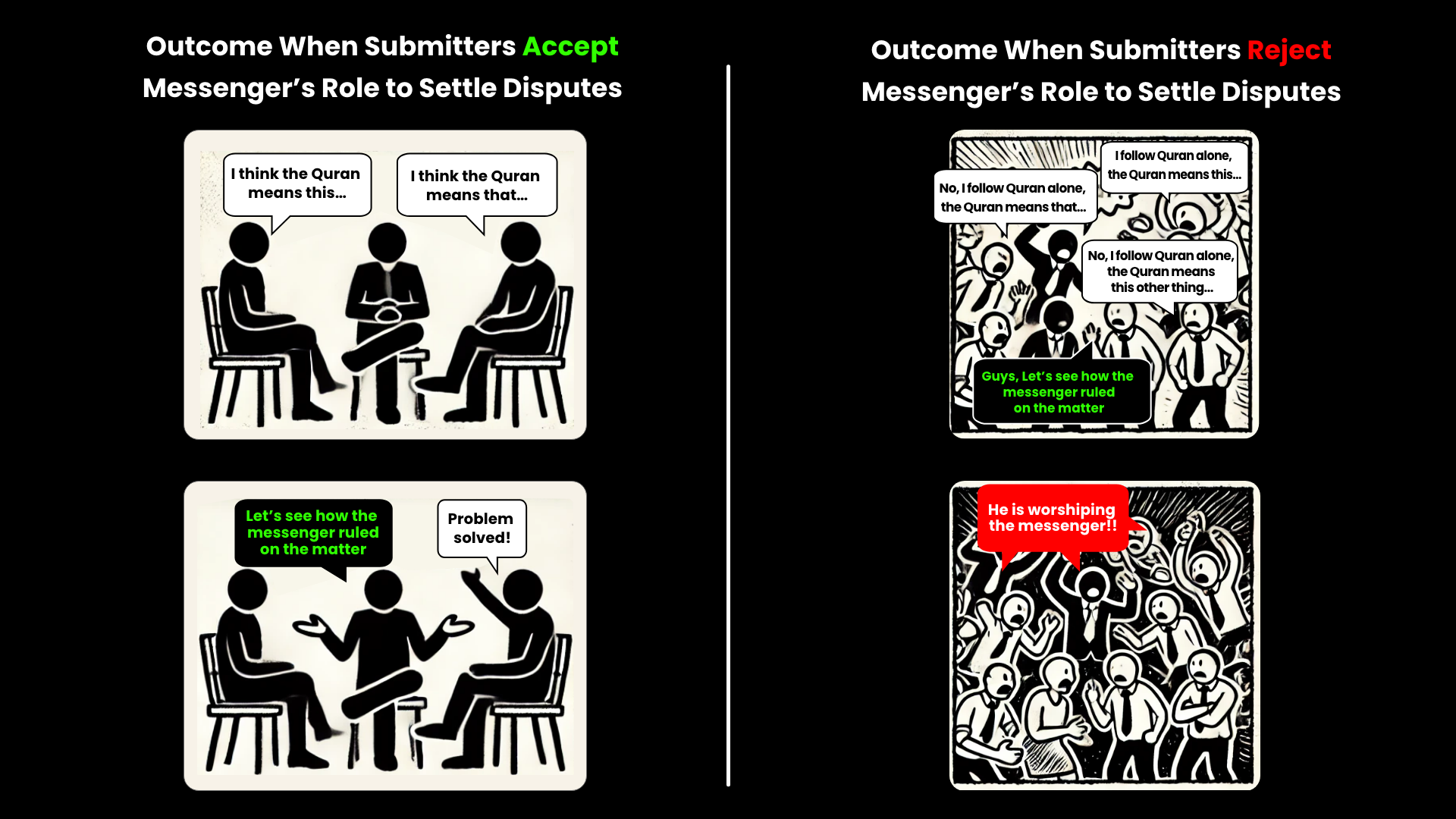
The solution to the challenges of growth and conflict is not to establish a religious hierarchy, censor discussions on matters of contention, or be indifferent to opposing views, as the three approaches mentioned above utilize. The solution is establishing a baseline methodology for resolving disputes between true Submitters and a way to easily distinguish between Submitters and Quranists larping as Submitters.
This approach can be broken down into the following steps:
- The Quran is a Submitter’s only source of religious law. (6:114-115, 4:105)
- If a dispute occurs regarding a religious understanding, Submitters should refer to the conclusion made by God’s messenger when available. (4:65, 4:80, & 5:19)
- If a ruling on the matter by God’s messenger doesn’t exist and no side is able to convince the other side of their understanding, then each side should agree to disagree.
Rashad, at the end of Appendix 2 of the Quran, wrote the following under the title “Mercy from God (2:107):
When the believers are faced with a problem, they develop a number of possible solutions, and this invariably leads to considerable bickering, disunity, and disarray. We learn from 2:151, 3:164, and 21:107 that it is but mercy from God that He sends to us messengers to provide the final solutions to our problems. We learn from 42:51 that God sends His messengers to communicate with us, and to disseminate new information. Hence the strong injunction in 4:65, 80 to accept, without the slightest hesitation, the teachings delivered to us through God’s messengers.
And for reference here are the verses from the excerpt mentioned above:
[2:151] (Blessings) such as the sending of a messenger from among you to recite our revelations to you, purify you, teach you the scripture and wisdom, and to teach you what you never knew.
كَمَآ أَرْسَلْنَا فِيكُمْ رَسُولًا مِّنكُمْ يَتْلُوا۟ عَلَيْكُمْ ءَايَـٰتِنَا وَيُزَكِّيكُمْ وَيُعَلِّمُكُمُ ٱلْكِتَـٰبَ وَٱلْحِكْمَةَ وَيُعَلِّمُكُم مَّا لَمْ تَكُونُوا۟ تَعْلَمُونَ
[3:164] GOD has blessed the believers by raising in their midst a messenger from among them, to recite for them His revelations, and to purify them, and to teach them the scripture and wisdom. Before this, they had gone totally astray.
لَقَدْ مَنَّ ٱللَّهُ عَلَى ٱلْمُؤْمِنِينَ إِذْ بَعَثَ فِيهِمْ رَسُولًا مِّنْ أَنفُسِهِمْ يَتْلُوا۟ عَلَيْهِمْ ءَايَـٰتِهِۦ وَيُزَكِّيهِمْ وَيُعَلِّمُهُمُ ٱلْكِتَـٰبَ وَٱلْحِكْمَةَ وَإِن كَانُوا۟ مِن قَبْلُ لَفِى ضَلَـٰلٍ مُّبِينٍ
[21:107] We have sent you out of mercy from us towards the whole world.
وَمَآ أَرْسَلْنَـٰكَ إِلَّا رَحْمَةً لِّلْعَـٰلَمِينَ
How God Communicates With Us
[42:51] No human being can communicate with GOD except through inspiration, or from behind a barrier, or by sending a messenger through whom He reveals what He wills. He is the Most High, Most Wise.
وَمَا كَانَ لِبَشَرٍ أَن يُكَلِّمَهُ ٱللَّهُ إِلَّا وَحْيًا أَوْ مِن وَرَآئِ حِجَابٍ أَوْ يُرْسِلَ رَسُولًا فَيُوحِىَ بِإِذْنِهِۦ مَا يَشَآءُ إِنَّهُۥ عَلِىٌّ حَكِيمٌ
[4:65] Never indeed, by your Lord; they are not believers unless they come to you to judge in their disputes, then find no hesitation in their hearts whatsoever in accepting your judgment. They must submit a total submission.
فَلَا وَرَبِّكَ لَا يُؤْمِنُونَ حَتَّىٰ يُحَكِّمُوكَ فِيمَا شَجَرَ بَيْنَهُمْ ثُمَّ لَا يَجِدُوا۟ فِىٓ أَنفُسِهِمْ حَرَجًا مِّمَّا قَضَيْتَ وَيُسَلِّمُوا۟ تَسْلِيمًا
[4:80] Whoever obeys the messenger is obeying GOD. As for those who turn away, we did not send you as their guardian.
مَّن يُطِعِ ٱلرَّسُولَ فَقَدْ أَطَاعَ ٱللَّهَ وَمَن تَوَلَّىٰ فَمَآ أَرْسَلْنَـٰكَ عَلَيْهِمْ حَفِيظًا
Related Articles:

 Quran Talk Blog