

A term that is used often in Islamic studies is the concept of Mutawātir. Mutawātir is a successive narration that has been transmitted by such a large number (thousands) of narrators at each level of its chain of transmission that it becomes particularly impossible for them to have collectively agreed upon a lie or fabrication.
This term was particularly co-opted by Hadith scholars as an argument for the authenticity of Hadith. Ironically, using mutawātir to argue for the authenticity of Hadith fails for two predominant reasons.
Reason #1: Mutwatir does not require isnad
Firstly, when information is genuinely mutawātir, it is so widely known that it does not need to be proven by a chain of narrators. For instance, how do we know that George Washington was the first president of the United States? This information has been disseminated by so many multitudes of people over the generations that we just accept this statement as fact. When presented with this claim, individuals do not ask to see the chain of narrations to authenticate this information.
Yet, when it comes to Hadith, authenticity is determined by the chain of narrators. If the fact encompassed in a Hadith was genuinely mutawatir, it would not require a chain of narrators to validate its claims; it would be accepted because it would be common knowledge.
This is why the earliest believers did not feel compelled to provide an isnad for the Quran like they did the Hadith. An isnad for the Quran wasn’t even concocted until the 4th century Hijri (10th CE). This is because the earliest believers all understood that the Quran is the most widely circulated masterfully preserved text in history, and just like any other fact that is genuinely mutawatir, it did not require an isnad to prove its authenticity. So, since Hadith requires an isnad to prove its validity, it is, by definition, not mutawatir.
Reason #2: scholars admit no hadith is mutawatir
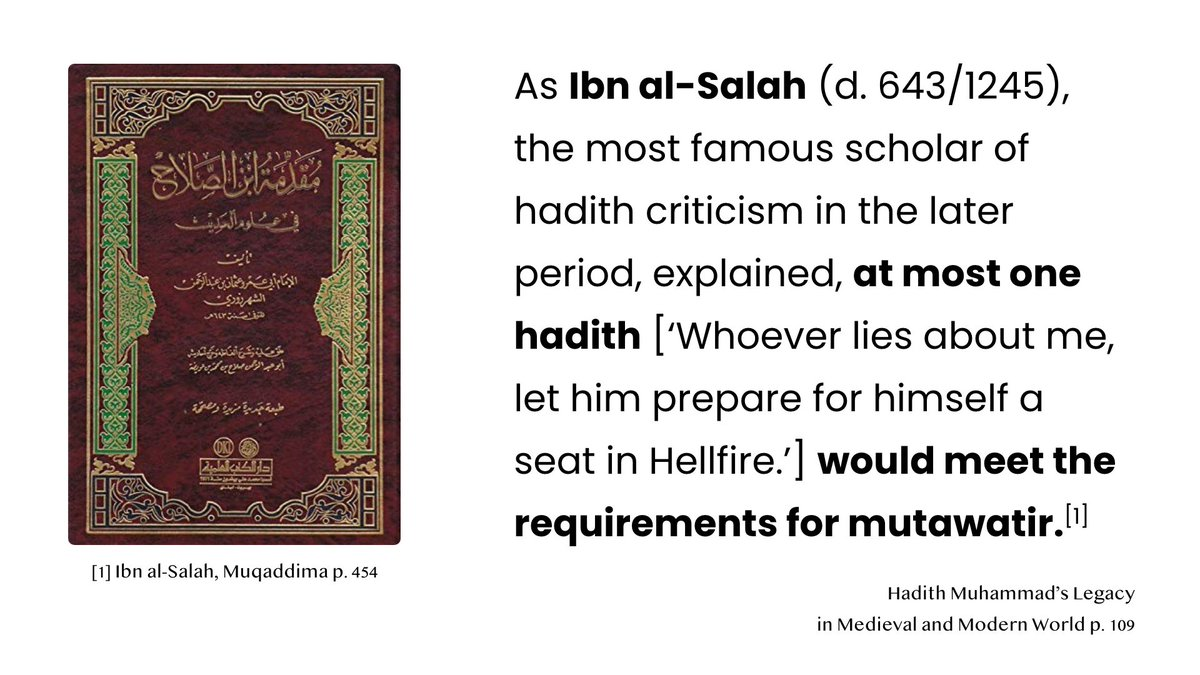
Secondly, many respected scholars did not believe any Hadith were mutawatir. For example, Ibn Hibban (d. 354) thought there was no mutawatir Hadith. Ibn al-Salah claimed if we apply the definition of mutawatir, it is doubtful that any Hadith can meet the requirements except for possibly one Hadith, which is the famous Hadith regarding anyone who lies about the prophet will find their place in Hell.
In the book “Hadith, Muhammad’s Legacy in the Medieval and Modern World,” by Jonathan A.C. Brown, on page 109, it states:
The categories of mutawatir and had were similarly unsuitable for the hadith tradition, for essentially all hadiths were ahead. As Ibn al-Salah (d. 643/1245), the most famous scholar of hadith criticism in the later period, explained, at most one hadith (‘Whoever lies about me, let him prepare for himself a seat in Hellfire.’) would meet the requirements for mutawatir.[1] No hadiths could actually be described as being narrated by a large number of narrators at every stage of their transmission. In fact, when Mu’tazilites had insisted that hadiths be transmitted by a mere two people at every stage, the Sunni Ibn Hibban had accused them of trying to destroy the Sunna of the prophet in its entirety.[2]
[1] Ibn al-Salah, Muqaddima p. 454
[2] Ibn Hibban, Sahih Ibn Hibban, vol. 1, p. 145
The Companion Wathila b. Asqa‘ had admitted that sometimes the early Muslims even confused the exact wording of the Quran, which was universally well-known and well-preserved. So how, he asked, could one expect any less in the case of a report that the Prophet had said just once? Al-Hasan al-Basri is reported to have said, “If we only narrated to you what we could repeat word for word, we would only narrate two hadiths.”
Hadith Muhammad’s Legacy in the Medieval and Modern World p. 24


 Quran Talk Blog