

The Shema is a foundational Jewish prayer that declares the oneness of God, serving as a cornerstone of Jewish faith and identity. Its name, “Shema,” comes from the first word of the prayer in Hebrew, שְׁמַע (Shema), meaning “Hear.” The prayer is derived from the Torah, specifically Deuteronomy 6:4-9, and it begins with:
“Hear, O Israel: The LORD our God, the LORD is one.”
Deuteronomy 6:4
שְׁמַע יִשְׂרָאֵל יְהוָה אֱלֹהֵינוּ יְהוָה אֶחָֽד
She-ma yisrael, adonai eloheinu, adonai echad
This declaration of God’s oneness is central to Jewish monotheism and is recited in daily prayers as well as in significant religious ceremonies. Following the declaration of God’s oneness, the Shema continues with commandments regarding loving God with all one’s heart, soul, and might; the importance of these words being kept in heart; teaching them to one’s children; speaking of them at home and away, when lying down and when rising; binding them as a sign on the hand and forehead; and writing them on the doorposts of the house and on the gates.
5 and you shall love the Lord your God with all your heart, and with all your soul, and with all your might. 6 And these words which I command you this day shall be upon your heart; 7 and you shall teach them diligently to your children, and shall talk of them when you sit in your house, and when you walk by the way, and when you lie down, and when you rise. 8 And you shall bind them as a sign upon your hand, and they shall be as frontlets between your eyes. 9 And you shall write them on the doorposts of your house and on your gates.
Deuteronomy 6:5-9
וְאָ֣הַבְתָּ֔ אֵ֖ת יְהוָ֣ה אֱלֹהֶ֑יךָ בְּכָל־לְבָבְךָ֥ וּבְכָל־נַפְשְׁךָ֖ וּבְכָל־מְאֹדֶֽך
וְהָי֞וּ הַדְּבָרִ֣ים הָאֵ֗לֶּה אֲשֶׁ֨ר אָנֹכִ֧י מְצַוְּךָ֛ הַיּ֖וֹם עַל־לְבָבֶֽךָ
וְשִׁנַּנְתָּ֣ם לְבָנֶ֔יךָ וְדִבַּרְתָּ֖ בָּ֑ם בְּשִׁבְתְּךָ֤ בְּבֵיתֶ֙ךָ֙ וּבְלֶכְתְּךָ֣ בַדֶּ֔רֶךְ וּֽבְשָׁכְבְּךָ֖ וּבְקוּמֶֽךָ
וּקְשַׁרְתָּ֥ם לְא֖וֹת עַל־יָדֶ֑ךָ וְהָי֥וּ לְטֹטָפֹ֖ת בֵּ֥ין עֵינֶֽיךָ
וּכְתַבְתָּ֛ם עַל־מְזוּזֹ֥ת בֵּיתֶ֖ךָ וּבִשְׁעָרֶֽיךָ
The Shema, therefore, encapsulates the essence of Jewish devotion and commitment to God, emphasizing the importance of remembering and observing God’s commandments throughout daily life. It reflects both a theological affirmation and a call to action, guiding the faithful in their relationship with God and the practice of their faith.
The Greatest Commandment
This was also the declaration of Jesus when a scribe asked him what the greatest commandment was.
28 And one of the scribes came up and heard them disputing with one another, and seeing that he answered them well, asked him, “Which commandment is the first of all?” 29 Jesus answered, “The first is, ‘Hear, O Israel: The Lord our God, the Lord is one; 30 and you shall love the Lord your God with all your heart, and with all your soul, and with all your mind, and with all your strength.’ 31 The second is this, ‘You shall love your neighbor as yourself.’ There is no other commandment greater than these.” 32
Mark 12:29-34
And the scribe said to him, “You are right, Teacher; you have truly said that he is one, and there is no other but he; 33 and to love him with all the heart, and with all the understanding, and with all the strength, and to love one’s neighbor as oneself, is much more than all whole burnt offerings and sacrifices.”
34 And when Jesus saw that he answered wisely, he said to him, “You are not far from the kingdom of God.” And after that no one dared to ask him any question.
Trinitarian Shema
Notice that when the scribe confirmed Jesus’ statement, Jesus did not claim he was mistaken in his understanding. Instead, Jesus reaffirmed his understanding. Yet Trinitarians today claim that Jesus meant by the Shema that God has three coequal, coeternal, and consubstantial persons. Thus, by redefining the word “One,” Trinitarians attempt to convince themselves they are upholding the letter of the law while completely destroying the spirit of the law.
Ironically, this is the very kind of thing that Jesus criticized the Jews for doing. For example, in the Gospel of Mark, chapter 7, verses 6-9, Jesus addresses the Pharisees who had criticized His disciples for not following the traditional Jewish ritual of handwashing before eating.
6 And he (Jesus) said to them, “Well did Isaiah prophesy of you hypocrites, as it is written,
Mark 7:6-9
‘This people honors me with their lips,
but their heart is far from me;
7 in vain do they worship me,
teaching as doctrines the precepts of men.’
8 You leave the commandment of God, and hold fast the tradition of men.”
9 And he said to them, “You have a fine way of rejecting the commandment of God, in order to keep your tradition!
In this passage, Jesus quotes Isaiah to highlight the discrepancy between outward religious observance and true inward devotion to God. He criticizes the Pharisees for prioritizing human traditions over the commandments of God, illustrating how they adhered to the letter of the law (ritual purity laws, in this case) but missed its underlying purpose and spirit, which is to foster a genuine and heartfelt relationship with God. This example underscores Jesus’ broader teaching that true obedience to God goes beyond mere external compliance to encompass the intentions and attitudes of the Law.
Similarly, Trinitarians today can claim they are upholding the Shema, but in actuality, they have infused it with severe idol worship, the exact thing that the Shema is meant to abolish.
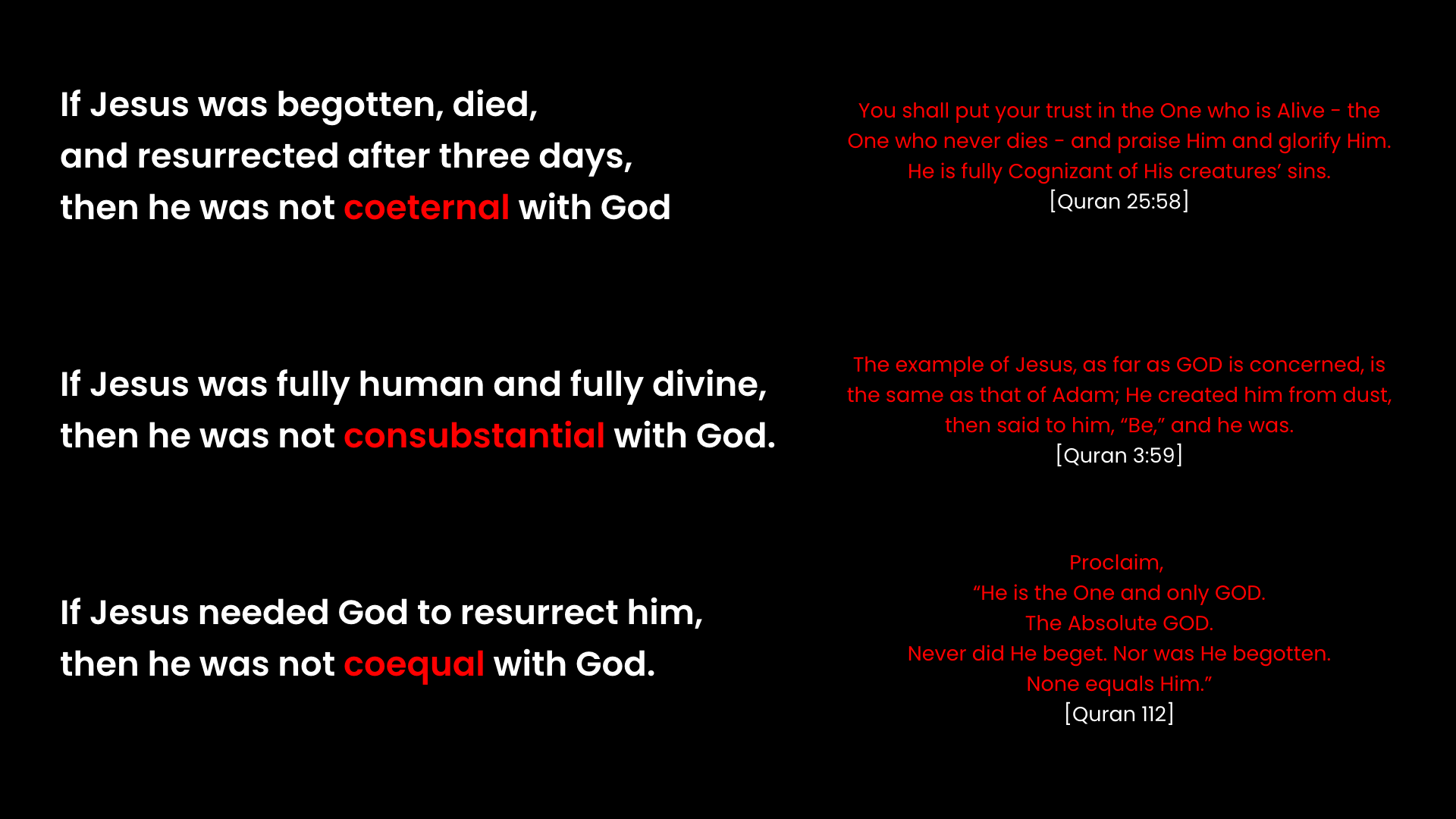
Nowhere in the Bible is the doctrine of the Trinity explicitly taught. The term “Trinity” is never used, nor is the concept of “one-in-three” or “three-in-one.” Additionally, the ideas of one “essence,” one “substance,” or three “persons” are not mentioned.
The contradiction between the Nicene Creed and the Shema was so glaring that in 529 CE, the Christian emperor Justinian established the Corpus Juris Civilis, commonly known as the Justinian Code. This law included new Church-codified ordinances that forbade the use of “Jewish language” in the empire’s worship services, effectively banning the Jewish prayer and the Shema.
ShaHAdah
The Shema in the Quran would correspond with the Shahadah ( الشَّهَادَة ), the declaration of faith. This statement occurs about fifty times in the Quran in various forms, and can be summarized to the following:
أشْهَدُ أنْ لا الهَ الاّ الله
ašhadu ʾan lā ʾilāha ʾillā -llāh
“I bear witness there is no god beside God.”
According to the Quran, the Shahada is the proclamation that every human must uphold to be redeeemed back to God’s kingdom.
[7:172] Recall that your Lord summoned all the descendants of Adam, and had them bear witness for themselves: “Am I not your Lord?” They all said, “Yes. We bear witness.” Thus, you cannot say on the Day of Resurrection, “We were not aware of this.”
وَإِذْ أَخَذَ رَبُّكَ مِنۢ بَنِىٓ ءَادَمَ مِن ظُهُورِهِمْ ذُرِّيَّتَهُمْ وَأَشْهَدَهُمْ عَلَىٰٓ أَنفُسِهِمْ أَلَسْتُ بِرَبِّكُمْ قَالُوا۟ بَلَىٰ شَهِدْنَآ أَن تَقُولُوا۟ يَوْمَ ٱلْقِيَـٰمَةِ إِنَّا كُنَّا عَنْ هَـٰذَا غَـٰفِلِينَ
The Quran informs us that the Shahada of God, the angels, and the knowledgeable is simply that there is no god except God:
[3:18] GOD bears witness that there is no god except He, and so do the angels and those who possess knowledge. Truthfully and equitably, He is the absolute god; there is no god but He, the Almighty, Most Wise.
شَهِدَ ٱللَّهُ أَنَّهُۥ لَآ إِلَـٰهَ إِلَّا هُوَ وَٱلْمَلَـٰٓئِكَةُ وَأُو۟لُوا۟ ٱلْعِلْمِ قَآئِمًۢا بِٱلْقِسْطِ لَآ إِلَـٰهَ إِلَّا هُوَ ٱلْعَزِيزُ ٱلْحَكِيمُ
The Quran informs us that this was also the Shahada of the prophet, in the Sura titled by his name, Muhammad.
[47:19] You shall know that: “There is no other god beside GOD,” and ask forgiveness of your sins and the sins of all believing men and women. GOD is fully aware of your decisions and your ultimate destiny.
فَٱعْلَمْ أَنَّهُۥ لَآ إِلَـٰهَ إِلَّا ٱللَّهُ وَٱسْتَغْفِرْ لِذَنۢبِكَ وَلِلْمُؤْمِنِينَ وَٱلْمُؤْمِنَـٰتِ وَٱللَّهُ يَعْلَمُ مُتَقَلَّبَكُمْ وَمَثْوَىٰكُمْ
Yet, Muslims, after the prophet’s death, decided to include a second part of this Shahadah as an addendum to what we are commanded.
Muslim Shahadatan
If you ask the average Muslim today what their Shahada ( ٱلشَّهَادَةُ ) is, they will provide what is known as the dual Shahada known as the Shadhatan ( شَهَادَتَان ). in this dual testimony, in addition to bearing witness that there is no other god beside God, they will also include that they bear witness that Muhammad is a messenger of God.
أشْهَدُ أنَّ مُحَمَّداً رَسُولُ اللّه
ašhadu ʾanna muḥammadan rasūlu -llāh
“I bear witness Muhammad is the messenger of God.”
Ironically, this statement only occurs once in the Quran in Sura 63, The Hypocrites, Al-Munaafeqoon ( الـمنافقون ). This statement is made by the hypocrites, and God calls the hypocrites “liars” for making this statement.
[63:1] When the hypocrites come to you they say, “We bear witness that you are the messenger of GOD.” GOD knows that you are His messenger, and GOD bears witness that the hypocrites are liars.
إِذَا جَآءَكَ ٱلْمُنَـٰفِقُونَ قَالُوا۟ نَشْهَدُ إِنَّكَ لَرَسُولُ ٱللَّهِ وَٱللَّهُ يَعْلَمُ إِنَّكَ لَرَسُولُهُۥ وَٱللَّهُ يَشْهَدُ إِنَّ ٱلْمُنَـٰفِقِينَ لَكَـٰذِبُونَ
So, rather than upholding the Shahadah of God, the angels, the knowledge, and the prophet himself, they choose to uphold the Shahadah of the hypocrites. They infuse this Shadhatan in every facet of their religion, including their Adhan (call to prayer), Salat, Tashahud, and masjid walls. Yet, they convince themselves they are not breaking the testimony of God, but only adding to it.
[20:14] “I am GOD; there is no other god beside Me. You shall worship Me alone, and observe the Contact Prayers (Salat) to remember Me.
إِنَّنِىٓ أَنَا ٱللَّهُ لَآ إِلَـٰهَ إِلَّآ أَنَا۠ فَٱعْبُدْنِى وَأَقِمِ ٱلصَّلَوٰةَ لِذِكْرِىٓ
[72:18] The places of worship belong to GOD; do not call on anyone else beside GOD.
وَأَنَّ ٱلْمَسَـٰجِدَ لِلَّهِ فَلَا تَدْعُوا۟ مَعَ ٱللَّهِ أَحَدًا
[39:45] When GOD ALONE is mentioned, the hearts of those who do not believe in the Hereafter shrink with aversion. But when others are mentioned beside Him, they become satisfied.
وَإِذَا ذُكِرَ ٱللَّهُ وَحْدَهُ ٱشْمَأَزَّتْ قُلُوبُ ٱلَّذِينَ لَا يُؤْمِنُونَ بِٱلْـَٔاخِرَةِ وَإِذَا ذُكِرَ ٱلَّذِينَ مِن دُونِهِۦٓ إِذَا هُمْ يَسْتَبْشِرُونَ
Final Thoughts
This shows the sneaky way that Satan works to trick people into thinking that they are upholding the law and feel comfortable with their idol worship and innovations. While the Trinitarians redefined the word “One” to mean “three,” the Muslims kept the commandment yet added another name besides God. Either way, what they are doing is blasphemy.
[7:138] We delivered the Children of Israel across the sea. When they passed by people who were worshiping statues, they said, “O Moses, make a god for us, like the gods they have.” He said, “Indeed, you are ignorant people.
[7:139] “These people are committing a blasphemy, for what they are doing is disastrous for them.
[7:140] “Shall I seek for you other than GOD to be your god, when He has blessed you more than anyone else in the world?”
وَجَـٰوَزْنَا بِبَنِىٓ إِسْرَٰٓءِيلَ ٱلْبَحْرَ فَأَتَوْا۟ عَلَىٰ قَوْمٍ يَعْكُفُونَ عَلَىٰٓ أَصْنَامٍ لَّهُمْ قَالُوا۟ يَـٰمُوسَى ٱجْعَل لَّنَآ إِلَـٰهًا كَمَا لَهُمْ ءَالِهَةٌ قَالَ إِنَّكُمْ قَوْمٌ تَجْهَلُونَ
إِنَّ هَـٰٓؤُلَآءِ مُتَبَّرٌ مَّا هُمْ فِيهِ وَبَـٰطِلٌ مَّا كَانُوا۟ يَعْمَلُونَ
قَالَ أَغَيْرَ ٱللَّهِ أَبْغِيكُمْ إِلَـٰهًا وَهُوَ فَضَّلَكُمْ عَلَى ٱلْعَـٰلَمِينَ

 Quran Talk Blog
This is a very interesting inter-textual analysis. And quite a nuanced theological commentary, on both Islam and Christianity.
Like the spirit of this blog suggests, one mustn’t ignore (or even, one must be weary) of the hand of man tampering with religious teaching.
In light of this, the Trinitarian formula likely came later, as a result of political tensions within the Roman Empire. Rather than an actual theophany, per scripture.
But as someone who isn’t dogmatically Trinitarian, I feel a need to express a certain disagreement with this posts’ assessment of the Gospel.
The Gospel of Mark is certainly a good choice for this analysis, considering it has the simplest Christology, of the four.
But it’s somewhat of an overstatement to consider Jesus’ Gospel to be concerned with “preaching monotheism”, as often presented in Islamic theology.
Indeed it is evident that Jesus preached against religious hypocrisy, that had corrupted the original Torah.
But a rather prevalent theme throughout the Gospel is Jesus’ identity.
He asks: “Who do people say I am?” And when Peter identified him as Christ, “Jesus warned them not to tell anyone about him.” (Mark 8.27-30)
More than a prophet, Jesus identified himself with the awaited Christ/Messiah. Coming with divine authority.
He cast out demons, broke the Sabbath, healed the sick, fed the hungry and calmed storms. All as to proclaim that the kingdom of God hath come (Mk. 1.15). He embraced the Cross and told that whoever is his follower and disciple, ought to do the same (Mk. 8.34).
Dare I say, that the focal creed and testament of faith in Mark isn’t Gods’ oneness (Shema). It’s Jesus’ Messianic/Christic identity and authority.
Even the demons, before being cast out of a man by Jesus, professed it: “Why are you interfering with us, Jesus of Nazareth? Have you come to destroy us? I know who you are—the Holy One of God!” (Mk. 1.24).
The Apostles never really proclaimed the Trinity in any way that the Church would later do. But they did proclaim Jesus’ Christhood.
“Jesus of Nazareth was a man accredited by God to you by miracles, wonders and signs, which God did among you through him […] But God raised him from the dead, freeing him from the agony of death, because it was impossible for death to keep its hold on him. […] Therefore let all Israel be assured of this: God has made this Jesus, whom you crucified, both Lord and Messiah.” (Acts 2.22-24)
Further exorting the people to be baptized in Jesus’ name, to receive the Holy Spirit (Acts 2.38).
If the Trinity isn’t Biblical, recognizing Jesus’ death and resurrection through the Spirit of God is. Which is a core aspect of any Christian creed.
So before the council of Nicea, early Christian Jews were likely monotheists in the more classical sense of the word. But, their testament of faith would also affirm and pledge allegiance to Jesus’ Missianship. In fact, Peter seems to proclaim that Jesus was immortalized by Gods’ Spirit, and made intermediary between God and man. With whom one may commune through the promissed Holy Spirit of God.
Of course, this is a minority view within Christianity itself (Unitarianism). But I just wanted to share that, as a middle ground between Islamic and mainstream Nicean Christologies.
I sincerely do hope this was more constructive, rather than detractive or disrespectful.
LikeLike