
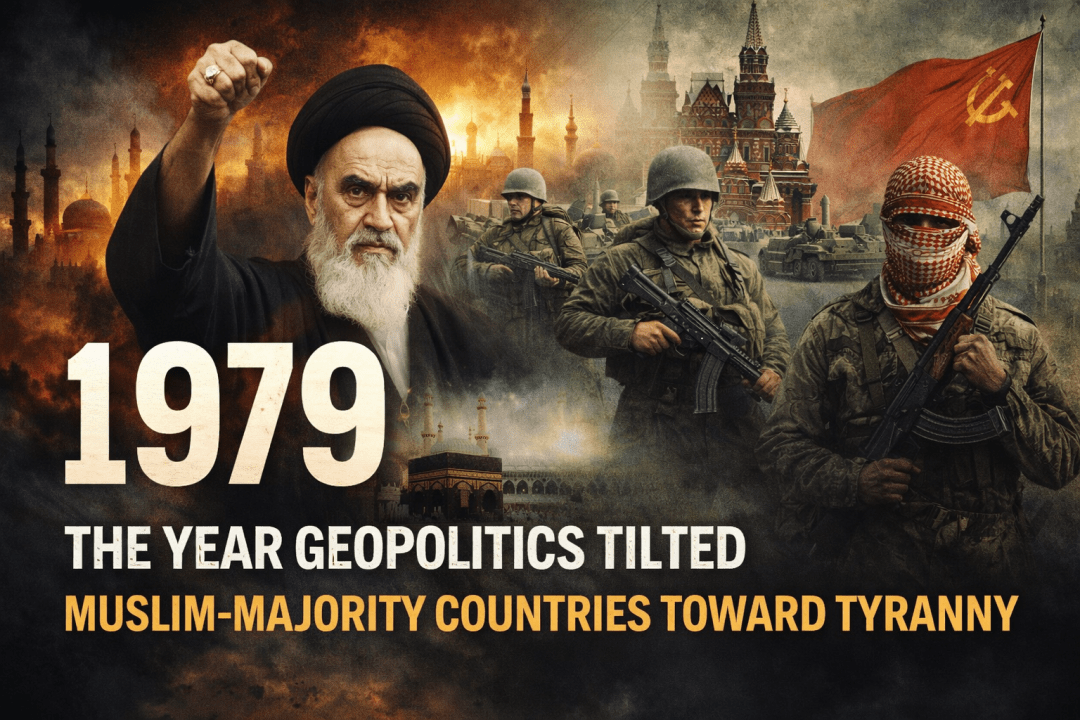
There is a temptation, when examining contemporary predominantly Muslim countries, more rigid expressions—the political repression, the enforced uniformity, the sanctioned violence—to trace these features back through history until they disappear into some unchanging essence of the religion itself. This is a mistake, and not merely an academic one. It misreads the historical record, misattributes responsibility, and obscures what actually happened: a significant and relatively concentrated transformation, accelerated through a single decade, driven not primarily by theology but by geopolitics, petrodollars, and state calculation.
The pivotal year is 1979. Three events, each seismic on its own, converged within months of each other: Khomeini’s revolutionaries displaced the Shah and declared an Islamic Republic in Iran; a Saudi militant seized the Grand Mosque in Mecca; and the Soviet Union invaded Afghanistan, triggering a Western-backed jihad that would arm, fund, and internationalize radical Islamism for two decades. These were not coincidences. They were the ignition of pressures that had been building since at least 1967—and their combined effect was to permanently redraw what counted as normative Islam in public life across Muslim-majority societies.
Much of what people today encounter as “Islamic orthodoxy”—the dress codes, the suppression of music and visual art, the criminalization of dissent under religious cover, the hostility to Sufi and other sects within the religion, the insistence on a single correct reading—is substantially a modern construction, assembled and exported in the 1970s and after, shaped as much by Cold War strategy and authoritarian statecraft as by internal religious logic. But this is not a story of innocent Islam corrupted by outside forces. Classical Sunni and Shia doctrine carried real rigidities, real exclusions, and real capacities for intolerance long before 1979. The decade did not introduce pathology into a healthy tradition; it weaponized and standardized existing tendencies, crowding out the tradition’s simultaneously existing pluralism and redirecting theological energy toward political ends on an unprecedented scale.
Before the Break: Plurality Without Innocence
To understand what 1979 accelerated, it is necessary to describe what existed before it—without romanticizing it.
Mid-twentieth century Islam was, across most of its geographic range, decisively plural in practice. Cairo’s intellectual culture in the 1950s accommodated Marxists, Arab nationalists, liberal constitutionalists, skeptics, and practicing Muslims who saw no contradiction between these commitments. Beirut was genuinely cosmopolitan, not merely in the sense of wine bars, but in the sense of coexisting religious communities whose intellectual classes actually argued across confessional lines. Kabul’s educated class in 1975 would be largely unrecognizable to anyone who knows only its contemporary successor. Across West Africa, Sufi orders—the Tijaniyya, the Qadiriyya—provided the religious texture for hundreds of millions of Muslims through devotional poetry, commemoration circles, and ritual practices that had developed in productive synthesis with local culture.
A traveler moving from Anatolia to West Africa encountered different ritual emphases, different jurisprudential reasoning, different relationships between the religious and the political. This pluralism was not merely sociological accident; it was encoded in the institutions of traditional Islamic learning, where the ijaza system meant that religious authority derived from recognized chains of scholarship rather than from ideological conformity.
But this picture requires qualification. The same tradition that produced Ibn Rushd and Rumi also produced, through its mainstream legal schools, systematic subordination of women, criminalization of apostasy, and frameworks for religiously sanctioned violence that were never merely theoretical. The Hanbali school—which would provide much of Wahhabism’s intellectual scaffolding—was not a later invention; it was always part of classical Sunni jurisprudence, always inclined toward literalism, always suspicious of innovation. Shia Islam, for its part, carried its own internal hierarchies, its own practices of clerical authority, and its own traditions of condemning Sunni practice that predated any modern political project. What the pre-1979 world had was not a wholesome, tolerant Islam subsequently corrupted—it had competing tendencies within a complex tradition, and what the 1970s did was dramatically tilt the balance among them.
The pre-1979 world also had its own illiberalism in religious form. Pakistan’s 1953 anti-Ahmadi riots demonstrated that mob-enforced heresy policing required no Saudi funding. The Muslim Brotherhood, founded in Egypt in 1928, had developed a comprehensive Islamist political program decades before Khomeini. The Deobandi movement in South Asia, emerging from the 1867 founding of the Darul Uloom at Deoband, had been cultivating a scripturalist, anti-Sufi Islam for a century before the oil boom. Early twentieth-century Wahhabi forces had already violently dismantled shrine culture in the Hijaz in the 1920s. These movements were not waiting for petrodollars to be activated; they were already present, already institutionalized. What happened after 1973 was that one tendency within this complex landscape—the most politically legible, the most amenable to state use, the most hostile to local variation—received resources, platforms, and geopolitical backing on a scale that distorted the entire field.
The Long Fuse: 1967 and the Death of Secular Alternatives
The Six-Day War did not produce 1979 directly, but it destroyed the dominant alternative to political Islam, which made 1979’s consequences so lasting.
Gamal Abdel Nasser had built his authority on a specific promise: Arab unity, secular nationalism, and socialist redistribution could deliver dignity and territorial integrity. The 1967 defeat—swift, total, humiliating—was not merely a military loss. It was an ideological catastrophe. Nasserism could not survive it. The entire framework of secular modernism as the vehicle of Arab liberation collapsed within six days, and with it the political space that had kept Islamist movements largely at the margins of state power.
The intellectual groundwork for what followed had already been laid. Sayyid Qutb had spent years in Nasser’s prisons, where his thought hardened from a call for Islamic social reform into a framework justifying revolutionary violence against Muslim rulers he deemed apostate. His prison writings, particularly Milestones (1964), provided the ideological architecture for what followed. But it is important to note that Qutb was drawing on existing Sunni jurisprudential categories—the concept of takfir (declaring other Muslims apostate), the distinction between dar al-Islam and dar al-harb, the classical duty of enjoining right and forbidding wrong. He radicalized these categories; he did not invent them. The tradition gave him materials. The defeat of 1967 gave those materials an audience.
The defeat also produced a specific psychological dynamic: the sense that Arab failure was divine punishment for having abandoned Islam. This reading was constructed and disseminated, not spontaneously obvious—but it resonated precisely because secular nationalism had so publicly and catastrophically failed on its own terms. When the secular alternative to Islam-in-politics collapsed, the field was left to those who had always argued that only the religious framework was adequate.
Saddam Hussein’s formal consolidation of power in Iraq that same July—achieved through a televised purge of the Ba’ath Party in which he read aloud the names of alleged conspirators while colleagues wept and confessed on camera—was a reminder that 1979’s authoritarianism was not exclusively religious in character. Ba’athism was secular in its founding ideology, pan-Arab rather than pan-Islamic, and Saddam represented its most brutal expression. But even he would eventually reach for religious legitimation when it served him: Quranic verses were inscribed on the Iraqi flag after the Gulf War, mosque construction accelerated domestically, and the 1990s “Faith Campaign” rebranded a cornered dictator in Islamic terms. The secular alternative to political Islam was not holding a line against religion’s political instrumentalization—it was simply instrumentalizing it differently, and more slowly.
Oil and the Industrialization of Religious Authority
Before the 1973 oil embargo, Saudi Arabia had the ideology but not the money to export it at scale. After it, the equation changed fundamentally.
The Wahhabi-Salafi tradition that the Al Saud had formally embraced since the eighteenth century was, in the broader Islamic world, a regional peculiarity. Its hostility to Sufism, saint veneration, decorative art, and jurisprudential pluralism made it an outlier, not a mainstream. Classical Sunni scholarship centered in Cairo, Damascus, and the subcontinent regarded it with varying degrees of skepticism. What oil wealth did was finance a global program of religious standardization in favor of this minority tendency—and the mechanism was institutional, overt, and extraordinarily effective.
The primary vehicle was the World Muslim League (Rabitat al-Alam al-Islami), founded in Mecca in 1962, which became after 1973 the main conduit for Saudi religious outreach. Through the League and affiliated bodies—the International Islamic Relief Organization, the World Assembly of Muslim Youth—Saudi Arabia financed mosque construction across South and Southeast Asia, sub-Saharan Africa, Central Asia, and the Western diaspora. The Islamic University of Medina, founded in 1961, trained foreign students from across the Muslim world in Salafi doctrine and returned them to their home countries as credentialed religious authorities, their credentials carrying the weight of state backing and financial resources that local traditional scholars could not match.
The funding came with conditions, explicit or implied: Saudi-approved imams, Saudi-printed Qurans (distributed free in enormous numbers), Saudi curricula. Madrasas across Pakistan were restructured around Deobandi and Wahhabi frameworks, often replacing older, locally rooted educational traditions. This was not accomplished overnight, and it was not accomplished without local collaboration—which raises the agency question directly.
It would be too simple to say that these transformations were imposed on passive Muslim populations from outside. Indigenous reform movements had their own momentum and their own appeal. The Muhammadiyah in Indonesia, founded in 1912, had been pursuing scripturalist reform for decades on the basis of its own reading of Islamic sources, independent of Saudi influence. The Tablighi Jamaat, founded in India in 1926, built the largest Islamic missionary movement in the world through grassroots organization with minimal state backing. Many Muslims who embraced more conservative practice did so in response to genuine moral concerns—corruption, colonial humiliation, social disintegration—that no outside actor manufactured. The Salafi message of returning to pure sources resonated partly because it offered clarity in conditions of profound confusion, and partly because it provided entry into a transnational community at a moment when national communities were failing their members.
But choice is not made in a vacuum. When one set of religious options arrives funded by a petrostate, institutionally backed, and packaged with career opportunities for aspiring religious professionals, while another set of options is economically marginalized and institutionally displaced, the resulting religious landscape cannot be explained purely by the preferences of individuals freely choosing among equals. The Salafi expansion was a market intervention on a massive scale, and the market it intervened in was the market for religious authority.
1979, First Movement: Iran and the Theology of State Power
The Iranian Revolution of 1979 was not an export of Salafi doctrine—Khomeini’s Twelver Shia theology was anathema to Sunni Wahhabists—but its global significance operated at a different level. It demonstrated that an Islamic revolution was possible. It proved that a modern state could be organized entirely around religious authority. And it triggered a Sunni-Shia rivalry that both Tehran and Riyadh would exploit at enormous cost to populations caught between them.
Khomeini’s doctrine of wilayat al-faqih—the guardianship of the jurist—was a genuine theological innovation, though it was presented as recovery of tradition. Classical Shia jurisprudence had been, in several respects, more cautious about clerical political authority than its Sunni counterpart; the occultation of the Hidden Imam had traditionally counseled at least partial political quietism. Khomeini argued that qualified jurists should exercise direct political sovereignty in the Imam’s absence—a position that was contested among senior Shia scholars both inside and outside Iran and that Grand Ayatollah Khoei, the leading Shia authority of the period, explicitly rejected. This was not a recovery of latent Shia politics. It was a specific construction in service of a specific political project, assembled from existing jurisprudential materials and forced through by revolutionary circumstances.
This matters because it corrects a double error. The error is not only the Western one that assumes all Islamist politics flows from some essential Islamic core—it is also the Iranian revolutionary claim that wilayat al-faqih represents the authentic Shia tradition finally realized. Both claims obscure construction as continuity.
What the revolution demonstrated, regardless of its theological content, was that religion could be the medium of total political reorganization. Islamist movements across the Sunni world absorbed this lesson even as they rejected its Shia form. The demonstration effect traveled across ideological lines in ways the actors did not intend and could not control.
The Saudi response to the revolution was immediate and consequential. Riyadh perceived Khomeini’s claim to Islamic leadership as both theological affront and geopolitical threat. The response was to dramatically accelerate global Salafi outreach—making Sunni orthodoxy the explicit counter-narrative to Iranian Shia revolutionism. The competition between two ideological systems, both of which had resolved the tension between religious authority and political power in favor of clerical domination, produced a race to the bottom in religious pluralism across the Muslim world.
1979, Second Movement: Mecca and the Bargain’s Cost
In November 1979, Juhayman al-Otaybi led several hundred armed men into the Grand Mosque in Mecca and seized it. Al-Otaybi’s ideology was an extreme internal extension of Wahhabism—he believed the Saudi state had become corrupt and insufficiently Islamic, a critique that put him in paradoxical alignment with Khomeini’s anti-monarchism even as both would have rejected the comparison.
The siege lasted two weeks. French commandos assisted in retaking the mosque. The immediate crisis passed. But what followed was more consequential than the siege itself.
The Al Saud made a calculation. Facing simultaneous pressure from the Iranian revolution, from the radical Wahhabi critique represented by al-Otaybi, and from a domestic religious establishment with its own political ambitions, they chose accommodation over confrontation. Religious authorities received expanded control over public life. Social codes were tightened. The religious police—the mutawwa—were empowered. Entertainment venues closed. Women faced new restrictions on public presence. The implicit bargain between the Saudi state and the Wahhabi establishment—you legitimate our political authority, we enforce your social vision—was renegotiated in the establishment’s favor.
The irony was sharp: a state that presented itself as the guardian of Islamic authenticity responded to a challenge from its own theological tradition by giving that tradition more power over daily life. The theological content of Wahhabism did not change; its political leverage increased. And the global export program intensified, partly as a demonstration of Islamic credentials at home. Every mosque built in Nigeria or Bradford was evidence that the custodians of the holy cities were fulfilling their obligations to the umma—obligations that the establishment could now enforce as a condition of continued political support.
1979, Third Movement: Afghanistan and the Globalization of Jihad
The Soviet invasion of Afghanistan in December 1979 transformed Islamism from a regional political force into a globally networked military movement. This transformation was deliberately engineered.
The Carter administration authorized CIA support for the Afghan mujahideen within weeks of the invasion; the Reagan administration dramatically accelerated it; Saudi Arabia matched American funding dollar for dollar; Pakistan’s ISI served as the operational conduit. The strategy was to bleed the Soviet Union through proxy war, and the vehicle was religiously motivated fighters drawn from across the Muslim world.
The religious infrastructure built to support this strategy was real and institutional. Fatwas were issued—by Saudi clerics with state backing—legitimizing offensive jihad against the Soviets. Madrasas in Pakistan’s border regions, many funded by Saudi and Gulf money, trained fighters within a specifically Deobandi-Wahhabi synthesis that was more immediately actionable than either tradition would have been alone. Transnational recruitment networks connected organizers in Egypt, Saudi Arabia, and Algeria with battlefields in Afghanistan. Abdullah Azzam, the Palestinian scholar who formalized the theology of transnational jihad with his doctrine that fighting in Afghanistan was an individual obligation for every able Muslim, operated out of Peshawar with institutional support that did not come from nowhere.
When the Soviets withdrew in 1989, this infrastructure did not dissolve. Fighters, networks, ideology, and organizational capacity dispersed into the broader Muslim world, carrying a specific understanding of Islam: that the faith was under assault, that defensive obligation had become offensive duty, that existing Muslim governments were corrupt apostates, and that violence was an appropriate tool of religious politics. What would eventually become al-Qaeda was not an aberration—it was the institutionalized product of a specific strategic decision made in 1979 and 1980, its radicalism inseparable from the resources and legitimacy provided by state actors who believed they could control what they were building.
The Afghanistan jihad also accomplished something subtler than the creation of specific organizations. It normalized a particular image of authentic Muslim masculine identity—armed, politically engaged, prepared for martyrdom, contemptuous of accommodation. This image circulated globally through cassettes, videos, and eventually the internet, reshaping how young Muslim men in Morocco, Indonesia, and Birmingham understood their religious and political identities. The 1991 Gulf War and 9/11 would cement and accelerate the transformation, but the structural conditions were in place before either event.
The Standardization Machine: Institutional Specifics
The combined effect of these forces was what might be called the standardization of Islam—the progressive replacement of local, pluralistic, tradition-rooted religious practice with a single exported ideological template. The mechanism warrants specificity, because “standardization” can sound abstract when the process was quite concrete.
The World Muslim League directly funded the construction of thousands of mosques globally, each coming with the implicit expectation of doctrinal alignment. The Islamic University of Medina produced tens of thousands of graduates between its founding and 2000, who returned to their home countries carrying Saudi credentials and Saudi frameworks—frameworks that gave them institutional advantages over locally trained scholars whose authority derived from older, less legible networks. Saudi-printed Qurans, distributed free by the hundreds of millions, came with marginal commentary reflecting Wahhabi interpretive priorities. This was not censorship; it was the construction of a default.
These mechanisms interacted with local religious authorities in ways that varied by region. In some contexts—parts of sub-Saharan Africa, Central Asia after the Soviet collapse—the interaction was competitive, with Saudi-backed movements actively displacing existing clerical hierarchies. In other contexts—parts of South Asia, where Deobandi institutions were already established—it was more collaborative, a convergence of compatible reform impulses amplified by new resources. In still other contexts—Turkey, Iran’s Shia periphery—the interaction produced resistance and hybridization. Standardization was a tendency and a pressure, not a totalizing achievement.
The loss was concrete. Across West Africa, musical and ceremonial Islamic traditions rooted in centuries of cultural synthesis came under sustained attack from returning graduates of Saudi institutions who labeled them heresy. In the Balkans, the tolerant Bektashi tradition—which had provided the religious character of Albanian and parts of Bosnian Islam for centuries—found itself increasingly marginalized. In the Malay world, adat (customary practice) that had been integrated with Islamic observance for generations was reframed as pre-Islamic contamination to be purged. What was being replaced was not a pristine original Islam but a series of complex, living syntheses whose legitimacy was now denied by better-funded competitors.
Two Models, One Direction
The article has treated the Iranian and Saudi models as different responses to the same moment, and they were different—theologically, jurisprudentially, politically. But it is worth noting where they converged, because the convergence illuminates the deeper dynamic.
Both systems resolved the classical tension between religious authority and political power by subordinating one to the other—in Iran, through wilayat al-faqih, which placed political authority directly under clerical control; in Saudi Arabia, through a formal alliance in which the state enforced Wahhabi doctrine in exchange for religious legitimation of the monarchy. Both framed their specific arrangements as the authentic realization of Islamic governance. Both were systematically hostile to pluralism within Islam—Iran suppressed Sunni and Sufi minorities, Saudi Arabia suppressed Shia communities in its Eastern Province and pursued global Salafi standardization. Both instrumentalized religious education as a tool of ideological reproduction. Both used soft power—mosque construction, scholarship programs, broadcast media—to export their models.
The competition between them produced an arms race in religious restriction. When Iran claimed that the Saudi monarchy was insufficiently Islamic, the Saudis responded by becoming more visibly Islamic in their social policy. When Saudi funding reached Shia communities in Lebanon and Bahrain and Iraq, Iran responded by increasing its own transnational religious infrastructure. The populations living within these competing spheres of influence did not experience the competition as theological enrichment. They experienced it as narrowing—as the progressive elimination of religious options that did not fit either pole.
The Distinction That Matters
The argument made throughout this article depends on a distinction between Islam as a faith and Islam as a politicized ideology. This is not a distinction between “real Islam” and “fake Islam”—it is a distinction between a set of theological commitments, ritual practices, and ethical orientations that have characterized Muslim life across enormous cultural diversity for fourteen centuries, and a specific modern project of political mobilization that uses Islamic symbols, vocabulary, and institutions as its medium.
The former admits of extraordinary variety and contains within it genuine tensions—between legalism and mysticism, between individual conscience and communal authority, between the tradition’s egalitarian impulses and its historical hierarchies. The latter tends toward uniformity and control, because uniformity and control are what political projects require. Classical Islamic scholarship was never politically innocent—the relationship between the ulama and the state was always a relationship of mutual use—but it operated within institutional structures that preserved a degree of internal diversity and a degree of epistemic humility about the gap between divine will and human interpretation.
What the 1970s construction of political Islam did, at its worst, was to collapse that gap on behalf of specific political arrangements. Particular dress codes, particular hierarchies, particular exclusions were presented not as human interpretations of divine guidance but as divine guidance directly expressed. This move is not unique to Islam; every major religious tradition has produced versions of it. What made the post-1973 version distinctive was the scale of the resources deployed to propagate it and the geopolitical interests it served—interests that had nothing intrinsically to do with the theological questions at stake.
This is also not to say that the doctrines in question came from nowhere. The classical legal tradition is riddled with provisions for apostasy punishment, the subordination of women, and the justification for militant mobilization as a mandate of faith. The Hadith literature genuinely contains material that has been used to justify a range of restrictions. The point is not that these elements were invented in 1979—they were not—but that they were selected, emphasized, systematized, and exported in ways that crowded out the tradition’s simultaneously existing countercurrents, and that this selection was driven by political logic as much as by theological reasoning.
The Long Shadow
1979 was not the birth of a new Islam but the year when competing state and transnational actors successfully redrew the boundaries of orthodoxy—transforming long-standing theological currents into geopolitical tools under conditions of oil wealth, Cold War patronage, and emerging media globalization. Understanding how those boundaries were redrawn is the precondition for understanding whether, and under what conditions, they might be redrawn again.
The world built between 1973 and 1989 has proved durable. The religious infrastructure exported during those years—the mosques, the schools, the transnational networks, the ideological frameworks—continues to shape Muslim public life from Morocco to Indonesia. The 1991 Gulf War and the September 2001 attacks further cemented the global visibility of political Islam and, by making it the dominant lens through which Western audiences understood Muslim-majority societies, inadvertently reinforced its claim to represent Islam as such.
What has also proved durable is the misreading of what happened. Because the transformation was presented in religious language, and because its products presented themselves as recovery of authentic tradition, it has been easy to mistake construction for continuity—to imagine that what emerged from the 1970s is simply what Islam had always been and would always produce. This misreading is convenient for multiple parties: for those who wish to portray Islam as inherently incompatible with pluralism; for those who wish to legitimate current arrangements by claiming their deep historical roots; and for those who find it easier to police religious practice than to examine the political and economic interests that shaped it.
The historical record does not support this misreading—though it requires us to hold two uncomfortable truths simultaneously. The first is that Islam, like every major religious tradition, carries within it real tensions and real tendencies toward intolerance that have been expressed across history, not only in the modern period. The second is that the specific form these tendencies took after 1979—their scale, their global uniformity, their political instrumentalization—was not historically inevitable. It required identifiable actors, identifiable resources, and identifiable decisions made under specific geopolitical conditions.
To understand contemporary Islam—its internal debates, its relationship to political authority, its tensions around pluralism—requires holding these truths together. The tradition is neither innocent of its history nor reducible to the modern construction that has claimed to represent it. What is at stake in this history is not just an abstract argument about authenticity. It is a question about what resources exist within the tradition for those traditionalist Muslims who want to argue, from within Islam rather than against it, for pluralism, tolerance, and the dignity of religious difference. Those resources exist—in the tradition’s own pluralism, in its history of productive synthesis with local cultures, in the countercurrents that the post-1973 standardization sought to eliminate but did not fully succeed in eliminating. Recovering their history is not nostalgia. It is archaeology of what is still, stubbornly, present.
With this history in view, one may take a hard stance against the movement that emerged from the fringes—against its legal sanctions, its gender hierarchies, and its doctrines of coercion—and still read the past honestly. But even those unwilling to make so uncompromising a break are left with a more modest, unavoidable conclusion: the rigid, homogenized, and punitive Islam promoted by jihadist movements and contemporary fanatics is not an eternal inheritance but a historically contingent construction. Prior to the 1970s, Muslim societies were not uniformly liberal, but they were recognizably plural—internally diverse in practice, intellectually contested, and capable of accommodating disagreement without demanding total conformity. To acknowledge this is not to romanticize the past or absolve the tradition of its exclusions; it is simply to reject the caricature that presents today’s most extreme expressions as Islam’s natural or inevitable form. Recovering this history does not tell Muslims what they must believe—but it does remind them, and their critics, that what now claims to be timeless orthodoxy was once only one tendency among many, and that the narrowing of the field was a political achievement, not a theological necessity.

 Quran Talk Blog