Here is a question worth contemplating: What is the difference between you and a bear?
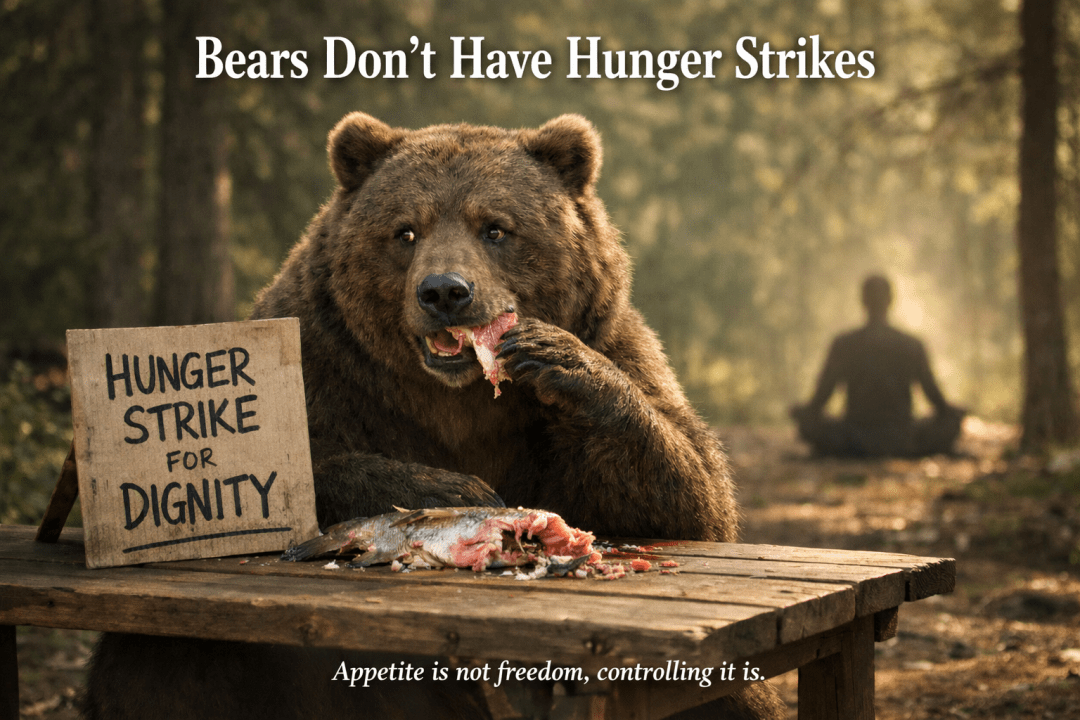
The obvious answers—opposable thumbs, Netflix subscriptions, the ability to feel existential dread—are correct but beside the point. Francis Fukuyama, in The End of History and the Last Man, offers a more philosophically interesting answer. The bear, he observes, cannot stage a hunger strike. It cannot look at its growling stomach and say, not today, and not for any amount of salmon—I have a higher principle to attend to. The bear is “free” in a technical sense when it roams the forest unrestrained, but it is not free in any meaningful sense, because it has absolutely no choice but to obey its hunger. It is, in Fukuyama’s memorable framing, essentially a very sophisticated machine running on the laws of physics, with fur.
You, on the other hand, can choose not to eat. And that small, uncomfortable fact turns out to be the hinge on which an enormous amount of human history swings.
The Part of You That Is Not the Bear
Fukuyama borrows a concept from Plato called thymos—the spirited, dignity-seeking part of the soul that is neither cold reason nor raw appetite. Thymos is what makes someone risk it all rather than quietly swallow injustice. It is what makes a person whistle-blow on a powerful employer, knowing full well it will cost them. It is, in short, the part of you that occasionally overrides what is comfortable, convenient, or calorically optimal because something else matters more.
The bear has no thymos. It has very impressive appetites and very good instincts, and they run the show completely. What it fundamentally lacks is the capacity to look at its own desires and say: I am bigger than this. Humans can do that. Humans do it all the time—sometimes nobly, sometimes foolishly, always in ways that reveal something essential about the kind of creature we are.
Ramadan: Doing Something a Bear Cannot
If you want the single most dramatic large-scale demonstration of thymotic freedom on the planet, you do not need to look at political revolutions or wartime heroics. You need to look at what happens every year when the crescent moon appears, and ~1.8 billion Muslims simultaneously decide to stop eating until sunset.
[2:185] Ramadan is the month during which the Quran was revealed, providing guidance for the people, clear teachings, and the statute book. Those of you who witness this month shall fast therein. Those who are ill or traveling may substitute the same number of other days. GOD wishes for you convenience, not hardship, that you may fulfill your obligations, and to glorify GOD for guiding you, and to express your appreciation.
Ramadan is not a diet. This distinction matters enormously. A person on a diet is, in the bear’s terms, simply a bear with a goal—still fundamentally governed by appetite, just redirecting it toward a different outcome (fitting into last summer’s jeans). The Submitter fasting during Ramadan is doing something categorically different. They are not eating precisely because they are hungry. The hunger is not the enemy to be defeated or the problem to be solved. It is the point. The discomfort is the vehicle.
The Arabic word for fasting, Siyam, simply means to abstain, and to abstain requires a desire and the means to fulfill the desire, yet the will to refrain. The Quran frames the whole practice as training in taqwa—a word often understood as “God-consciousness” but which might be more vividly rendered as the cultivated ability to not be run entirely by your appetites. This makes taqwa essential for salvation, because it is only through the taming of appetite that true freedom can be achieved and the grip of earthly desire can be loosened.
[2:183] O you who believe, fasting is decreed for you, as it was decreed for those before you, that you may attain salvation (taqwa).
Consider a submitter spends a month demonstrating to themselves, repeatedly, that the bear does not win. The stomach growls at 3pm, and they sit with it and say: I see you, and I am in charge here. Then the iftar meal at sunset—the breaking of the fast—hits differently than any other meal for exactly this reason. It is not just food. It is a celebration of the fact that the fast was chosen. They could have eaten. They didn’t. Now they do, and that too is a choice. The bear simply eats when food appears. That is the whole difference, right there at the dinner table.
The Hunger Strike, or: Taking the Bear Argument to Its Logical Extreme
Fukuyama notes, with what reads almost like dry amusement, that bears do not stage hunger strikes on behalf of higher causes. He is right, and the hunger strike is perhaps the starkest possible proof that human beings are not bears.
Consider what a hunger strike actually is: you take the most insistent biological signal your body knows how to send—feed me, this is not optional, I will cause you significant distress until you comply—and you weaponize your own suffering against it, in service of an idea. From a purely Darwinian standpoint this is absurd. Your genes are not being served by your principled starvation. The algorithm is very clearly malfunctioning.
And yet. Bobby Sands died in a British prison in 1981 after sixty-six days without food, and his death shook a government and galvanized a movement. Gandhi fasted so many times and to such effect that the British Empire—one of the most powerful institutional forces in human history—had to take seriously the spectacle of a small elderly man simply refusing to eat. The message in both cases was the same message encoded in every Ramadan fast, in every religious ascetic’s discipline, in every person who has ever turned down something they wanted because something else mattered more: I am not the bear. My body does not govern me.
Why the Liberal World Order Gets Slightly Nervous About All This
Here is where Fukuyama’s argument gets genuinely interesting, and a little unsettling. Liberal capitalism—the system that has more or less won the argument about how to organize societies—is extraordinarily good at feeding the bear. It produces abundance, satisfies preferences, and removes obstacles to desire-fulfillment with remarkable efficiency. This is not nothing. Ask anyone who has lived under a system that couldn’t manage it.
But liberal capitalism is, by design, somewhat agnostic about the thymotic self. It doesn’t especially need you to fast, sacrifice, or struggle for higher causes. It needs you to produce and consume. The formal freedom it offers—no one is forcing you to eat or not eat, believe or not believe, sacrifice or not sacrifice—is real. But it is, as Fukuyama nervously observes, a bit like the bear’s freedom in the open forest. Technically unconstrained. Not obviously elevating.
The worry is that a society of perfectly comfortable, perfectly fed, formally free individuals—with no causes worth hunger-striking over, no God or community or principle in whose name they’d override their appetites—starts to look, spiritually speaking, more like a very sophisticated bear than a fully realized human being. Fukuyama calls these people “the last men,” and he does not mean it as a compliment.
So What Are You Going to Do About It
The bear is not going anywhere. The hunger is real, the appetite is insistent, and anyone who tells you that transcending your desires is easy is either lying or has never encountered really good bread. The point is not that fleshly desires are evil or that comfort is the enemy of the good life. The point is that a life entirely governed by appetite—one in which you never choose the harder, higher thing over the easier, lower one—is missing something that human beings, across every culture and tradition and century, have recognized as essential.
Ramadan is one answer to this, encoded into religious practice and community rhythm so that the discipline doesn’t depend entirely on individual willpower on a Tuesday afternoon. The hunger strike is a more dramatic answer, available for extreme circumstances. Ordinary life is full of smaller versions: the difficult conversation you have instead of the comfortable silence, the principle you hold to when it costs you, the fast that is really just a quiet daily reminder that you are, in fact, in charge of yourself.
The bear can’t do any of that. Which is, when you think about it, a pretty good reason to get up in the morning.
Related Articles:

 Quran Talk Blog
2 thoughts on “Bears Don’t Have Hunger Strikes (Part I: Discipline Freedom)”