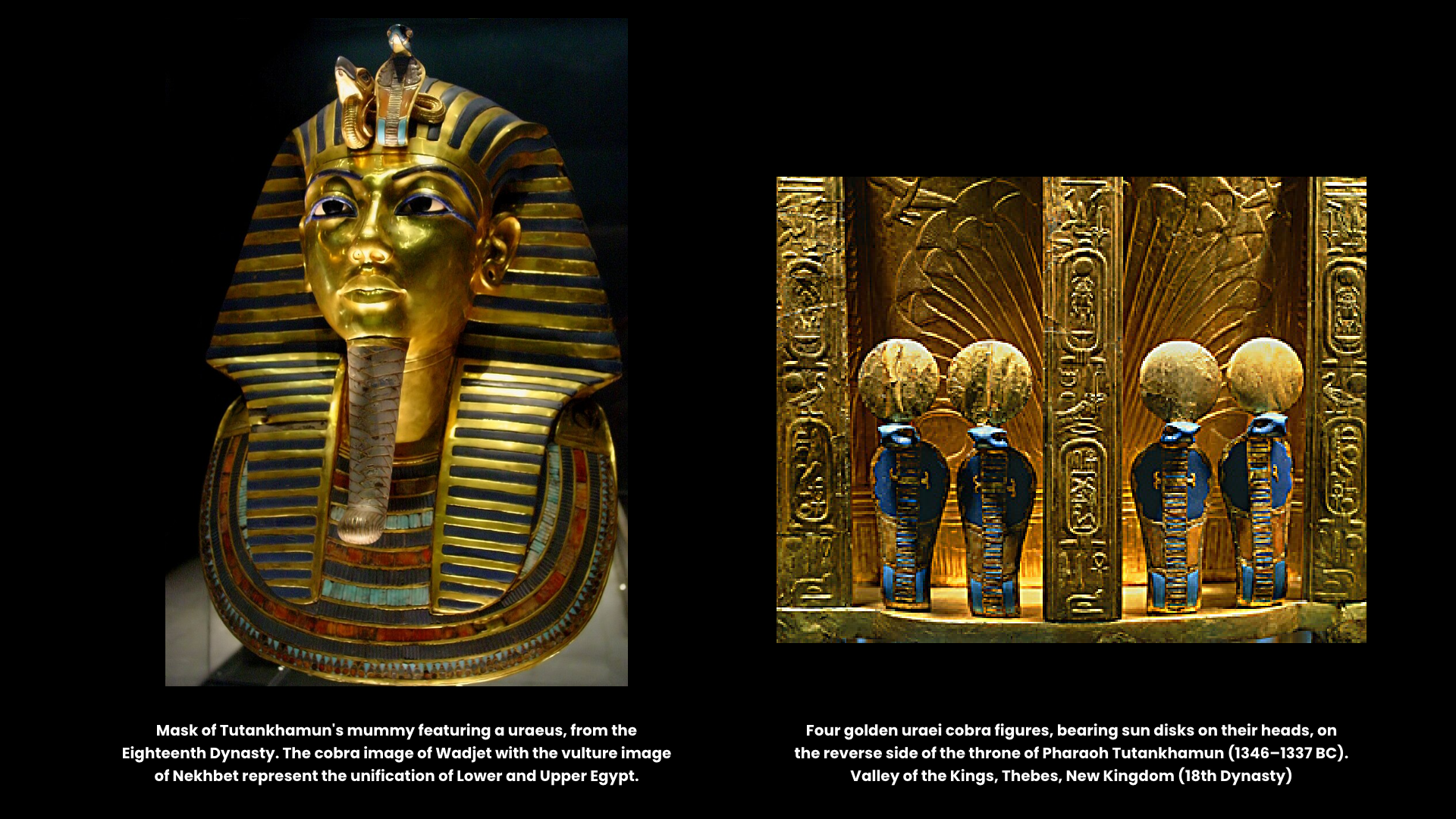
Long before Moses ever stood in the halls of Egypt, the kings of the Nile crowned themselves with a symbol found on the brow of every pharaoh: the Uraeus, a stylized cobra, hood flared, poised to strike. For more than two millennia, the Egyptians believed this serpent was not mere ornament but a living emblem of divine authority—a sign that the king ruled not by human assent but by heavenly appointment.
The oldest Pyramid Texts, scratched into the dark shafts of the Fifth and Sixth Dynasty pyramids, already testify to the cobra goddess of Lower Egypt, Wadjet, as the protector of the king. In Utterance 478, the king is promised that “the Great One will be on your brow,” a clear reference to the Uraeus as both guardian and legitimizer. Later Coffin Texts amplify the motif: the serpent will “spit fire against your enemies,” a metaphor that appears on temple after temple, from Luxor to Karnak. One sees it in the reliefs of Seti I, where the cobra shoots a ray of flame at those who dare oppose the king; one sees it most famously in the burial mask of Tutankhamun, where the golden cobra rises beside the vulture goddess Nekhbet—Wadjet and Nekhbet, the tutelary goddesses of Lower and Upper Egypt, united on the king’s brow as a miniature pantheon of empire.
To understand ancient Egypt is to understand that symbols were realities. The Uraeus was the outward sign of a timeless proposition: that Pharaoh was the earthly incarnation of divine order. Through him the gods maintained Ma’at, the balance of cosmos and society. The Uraeus, therefore, was active and alive—ready to strike down chaos, foreigners, rebels, and those who questioned the king’s mandate. Egyptologists have long noted that this cobra appears not only on crowns but on statues, scepters, architectural lintels, and magical papyri. The image that modern eyes might dismiss as ornament was, to ancient priests and scribes, an active force. Royal inscriptions from the Middle Kingdom speak of the king “flourishing the Uraeus,” sending terror into the hearts of enemies.
The Confrontation
Centuries later, when Moses returned from exile to demand Israel’s freedom, he entered a throne room where Pharaoh sat not merely as a king with political power, but as a god-king bearing the authority of a divine serpent. To challenge Pharaoh was to challenge the gods of Egypt themselves, and the greatest of their tokens was the uplifted cobra gleaming on the king’s brow.
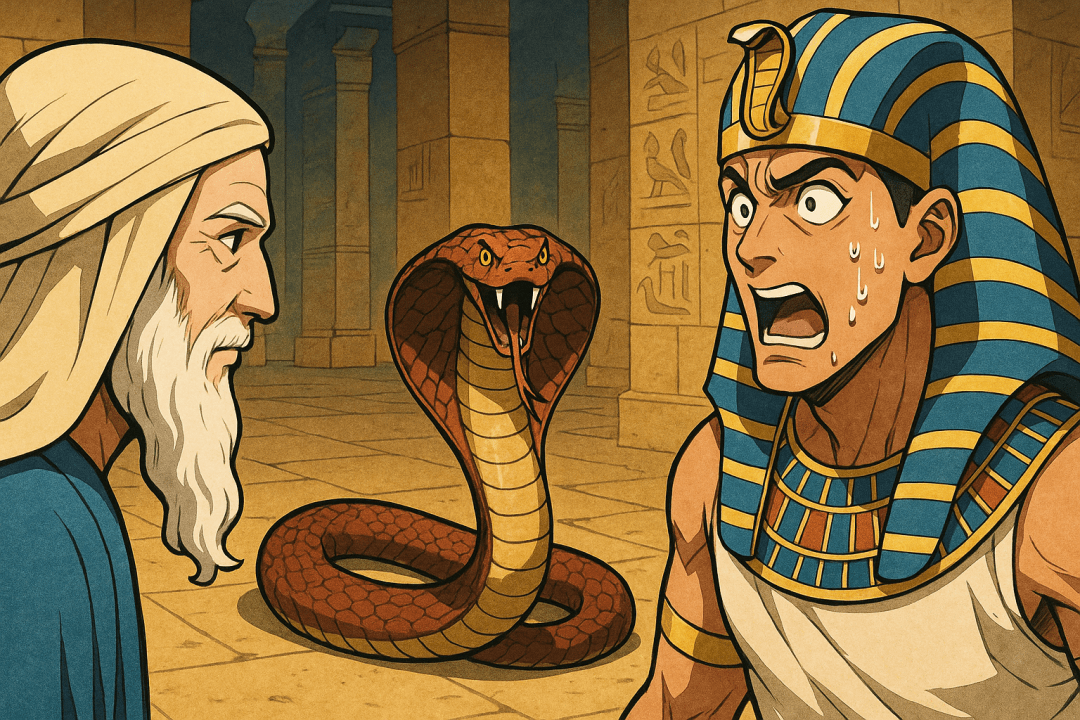
It is in this context that Moses casting down his staff must be read. The transformation of the rod into a serpent is too often imagined as mere spectacle, as if God intended only to impress or intimidate. But the ancient world spoke through symbols, and to an Egyptian audience this moment would have been unmistakable in its meaning. Moses produced not just any snake but a creature that invoked the very symbol of royal power. He was demonstrating that the god he represented had control over the Uraeus itself. The staff that became a living serpent was a direct confrontation with the very emblem of Pharaoh’s divine authority.
When Pharaoh’s magicians respond in kind, producing serpents of their own, Moses’s serpent swallows them whole. In Egyptian imagination, the Uraeus devours enemies; here, before the eyes of the court, it is Pharaoh’s divine emblem that is devoured. Temple inscriptions throughout Egypt depict the king’s serpent destroying all threats to his reign—yet here, in Pharaoh’s own chamber, the serpent of a foreign shepherd overpowers the serpents of Egypt’s priesthood. The divine symbol that steadied the Egyptian state for centuries—the cobra that promised protection, legitimacy, fire, and fear—is shown powerless. The god behind Moses does not compete with Egyptian magic; He consumes it. He does not challenge Pharaoh’s authority; He renders it null.
The Deeper Meaning
The miracle was not only the transformation of wood into a reptile, but the symbolic act of truth destroying the false power arrayed before it. This first sign was a forecast of what the plagues would represent—a systematic dismantling of Egypt’s theology, a quiet unmasking of a human king who claimed the mantle of a god.
Egypt’s priests believed the Uraeus secured the cosmic order. Yet Moses’s sign declared that this order had already fallen. The plagues would later dramatize this collapse on a national scale, but the decisive symbolic blow was demonstrated right in front of Pharaoh himself. The Uraeus—protector of the king, emblem of divine wrath, guardian of Egypt’s borders—had been defeated before a single disaster was summoned.
Egypt built its theology out of sunlight, serpents, and stone, weaving symbols into a worldview of dazzling coherence. The scriptural narrative took the images most revered by them and turned those symbols against them in their own stronghold. In this confrontation between the Uraeus and Moses’s serpent—between the symbols of man and the signs of God—ancient Egypt’s greatest emblem met a power it could not imitate. What followed was not merely political liberation but the collapse of a cosmic order that had stood for millennia, undone by a shepherd’s staff in the hands of a prophet.

 Quran Talk Blog