
The Unchanging Nature of Human Behavior
One of the most important insights in historical study is that human nature doesn’t change—only the environment does. The ancients were not a different species; they possessed the same cognitive capacity, emotional impulses, biases, temptations, ambitions, and insecurities as people today. Whether we examine Babylonian school tablets, Roman letters, or medieval chronicles, the patterns are instantly recognizable: people gossip, defend their tribes, exaggerate stories to impress others, rewrite events to protect reputations, and cling to inherited narratives because they provide comfort.
This continuity matters profoundly. If the people of the past were just like us, then the transmitters of Hadith were not angelic recorders immune to bias—they were ordinary human beings with the same flaws, motives, and social pressures we observe in religious communities today. When you examine Sunni culture in the present—the tribalism, the hero-worship of scholars, the selective memory, the sanctification of hearsay, the emotional storytelling passed off as fact—you are witnessing a living mirror of how Hadith culture operated in its earliest centuries.
Modern Sunnis perpetuate the same patterns: elevating human reports over divine revelation, enforcing communal conformity, defending narratives rather than truth, and mistaking tribalism for sincerity. Nothing about this behavior is new. It is simply the ancient psychology of rumor, authority, and group loyalty—the same psychology that produced the Hadith literature in the first place.
By recognizing the unchanging nature of human behavior, we can finally see the Hadith corpus for what it is: the accumulated religious folklore of communities acting exactly the way communities still act today.
Early Recognition of the Problem
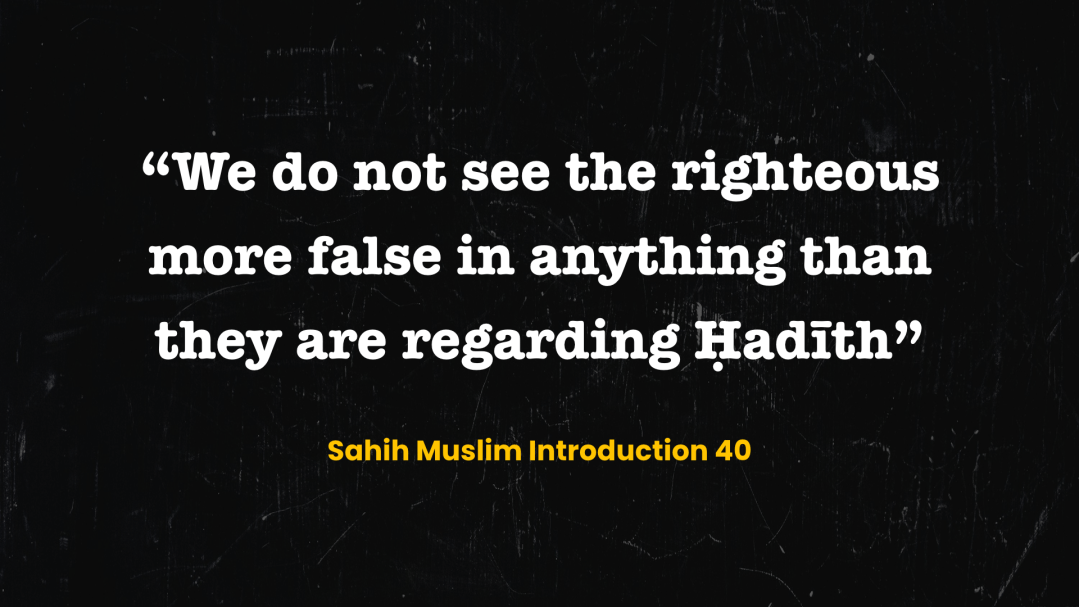
This problem was recognized even during the years Hadith were being compiled, more than a century after the Prophet’s death. The candid admission preserved in Sahih Muslim’s introduction is striking:
Muhammad bin Abī Attāb narrated to me, he said Affān narrated to me, on authority of Muhammad bin Yahyā bin Sa’īd al-Qattān, on authority of his father, he said: ‘We do not see the righteous more false in anything than they are regarding Ḥadīth’.
Ibn Abī Attāb said: ‘So Muhammad bin Yahyā bin Sa’īd al-Qattān and I met and I asked him about it and he said on authority of his father: ‘You will not see the people of good (Ahl ul-Khayr) more false in anything than they are regarding Ḥadīth.’ Muslim said: ‘He was saying that falsehood flows upon their tongues although they do not intend to lie’.
Sahih Muslim Introduction 40,
https://sunnah.com/muslim/introduction/39
Even the early scholars recognized that supposedly pious individuals were particularly prone to fabrication when it came to Hadith, because “falsehood flows upon their tongues” in the service of what they believe to be a righteous cause.
“The Orthodox Muslim” and the Fabricated Prophecy
Today, nowhere is dishonesty more prevalent than in the Sunni dawah scene. These individuals, die-hard adherents of their Sunni orthodoxy, seem unable to restrain themselves from engaging in deception.
Consider the recent incident involving someone who goes by the name “The Orthodox Muslim.” In a video published on October 29, 2025, titled “Proving Islam In 7 Minutes,” he attempted to use a Hadith regarding the siege of Basra by the Turks as prophetic evidence, claiming it foretold the Siege of Baghdad by the Mongols in 1258.
The problem? He pulled his diagram from Hadith Critic’s blog—a blog that explicitly demonstrates this Hadith was a fabrication. But he didn’t just use the image; he deliberately edited it to remove the differences in content between the various narrations of the Hadith, and then erroneously claimed that the content from all narrators was identical, thus “proving” it could not be a fabrication. This was not accidental borrowing. This was calculated deception.
Here is a video from Hadith Critic documenting this scandal.
Individuals like “The Orthodox Muslim” would be no different from the Hadith transmitters of the past. The fact that he had no problem concealing the truth he saw for himself and spreading lies he knew were false speaks volumes—not just about him, but about the human condition itself. History repeats: just as Hadith transmitters in the past were prone to deceptive tactics, so are Muslims today. Sunni Muslims of the present are living portraits of what the Sunnis of the past would have been when transmitting and fabricating Hadith—each making their own concessions to truth to match the narrative they wanted to propagate.
This is not an isolated incident. To quote Elon Musk’s apt metaphor: “What we have here is not an apple with a worm in it, but actually just a ball of worms. If you have an apple with a worm in it, you can take the worm out. If you have a whole ball of worms, it’s hopeless.”
The A.P. 259 Papyrus Deception
Every other day, individuals in the Sunni dawah scene demonstrate they cannot help themselves from blatantly lying to save face. In a previous article examining the papyrus fragment A.P. 259, I showed how Sunni apologists during a public debate quoted only the convenient portion of an academic study while concealing conclusions that undermine their narrative.
In this specific example—one among many—they eagerly highlighted a line from an article’s abstract suggesting a Hadith fragment dated to “the first century” Hijri. But they deliberately omitted the scholars’ actual palaeographic and isnād-based dating, which places the fragment squarely in the 2nd/8th to early 3rd/9th century—long after the Prophet. This wasn’t a casual oversight; the Hadith itself contained an isnad from this later timeframe, making it impossible for the fragment to be first-century. Yet, in the debate, they presented only a deceptive screenshot of the abstract, leading audiences to believe that the academic article proved a first-century Hadith fragment—all while knowing this was false. This selective citation was not a misunderstanding. It was a calculated attempt to manufacture the illusion of early Hadith documentation.
What makes this example significant is not the papyrus itself, but the behavior it exposes: even today, with access to full publications, digitized manuscripts, and instant verification, many Sunnis still distort evidence, cherry-pick quotes, and conceal context to defend preconceived doctrine. If this is how Hadith-defenders act now, under the pressure of modern transparency, what logical basis exists to assume that transmitters working centuries earlier—in environments of low literacy, political rivalry, sectarian pressure, and zero documentation standards—were any more honest?
The dishonesty we witness today is not an anomaly. It is a living continuation of the same cultural habits that produced the Hadith corpus in the first place.
The Mohammed Hijab & Sunni Dawh Crew Scandal
This pattern of deception is not confined to the lower ranks of the Muslim dawah scene. Even their most celebrated figures demonstrate far worse levels of lying, dishonesty, and manipulation.
Consider the case of Mohammed Hijab, a British Sunni Muslim dawah influencer known for his aggressive online debates and large following. In early 2025, he became embroiled in an explosive scandal when a woman identifying herself as “Sister Aisha”—a divorced Muslim woman vulnerable due to financial struggles and isolation in the UK—publicly accused him of manipulating her into a secretive Nikah Misyar marriage in 2022.
This form of contract, permissible in some conservative Islamic interpretations, allows a man to wed without providing full marital rights like cohabitation, financial support, or public acknowledgment. Critics often view it as a loophole for extramarital relations. Aisha claimed that Hijab, already married with children, approached her under the guise of genuine emotional and spiritual support, promising a fulfilling partnership while concealing the misyar’s restrictive terms. Over WhatsApp and in hotel meetings, he allegedly pressured her into sexual relations, treating the arrangement as a casual relationship devoid of commitment, while gaslighting her demands for equity as un-Islamic.
When she sought mediation from UK-based imams and scholars over a year later, they reportedly dismissed her due to Hijab’s influence, leaving her in emotional and health turmoil, including suicidal ideation. Her story broke via the YouTube channel Behind Veils on April 6, 2025, in the video “Deceived by Mohammed Hijab: The Secret Marriage That Broke Me.” She detailed the deception, shared leaked texts showing Hijab’s affectionate yet controlling messages, and challenged him to a mubahala—a solemn Islamic oath invoking divine curse on the liar. He ignored the challenge.
Hijab initially denied knowing Aisha, then pivoted to indirect responses through allies, releasing AI-generated voiceovers and edited videos portraying her as unstable or vengeful, without addressing specifics. His denial unraveled as further leaks emerged, including texts where Hijab admitted the union to confidants, and his father corroborated elements of her account in a subsequent Behind Veils video.
Rather than accountability, Hijab mobilized a vast network of dawah supporters in a coordinated cover-up. Leaked WhatsApp chats from a private “HP Dawah” group—revealed in July 2025 by Behind Veils in “The Da’wah Bros’ Leaked Messages: Collusion, Blasphemy, $uicide, X-Rated”—showed over 75 prominent figures actively colluding to discredit Aisha. These included close associates like Ali Dawah, Hashim (ScDawah), and Mohamed Mourad, as well as figures like Hamza Tzortzis and Adnan Rashid.
In these exchanges, dated from April onward, members:
- Fabricated evidence: Ali Dawah photoshopped screenshots to frame Aisha as an apostate plotting against Islam
- Shared vulgar jokes about her plight
- Strategized smear tactics: labeling her “mentally ill,” an “enemy of Islam,” or a forger of messages
- Brainstormed “spicy” sub-channels for explicit content to bury the story
- Dismissed her suffering: One chat captured Hijab saying, “If she’s an apostate and an enemy of Islam, we shouldn’t care” (in reference to her potential suicide), met with silence from the group
Ali Dawah, who had privately heard Aisha’s initial complaint in 2023 and feigned support before backing Hijab due to friendship, led public attacks. He accused her of consorting with “human satans” (anti-Islam critics) and invoked curses against her. Hashim orchestrated defamation by confirming the marriage privately while denying it publicly. Mourad posed as neutral before devoting videos to vilifying Aisha.
Even bystanders faced consequences. Sheikhs who showed sympathy were blackmailed. Dr. Abu Ayah issued a coerced AI apology recanting his support for Aisha, later revealing that Hijab had threatened to ruin his career. This machinery not only perpetuated the lie of Hijab’s innocence but weaponized Islamic rhetoric—accusations of apostasy, calls for divine retribution—to isolate Aisha, driving her deeper into distress. By mid-2025, the scandal had fractured online Muslim communities. Ex-Muslims and progressive voices amplified Aisha’s testimony, while Hijab’s core loyalists doubled down, framing critics as Islamophobes and ensuring the victim-blaming endured amid minimal institutional reckoning.
Conclusion: The Mirror Across Time
These examples reveal a disturbing pattern. They are not isolated incidents of individual moral failure. They are manifestations of a systemic cultural problem that has persisted for over a millennium.
The behaviors we witness in contemporary Sunni dawah—the deliberate falsification of evidence, the selective citation of sources, the coordinated campaigns to suppress inconvenient truths, the weaponization of religious rhetoric against victims, the protection of influential figures over vulnerable individuals—these are not aberrations. They are features of a tradition that has always prioritized the defense of inherited narratives over the pursuit of truth.
When Yahyā bin Sa’īd al-Qattān is said to have observed in the 2nd/8th century that “the righteous” were “more false in anything than they are regarding Hadith,” he was documenting the same phenomenon we see today. The psychological mechanisms are identical: in-group loyalty trumps honesty, the ends justify the means, and falsehood flows from the tongues of the pious “although they do not intend to lie.”
This is the key insight: most Hadith transmitters, like most modern dawah figures, probably did not see themselves as liars. They saw themselves as defenders of Islam, protectors of the Prophet’s legacy, warriors for truth. But their commitment to a predetermined conclusion made them incapable of honest inquiry. They became so invested in their narratives that they lost the ability to distinguish between what they believed should be true and what actually was true.
The question is no longer whether the early Hadith transmitters were capable of fabrication and distortion. The evidence from their own tradition answers that clearly. The question is: given what we observe today—in an age of literacy, documentation, instant communication, and public scrutiny—why would we assume they were any more honest when operating in an environment with none of these safeguards?
The modern Sunni dawah scene is not a corruption of an originally pure tradition. It is the continuation of that tradition in its truest form—a mirror reflecting back across the centuries, showing us exactly how the Hadith corpus was constructed in the first place.
When apologists fabricate evidence today, they are following in the footsteps of those who fabricated Hadith a thousand years ago. When they coordinate to suppress uncomfortable truths, they replicate the sectarian pressures that shaped the early collections. When they prioritize loyalty to their community over honesty, they embody the same tribalism that Muslim himself acknowledged caused “falsehood to flow upon their tongues.”
The tradition they claim to defend is, in reality, the tradition they perpetuate—not through their words about truth, but through their actions that reveal how little truth actually matters when it conflicts with belief.
Human nature has not changed. The environment has merely become more transparent, making visible what was always there. And what we see is not reassuring for those who would stake their faith on the reliability of human transmission across the centuries.
[4:135] O you who believe, you shall be absolutely equitable, and observe GOD, when you serve as witnesses, even against yourselves, or your parents, or your relatives. Whether the accused is rich or poor, GOD takes care of both. Therefore, do not be biased by your personal wishes. If you deviate or disregard (this commandment), then GOD is fully Cognizant of everything you do.

 Quran Talk Blog