The interpretation of the letter “Nun” (ن) at the opening of Surah 68 in the Qur’an has long intrigued scholars, mystics, and rationalists alike. Classical Islamic commentators such as Ibn Kathir, Al-Tabari, and Al-Qurtubi preserved a range of early opinions—some viewing it as a disjointed Arabic letter with unknown meaning, others presenting vivid cosmological imagery of the earth resting atop a giant whale named Nun. This peculiar interpretation also raises linguistic and conceptual parallels with the ancient Egyptian deity Nun, the god of the primordial waters.
This article was produced using ChatGPT’s Deep Research Tool, which compiles and analyzes classical Islamic texts, linguistic data, and cross-cultural mythological sources to provide a comprehensive and academically grounded examination. It explores the tafsir tradition surrounding Surah 68:1, the etymological roots of the word nun, and any potential (or coincidental) connections between Islamic cosmology and earlier mythologies like that of ancient Egypt.
Classical Exegesis of “Nun” in Surah Al-Qalam (68:1)
Surah 68 begins with the isolated Arabic letter Nun (ن), followed by an oath: “By the Pen and what they inscribe.” Early Islamic scholars offered multiple interpretations of this mysterious Nun, ranging from viewing it as a symbolic letter to identifying it with a cosmic creature. In classical tafsir (Qur’anic exegesis), it was common to cite various opinions, especially for the huruf al-muqatta‘at (disjoined letters) whose precise meanings are known only to Allah.
Ibn Kathir (d. 1373) – a prominent medieval commentator – records three main interpretations for Nun (wikiislam.github.io, quran.ksu.edu.sa):
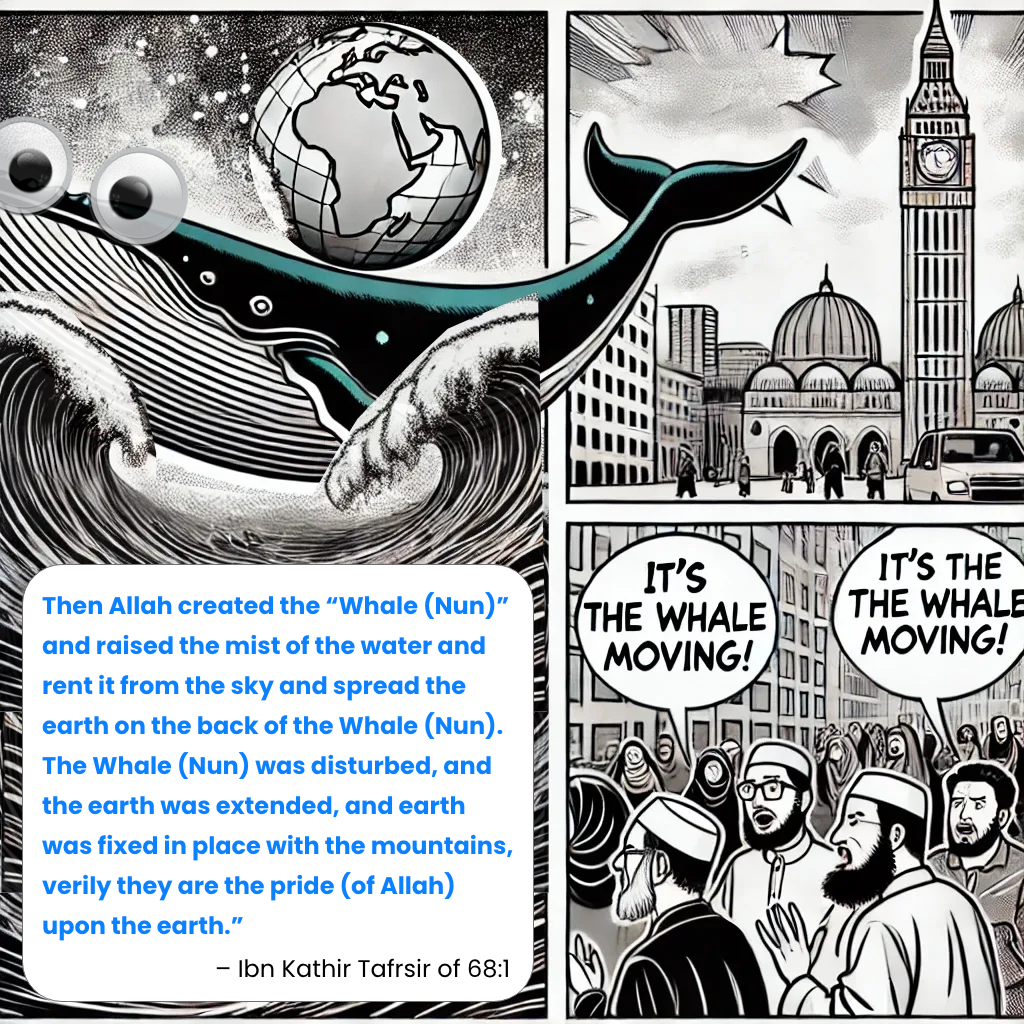
- Nun as a Colossal Whale: The first and most vividly detailed view holds that Nun is a great whale (al-ḥūt) floating on the primeval waters, upon whose back Allah placed the earth. Ibn Kathir, citing earlier authorities like Ibn ‘Abbas (the Prophet’s cousin), relates that “the first thing that Allah created was the Pen… then Allah created the ‘Nun’ and caused steam (vapour) to rise, from which the heavens were formed, and the Earth was then spread out flat on Nun’s back. Then Nun (the whale) became nervous and the earth began to sway, so Allah fixed the earth in place with mountains” (wikiislam.github.io, wikiislam.github.io). In another narration, “Allah… created the Nun (the whale) above the waters and pressed the Earth into its back”(wikiislam.github.io). Thus, some early Muslims envisaged a cosmology where a giant sea-creature named Nun carries the world, and the mountains serve as pegs stabilizing the earth (wikiislam.github.io, wikiislam.net). This remarkable image appears in multiple early sources: At-Tabari (d. 923) writes **“It [Nun] is a whale which carries the earth(s)”*(wikiislam.net), and Al-Qurtubi (d. 1273) likewise records that “Nun – the whale under the seventh earth” is one opinion (wikiislam.net). The seven earths were imagined like stacked layers resting on the whale’s back (wikiislam.net). Some reports even add that atop the whale stands a huge rock and a giant bull supporting the layers of earth (wikiislam.github.io) – an elaborate cosmic “stack” of whale, rock, bull, and flat earths.
- Nun as a Divine Instrument (Inkwell or Tablet): Another interpretation identifies Nun not as an animal, but as an object involved in writing divine decree. In one hadith narration (attributed to Abu Hurayrah), the Prophet ﷺ said “The first thing Allah created was the Pen, then He created Nun – and it is the inkwell (dawāt)” (quran.ksu.edu.sa, quran.ksu.edu.sa). In this view, “Nun” symbolizes an inkwell (or by some accounts, a tablet of light) from which the celestial Pen writes the fate of creation (quran.ksu.edu.sa, quran.ksu.edu.sa). Ibn Kathir notes a report (though mursal, i.e. lacking full chain) describing “Nun and the Pen” as “a tablet of light and a pen of light writing what is to be until the Day of Judgment” (quran.ksu.edu.sa). This interpretation conceptually pairs Nun (ink) with Al-Qalam (the Pen) in the verse – “the ink and the pen and what they write” (wikiislam.net). However, it remained a minority view; other scholars criticized it by pointing out that the Qur’an itself uses a different term for ink (midād, in 18:109) and even uses Nun elsewhere to mean “whale” (as seen below) (wikiislam.netwikiislam.net).
- Nun as a Mysterious Letter: Many classical scholars maintained that Nun is simply one of the Arabic alphabet’s mystery letters, with no specific meaning that can be determined. Ibn Kathir himself, after mentioning the above views, prefaces that Nun, like Ṣād or Qāf, can be understood as a letter opening the chapter (and Allah knows best) (quran.ksu.edu.sa). In other words, it could be part of the muqatta‘āt motif – the disjoined letters that appear at the start of 29 surahs – whose purpose or meaning is ultimately known only to God. This stance, often phrased as “Allahu a‘lam (Allah knows best)”, is an acknowledgement of the limits of interpretation (wikiislam.net). Indeed, some commentators explicitly say that after considering various theories, “the author (Allah) knows what He meant” (wikiislam.net).
Besides these, a few other opinions existed. For example, some early authorities suggested Nun is an oath (a waw al-qasam implied before Nun) – i.e. Allah swearing “by the letter Nun” – since the next word wal-qalam (“by the Pen”) is in the form of an oath (theislamissue.wordpress.com). Others fancifully proposed Nun could be the initial of one of Allah’s names (e.g. Nur, Najm, etc.), but such ideas were speculative and not widely accepted (theislamissue.wordpress.com). Overall, the two dominant interpretations in classical tafsir literature came to be Nun as a great whale versus Nun as an alphabetical letter whose exact meaning is unknown.
Tafsir Sources on Nun – A Comparative Summary
To appreciate how broadly the “whale” interpretation appeared, the table below compiles several key tafsirs and their explanations of Nun in Q68:1:
| Tafsir Source (Scholar) | Interpretation of “Nun” (Qur’an 68:1) |
|---|---|
| Al-Ṭabarī (d. 923) – Jāmi‘ al-Bayān | Cites multiple views. One explicitly states “Nun is the whale (al-ḥūt) that carries the [seven] earths” wikiislam.net. Also acknowledges the possibility that Nun is simply a letter or an oath, leaving the ultimate meaning to Allah. |
| Al-Qurṭubī (d. 1273) – Al-Jāmi‘ li-Aḥkām | Lists several opinions. Notably: “Nun: the whale which is under the seventh earth” wikiislam.net (attributed to Ibn ‘Abbas). He also mentions other interpretations (inkwell, etc.), but leans toward the safer view that these letters are muqatta‘āt whose true meaning is unknown (saying “Allah knows best”). |
| Fakhr al-Dīn al-Rāzī (d. 1209) – Tafsīr al-Kabīr | Discusses various theories. Includes the cosmological view that Nun is “the whale on whose back rests the earth, and it [the whale] is in a sea beneath the lower earth.” wikiislam.net This aligns with the layered-flat-earth-on-a-whale imagery. Razi often critiques weak reports, but he records this view as part of early cosmological opinions. |
| Ibn Kathīr (d. 1373) – Tafsīr al-Qur’ān al-‘Aẓīm | 1) Quotes the Ibn ‘Abbas narration of the cosmic whale Nun in detail wikiislam.github.io, wikiislam.github.io, describing how the earth was placed on its back and steadied with mountains. 2) Cites hadith reports identifying Nun as an inkwell or a tablet used with the Pen quran.ksu.edu.sa. 3) Refers back to the general notion of Nun as a disjoined letter, as discussed under Surat al-Baqarah quran.ksu.edu.sa. Ibn Kathir presents all these without decisively endorsing one, though he often prefers interpretations backed by sound hadith. |
| Al-Shawkānī (d. 1834) – Fatḥ al-Qadīr | Even in this later tafsir, the author notes various earlier opinions. He mentions that “Nun is the whale that carries the earth”wikiislam.net as one interpretation handed down in the tradition. (Shawkani, however, personally inclines to interpret Nun as one of the muqatta‘āt, cautioning against baseless myths.) |
| Early Authorities (Salaf) | Companions and Tābi‘īn: Numerous early narrations support Nun = a great fish. Ibn ‘Abbas reportedly said Nun was a whale under the earthwikiislam.github.io, and Mujāhid (d. 722) likewise “said, ‘It was said that Nun is the great whale beneath the seven earths.’”wikiislam.github.io. A mawqūf report from Abu Hurayrah describes the whale and even a bull and rock beneath the earthwikiislam.github.io. On the other hand, al-Ḥasan al-Baṣrī and Qatāda were among those saying Nun means an inkwell (dawāt) quran.ksu.edu.sa. Many others simply abstained, saying these letters are an oath or mystery known only to Allah wikiislam.net. |
Contextualizing the “Whale” Cosmology: The idea of a cosmic whale may sound astonishing, but it was part of the folkloric cosmology in early Islamic tradition (likely influenced by earlier cultures, as discussed below). This cosmology postulates a flat earth (actually seven flat earths) stacked on a giant creature. The Qur’an itself does not explicitly mention any whale holding up the world; however, believers who accepted this imagery saw indirect allusions to it in scripture. For instance, the Qur’an describes mountains as “pegs” stabilizing the earth (Q.78:6–7), which Ibn ‘Abbas reportedly linked to the idea that without mountains the earth would shake on the whale’s back wikiislam.net. Likewise, the Qur’an (11:7) says “His Throne was upon the waters” before creation, which commentators interpreted in light of the primordial ocean from which creation began wikiislam.net. Thus, the Nun whale narrative was used to explain such verses: Allah created Nun (the primal water/creature), then placed the earth on it and anchored it with mountains, and from the waters raised up the heavens wikiislam.github.io wikiislam.github.io. Classical scholars transmitted these stories to illustrate God’s power in creation, even if the reports were isrā’īliyyāt (of Judeo-Christian origin) or weak; it was generally held that since the Qur’an itself doesn’t clarify Nun’s meaning, one could mention such historical interpretations but ultimately say “Wallāhu a‘lam” (Allah knows best) wikiislam.net.
Linguistic Links: Arabic Nun and the Idea of a Fish/Whale
It is not by random chance that some Muslims thought of a fish when they saw “Nun” in 68:1. In Semitic languages, the word nūn itself has ancient associations with fish. In Aramaic (the language of the Talmud) as well as in Syriac and Akkadian, nūn means “fish.” In fact, the letter name Nun (נון) in Hebrew and Aramaic literally denotes a fish, and the original Phoenician letter N was likely named nun meaning “fish” (though possibly derived from a pictograph of a snake or eel in Egyptian hieroglyphics) en.wikipedia.org. Arabic retained a memory of this meaning: while the common Arabic word for whale/fish is ḥūt, the Qur’an itself uses “Nun” as a byname for a big fish. Notably, Prophet Jonah (Yūnus) is called “Dhū al-Nūn” – “the Man of the Fish” – in Qur’an 21:87, and Qur’an 68:48 also refers to Jonah obliquely as “the Companion of the ḥūt (fish)”. In a hadith about the Hereafter, the Prophet answers that the first meal in Paradise will be “the extra lobe of the liver of al-Nūn”, which scholars understand to mean a giant fish (whale) whose liver will feed the people of Paradise wikiislam.net, wikiislam.net. All these instances show nun was a known term for “big fish/whale.”
Given that background, some early exegetes read “Nun. By the Pen…” as if it were invoking a whale and a pen – perhaps imagining a scene of cosmic writing: a divine Pen writing on an expansive fish or on a tablet resting on a fish. While such an image is not explicit in the Qur’anic text, it was a way to “fill in” cosmological details consistent with the linguistic connotations of nun. Modern scholars note that grammatically, if nūn were taken as a noun (e.g. nun = “ink”), the verse could be rendered “By the ink and the pen and what they write,” but the stronger classical understanding was that Nun here is an abbreviated letter (like the “N” at the start of a chapter) wikiislam.net. The connection to a whale was drawn from tafāsīr and athar (narrations), not from the Quranic grammar itself.
The Ancient Egyptian Nun and Primordial Waters
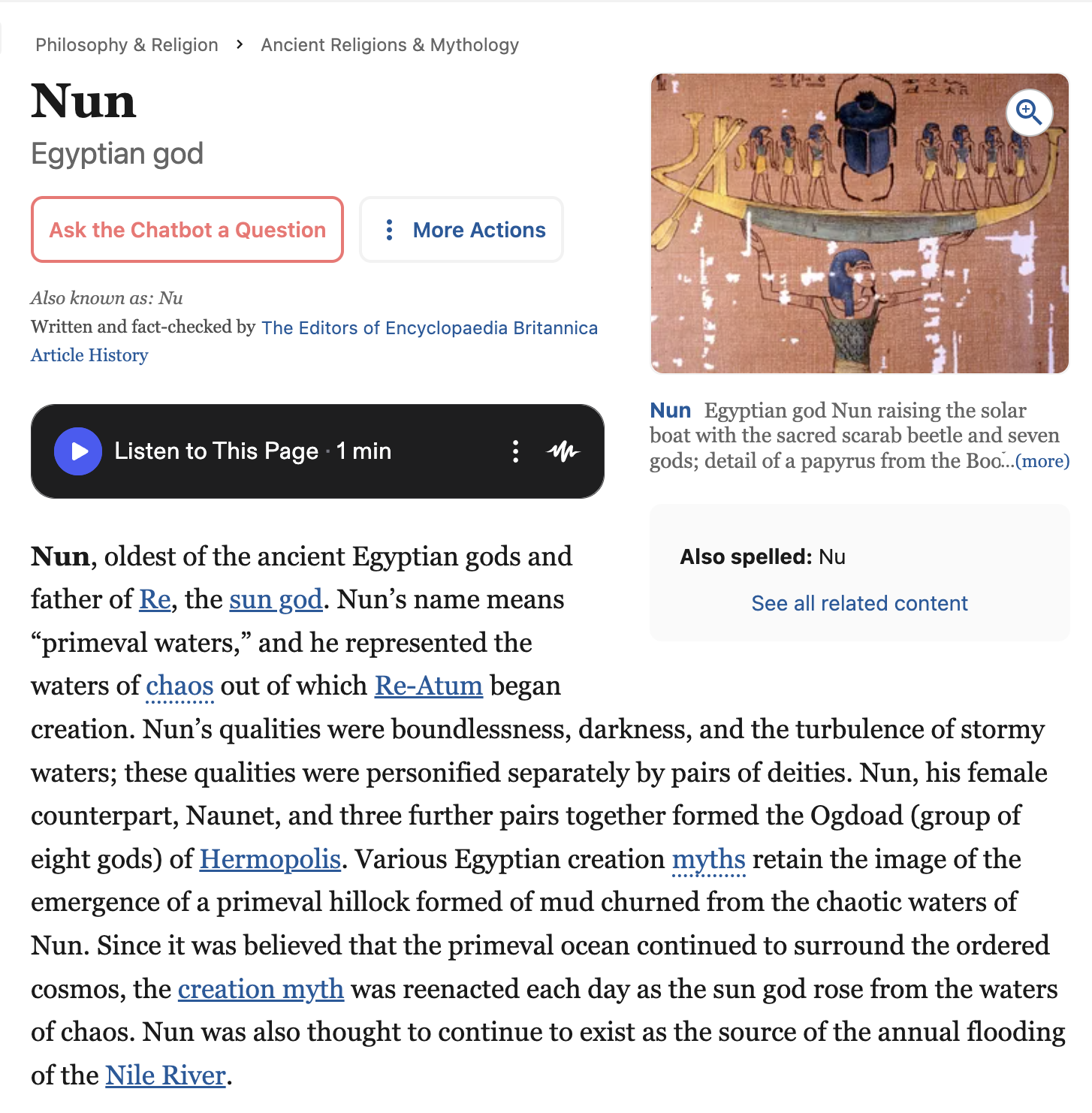
It is interesting that the Arabic word Nun (نُون), associated with a fish and primordial waters in Islamic lore, sounds identical to “Nun” in ancient Egyptian mythology – but here the similarity is largely coincidental and linguistic, rather than a direct borrowing. In ancient Egyptian religion, Nun (also called Nu) is the name of the primordial watery abyss, the boundless chaos of waters that existed before creation. The Egyptian god Nun personifies this chaotic ocean. Creation myths from pharaonic Egypt describe how in the beginning there was only dark, limitless water (Nun), from which the first land (the benben mound) emerged and on which the sun god Ra arose en.wikipedia.org, en.wikipedia.org. In other words, **Nun was the cosmic waters of chaos – teeming with potential but inert until the creator spoke the world into existence. Egyptian texts often depict Nun lifting up the solar barque (the boat carrying the sun deity) from the waters at the dawn of time en.wikipedia.org, en.wikipedia.org. Nun was not a fish in that tradition, but a water god – usually illustrated as a male figure standing in water or lifting the sun.
Ancient Egyptian depiction of Nun, god of the primordial ocean, lifting the sun god’s barque at the moment of creation (Book of the Dead of Anhai, c. 1050 BCE) commons.wikimedia.org. In Egyptian cosmology, “Nun” is the infinite dark waters of chaos from which the first land and sun emerged.
Etymologically, the Egyptian Nun (written nnw in hieroglyphs) is unrelated to the Semitic nun. The Egyptian term is thought to be linked to their word for “inactivity” (nen) – a wordplay in ancient texts: “I raised them up out of the watery mass (nu), out of inactivity (nen)” en.wikipedia.org. It also parallels the Coptic word for “abyss, deep” en.wikipedia.org. By contrast, the Semitic nun (“fish”) has its roots in the Proto-Semitic lexicon and possibly in ancient alphabet symbols. Thus, any phonetic resemblance between the two is likely coincidental. There is no historical evidence that Arabian audiences in the 7th century would have been aware of Egyptian creation deities like Nun, especially given the lapse of time and the difference in cultural contexts. The Qur’an and Hadith do not mention Egyptian cosmology by name.
However, on a conceptual level, one can draw some intriguing parallels. Both Egyptian mythology and Islamic cosmology (in some exegeses) envision primordial waters at the origin of creation, with a central role in cosmogony. In Egyptian belief, “before creation, the universe was an endless, formless expanse of dark, swirling waters known as Nun, symbolizing chaos and potential… life emerged from the waters of Nun.” egypttoursportal.com. In Islamic thought, we find a hadith stating “There was Allah, and nothing existed before Him, and His Throne was on the water” (reported in Ṣaḥīḥ al-Bukhārī), and as noted, Qur’an 11:7 says “His Throne was on water”. Additionally, the Nun whale legend has the earth resting on a great ocean (sometimes called “water of chaos” in later writings) wikiislam.net, wikiislam.net. So both traditions involve a primeval sea – in Egypt it is personified as a god named Nun, in Islamic lore it is a creation of God (sometimes associated with a great creature within it).
Could the **“Nun” of the Qur’an’s opening be referencing a similar primordial water or chaos? Traditional Muslim scholars did not explicitly make an Egyptian connection. Instead, if they considered Nun as representing something cosmic, they explained it through their own religious heritage: e.g. linking it to the waters beneath the earth mentioned in hadith and the idea of the world’s foundations. The Quranic Nun was generally either left undefined or explained via Islamic narratives (Pen and whale, etc.) without invoking foreign gods.
Cross-Cultural Parallels and Possible Influences
The imagery of a cosmic aquatic creature supporting the world is not unique to Islam. It appears in various ancient cultures, which has prompted scholars to consider whether the Islamic Nun legend was influenced by earlier myths (directly or via Judeo-Christian transmission):
- In ancient Mesopotamia, the creation epic describes a primeval ocean goddess Tiamat (a dragon/serpent of chaos) and Apsu (the deep). The world is formed from their waters. While Mesopotamian myths don’t have a whale holding up earth, they do have the concept of a cosmic ocean and monsters of the deep which could parallel the idea of a giant water-creature.
- In Jewish tradition, the Bible speaks of Leviathan, a monstrous sea-serpent. Although the Bible does not say Leviathan supports the earth, later Jewish legends come closer. For example, a rabbinic text (Pirke de-Rabbi Eliezer, 8th century) says: “On the fifth day God brought forth the Leviathan, the flying serpent, and its dwelling is in the lowest waters; and between its fins rests the middle bar of the earth.” wikiislam.net. Here we see a notion that the earth’s stability (the “middle bar”) somehow lies upon a giant sea-creature – remarkably similar to the Nun whale holding the earth. This suggests the possibility that the early Muslim narrations about Nun were influenced by Israelite cosmological lore (isrā’īliyyāt). In fact, some modern Muslim writers have opined that Ibn ‘Abbas or other transmitters may have heard such stories from Jewish informants wikiislam.net. While Leviathan in Jewish myth is not exactly a whale (often depicted as a dragon or huge fish), the overlap in concept (a marine creature and the earth’s support) is noteworthy.
- In Indian (Hindu) mythology, the world is famously said to be supported by animals: one ancient Hindu cosmology describes the earth being carried by elephants, which stand on the back of a cosmic tortoise (or turtle) named Akūpāra, floating in an infinite sea. Some versions even have a serpent (Ananta or Shesha) below the turtle. This “World-Turtle” motif is another instance of an animal holding up the earth wikiislam.net.
- In Chinese mythology, there is a tale of the cosmic turtle Ao, whose legs were cut off to use as pillars to hold up the sky after a great flood, thereby stabilizing the world wikiislam.net.
Given such widespread motifs, scholars of comparative religion view the “earth-bearing whale” as part of the broader mythological theme of a World-Carrier – akin to world-serpents, world-turtles, or giants holding up the earth in various cultures wikiislam.net. The specific form varies (whale, fish, snake, turtle, bull, etc.), but the function is the same: explaining what lies beneath the earth and what keeps it stable. This theme addresses a common ancient question: “If the earth is flat, what does it rest on?” Each culture answered according to its environment and imagination – seafaring people might say a fish, others said a turtle or an ox, etc.
For Arabia and the early Muslim milieu, whales/fish and bulls were known symbols (there are pre-Islamic Arabian legends of a giant bull named Bahamut or Bahamūt, often conflated with the Qur’anic Nun in later folklore). The Qur’an does not endorse these specific images, but it doesn’t explicitly refute them either, so early storytellers filled the gap. Ibn Kathir, after describing the Nun and the layers of creation, actually acknowledges the fantastical nature of it and adds “Allah knows best” wikiislam.net, subtly indicating that such details are not firm doctrine but illustrative.
As for ancient Egyptian “Nun”, there is no direct evidence that the Qur’anic usage was consciously connected to it. By the Prophet Muhammad’s time, knowledge of Egyptian cosmogeny would have been limited in Arabia. The term nūn in Arabic already meant “fish/whale” in a Semitic context independently of Egyptian mythology. Thus, any overlap with the Egyptian idea of Nun as primordial water is likely analogous rather than genealogical. Both civilizations arrived at the notion of primeval waters, but one personified it as a god (Nun), while the other (in Islamic narration) described a created ocean and creature (Nun the whale) under Allah’s Throne.
It is worth noting, however, that modern researchers have pointed out how the Quranic creation imagery resonates with Near Eastern motifs. The Qur’an’s mention of waters, throne, darkness, and the word “Be” in creation has parallels in Biblical and extra-biblical lore. Some historians of religion propose that the Nun whale story in Islamic tradition could have been inspired by Jewish aggadic tales or other Near Eastern cosmologies that filtered into early Muslim exegesis wikiislam.net, wikiislam.net. The Apocalypse of Abraham (a Jewish pseudepigraphic text, ~2nd century CE) is sometimes cited as containing concepts of multiple layers of heaven and earth and possibly a great sea creature, which might be an antecedent to these ideas wikiislam.net. That said, the primordial ocean is such a universal concept (appearing in Mesopotamian, Egyptian, Greek, and Indian creation stories) that it may have independently arisen in an Arabian context as well.
In summary, classical Islamic scholarship treated “Nun” in Surah 68:1 primarily as either an unknown divine symbol or as an allusion to a cosmic whale carrying creation by Allah’s power. Ibn Kathir and other early exegetes did mention the whale narrative – attributing it to venerable sources like Ibn ‘Abbas – but usually without declaring it an article of faith, simply as one interpretative story among others. When we step back and look at cross-cultural parallels, we find that this idea of a world-bearing aquatic creature, as well as the notion of primordial waters, is part of a broader human cultural heritage. The ancient Egyptian Nun represents the waters of chaos from which life springs egypttoursportal.com, and intriguingly, the Arabic Nun surfaces in tafsir as a whale in a cosmic ocean helping inaugurate creation wikiislam.github.io, wikiislam.github.io. There is no known etymological link between the two beyond the name, but the cosmological imagery – water beneath earth, a great creature of the deep, mountains or gods ensuring stability – shows a thematic harmony. Scholars today emphasize that such Quranic interpretations should be understood in their historical context: they reflect the early Muslim engagement with cosmology, using the language and myths available to them to glorify Allah’s creative power, rather than a doctrinal assertion about the physical world. As with all the muqatta‘āt, the safest conclusion of the classical commentators after exploring these fascinating possibilities was ultimately: “Allāhu A‘lam” – God knows best wikiislam.net.
Sources:
- Ibn Kathir, Tafsīr (on Quran 68:1), citing narrations from Ibn ‘Abbas, et al. wikiislam.github.io, wikiislam.github.io, wikiislam.github.io.
- Al-Tabari, Jāmi‘ al-Bayān (commentary on 68:1) – multiple opinions including Nun = whale wikiislam.net.
- Al-Qurtubi, Tafsīr (68:1) – notes Nun as “the whale under the seventh earth” among other views wikiislam.net.
- Fakhr al-Din al-Razi, Mafātīḥ al-Ghayb – mentions the whale carrying earth in a sea under it wikiislam.net.
- WikiIslam compendium, “The Islamic Whale” – summary of classical reports (Ibn Kathir, Qurtubi, etc.) wikiislam.github.io, wikiislam.github.io.
- Qur’an 21:87 and 68:48 – use of “Nun”/“ḥūt” for the Fish of Jonah wikiislam.net.
- Sahih Muslim 3:614 – hadith of the whale’s liver as food for Paradise dwellers wikiislam.netwikiislam.net.
- Wikipedia, “Nun (letter)” – on nun meaning “fish” in Semitic scriptsen.wikipedia.org.
- Wikipedia, “Nu (mythology)” – on Egyptian Nun as personification of primordial waters en.wikipedia.org.
- Egyptian Mythology – Creation Story (Egypt Tours Portal, 2018) – description of Nun as endless dark waters of chaos egypttoursportal.com.
- Pirke de-Rabbi Eliezer, ch. 9 – Leviathan’s fins holding the earth’s “middle bar” wikiislam.net.
- Comparative mythology notes on world-bearing creatures (WikiIslam) wikiislam.net.

 Quran Talk Blog