
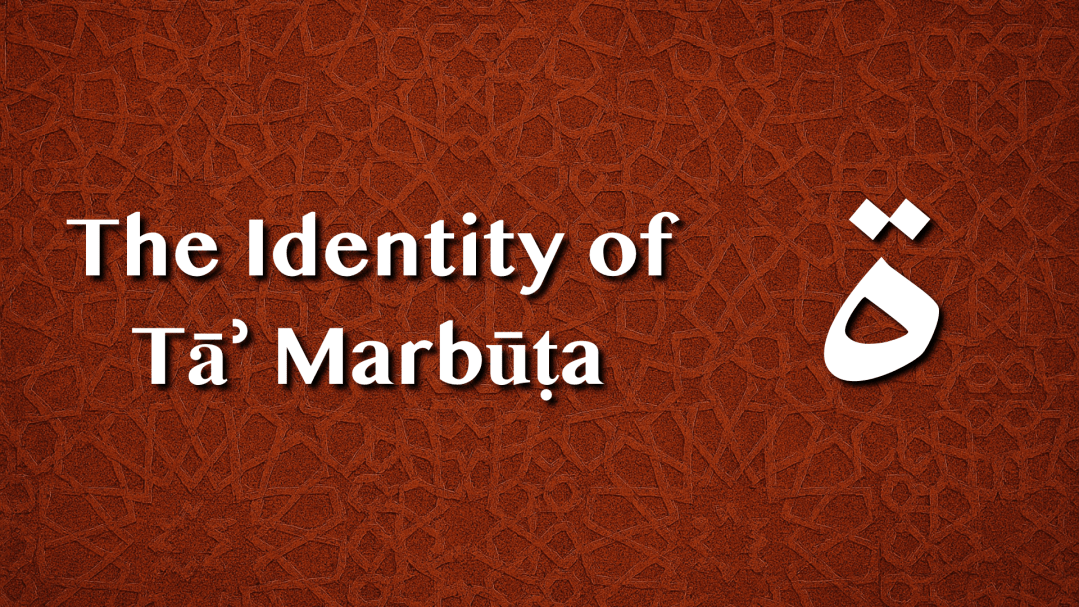
The tāʾ marbūṭa (ة) is commonly described as a grammatical variation of tāʾ (ت), functioning as a feminine marker at the end of many Arabic nouns and adjectives. However, a closer examination of its behavior in script, pronunciation, numerical value, and historical linguistics reveals a more complex identity. Though it plays a feminine grammatical role typically associated with tāʾ, its visual form, phonological shifts, and structural constraints strongly align it with hāʾ (ه).
This article will demonstrate that the tāʾ marbūṭa should not be understood merely as a modified tāʾ, but rather as a grammatical suffix that is historically, visually, and phonetically closer to hāʾ. By examining how this letter was used in early Qur’anic manuscripts, phonological behavior in pause, Abjad numerology, morphological limitations, and parallels in other Semitic languages, this study reevaluates the true nature of the tāʾ marbūṭa to demonstrate that this letter should be associated with hāʾ (ه) and not tāʾ (ت).
Orthography: Visual Identity with Hāʾ
This association with hāʾ is particularly evident in early Qur’anic manuscripts written in the rasm script, the original consonantal skeleton of Arabic writing that omitted diacritical marks. In these manuscripts, the tāʾ marbūṭa and final hāʾ were written identically, without any graphic distinction. In contrast, the standard tāʾ was increasingly marked with two diacritical dots above, especially as dotting conventions became more standardized. The visual indistinguishability of tāʾ marbūṭa from hāʾ, and its contrast with the carefully marked tāʾ, suggest that early scribes did not consider tāʾ marbūṭa to be a true variant of tāʾ, at least in its written form.
Phonology: Behavior in Pause
Phonologically, the tāʾ marbūṭa also behaves more like hāʾ. In pause (waqf), where pronunciation naturally softens or ends, the tāʾ marbūṭa shifts from /t/ to /h/ or becomes silent altogether. This is in direct contrast to tāʾ, which retains its /t/ sound regardless of position. The shift from tāʾ to hāʾ in final pronunciation mirrors a broader Semitic pattern, where feminine markers soften or reduce in final position. The default or resting pronunciation of tāʾ marbūṭa, therefore, aligns more closely with that of hāʾ than with tāʾ.
Gematrical Value: Abjad Alignment
This perception is further reinforced by gematrical values in the Abjad system, an alphanumeric tradition in which each Arabic letter is assigned a numerical value. While the letter tāʾ (ت) has the value 400, the tāʾ marbūṭa is traditionally assigned the value 5, the same as hāʾ (ه). This gematrical equivalence reflects how scholars and scribes historically understood the letter in symbolic and numerical contexts. The assignment of the value for tāʾ marbūṭa to match hāʾ rather than tāʾ further supports the view that it was regarded as a form of hāʾ, despite its feminine grammatical function.

Structure: Limited Morphological Role
From a structural and morphological perspective, the tāʾ marbūṭa also diverges from standard tāʾ. It only appears in final position and never occurs at the beginning or middle of a word. It is also never used as part of a triliteral root—another trait that distinguishes it from fully phonemic letters like tāʾ. Instead, it functions strictly as a grammatical suffix, and its form—undotted, round, and terminal—is identical to the final form of hāʾ. These limitations in position and function reinforce the idea that tāʾ marbūṭa is not a full letter variant, but rather a fixed suffixal marker whose written and structural behavior mirrors that of hāʾ.
Semitic Parallels: Cross-Linguistic Evidence
A compelling case for associating the Arabic tāʾ marbūṭa (ة) with hāʾ (ه) rather than tāʾ (ت) emerges when viewed through the lens of related Semitic languages—especially Hebrew and Aramaic. These languages preserve a nearly identical morphological pattern: the use of a feminine suffix originating in -t, which shifts phonetically to a /h/ or silent form in pause, and is written with a letter equivalent to Arabic hāʾ (هـ). This cross-linguistic consistency confirms that Arabic’s tāʾ marbūṭa is not an isolated innovation but part of a broader Semitic tendency to represent the feminine suffix as a form of hāʾ in writing, while retaining its /t/ function in connected speech.
In Hebrew, for example, feminine nouns typically end in -ה (heh), such as מַלְכָּה (malkáh, “queen”). This reflects a pausal form in which the original feminine suffix -t is softened or dropped. However, when the noun appears in construct form (a grammatical structure indicating possession or close relationship between nouns), the /t/ reemerges: מַלְכַּת שְׁבָא (malkat Sheva, “Queen of Sheba”). This alternation between /h/ and /t/—and the use of the letter heh rather than tav (ת) in the base form—directly parallels the Arabic tāʾ marbūṭa, which is pronounced as /h/ in pause and /t/ in iḍāfa or other connected constructions. A similar pattern appears in the word Torah (תורה) and its construct form his Torah (תורתו), where the final /h/ reverts to a /t/.
Aramaic exhibits the same pattern. Feminine nouns commonly end in -āh or -ā, written with heh, and in pause this ending is pronounced as /h/ or silent. Yet in emphatic or construct forms, the original /t/ surfaces again. As in Hebrew, the suffix is written with a character corresponding to Arabic hāʾ, not tāʾ, showing that the visual representation of the feminine ending is aligned with hāʾ, even while its grammatical function stems from -t.
These linguistic parallels powerfully reinforce the argument that Arabic’s decision to represent the feminine suffix with the visual form of hāʾ was not arbitrary. Rather, it reflects a shared Semitic pattern—one that Arabic uniquely made explicit by creating a distinct hybrid letter: the tāʾ marbūṭa, which combines the shape and pausal sound of hāʾ with the grammatical function of tāʾ. While the origin of the suffix is indeed tied to tāʾ, its phonological behavior and graphic identity consistently align with hāʾ in Hebrew, Aramaic, and Arabic alike.
In this light, Arabic’s tāʾ marbūṭa should not be viewed merely as a softened form of tāʾ, but as a deliberate scriptural embodiment of a well-established Semitic linguistic behavior. This cross-linguistic evidence strengthens the claim that the tāʾ marbūṭa is more accurately understood as a form of hāʾ in writing and sound, even as it retains the feminine grammatical role tied to tāʾ.
| Language | Feminine Suffix (Written) | In Pause | In Construct/ Connection | Script Letter Used |
|---|---|---|---|---|
| Hebrew | -ה (heh) | /h/ or silent | ת (/t/) reappears | ה (heh) |
| Aramaic | -āh / -ā | /h/ or silent | /t/ reappears | ה (heh) |
| Arabic | -ة (tāʾ marbūṭa) | /h/ or silent | /t/ reappears | ه (hāʾ) |
Anticipated Objections and Clarifications
While the argument that the tāʾ marbūṭa (ة) is more closely aligned with hāʾ (هـ) than with tāʾ (ت) may seem to challenge long-held grammatical conventions, it is important to clarify the scope and basis of this claim. This study does not dispute the well-established origin of the feminine suffix -t or its grammatical role as a marker of femininity derived from tāʾ. Rather, it highlights how Arabic—uniquely among Semitic languages—visually encoded the suffix’s phonological behavior and structural constraints by giving it the form of hāʾ. In pause, where this suffix is pronounced as /h/ or becomes silent, Arabic reflects this shift not just phonetically but orthographically, in contrast to related languages like Hebrew and Aramaic, which write the suffix with heh (ה) but do not distinguish it as a separate letter.
Some may argue that the pausal pronunciation is merely a contextual phonological feature and not grounds for reclassifying the letter. However, Arabic’s deliberate choice to represent the suffix with a rounded, undotted shape identical to final hāʾ shows a conscious effort to align script with sound. Similarly, while Abjad numerology is symbolic rather than grammatical, the fact that tāʾ marbūṭa consistently shares the value of 5, like hāʾ, rather than 400, like tāʾ, indicates a scribal and conceptual identification with hāʾ, even in abstract representations.
Ultimately, the tāʾ marbūṭa is best understood as a hybrid form: grammatically linked to tāʾ in origin and function, but realized in script and pronunciation in a way that firmly associates it with hāʾ. This duality is not a contradiction but a reflection of Arabic’s nuanced integration of historical grammar, phonology, and script design—a synthesis that reinforces rather than undermines the claim that ta marbuta belongs more naturally to the orbit of hāʾ.
Conclusion: A Suffix Associated with Hāʾ
Taken together, these orthographic, phonological, numerical, and comparative linguistic observations all point toward the same conclusion: the tāʾ marbūṭa should not be regarded merely as a soft or decorative form of tāʾ, but rather as a grammatical suffix more closely aligned with hāʾ in both historical usage and linguistic behavior. It occupies a unique position in Arabic writing—one that reflects its complex origin and reinforces the richness of the Arabic script’s morphological heritage.

 Quran Talk Blog