
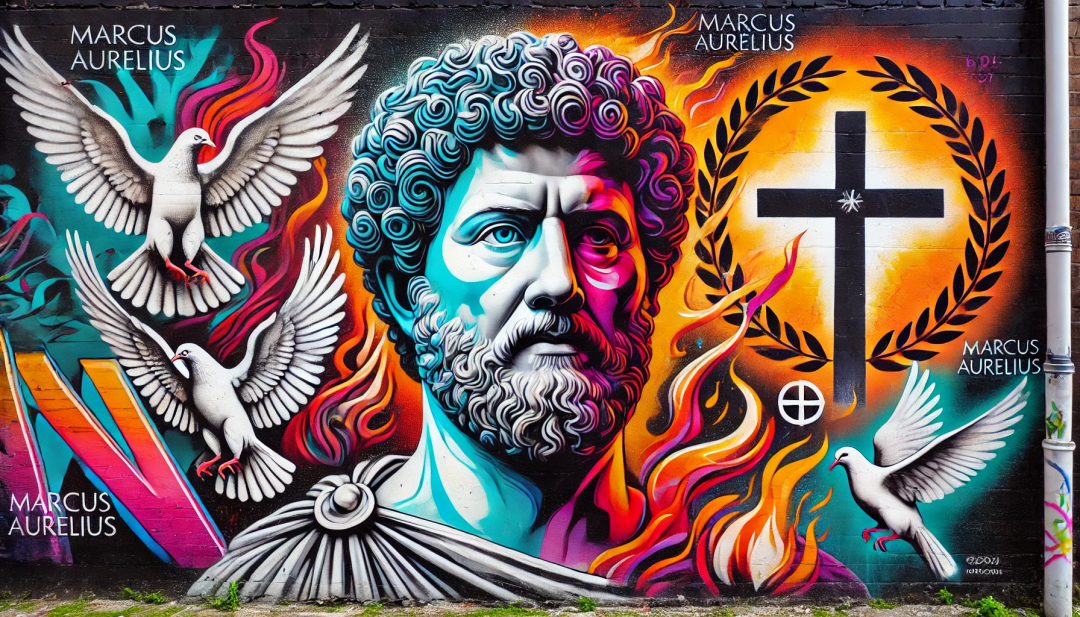
In the annals of history, Marcus Aurelius (r. 161-180 CE) stands as a paragon of wisdom and virtue, revered for his stoic resilience, philosophical depth, and steadfast governance during a tumultuous era of the Roman Empire. Born in 121 CE, Marcus rose to power as Rome’s emperor in 161 CE, leading with a profound commitment to Stoicism—a philosophy emphasizing rationality, self-discipline, and the acceptance of life’s trials with equanimity. His Meditations, a collection of personal reflections written amid the strains of war, remains a cornerstone of Western philosophy, inspiring leaders, thinkers, and lay readers alike.
Yet, within this gilded portrait of the philosopher-king lies a shadow that few admirers acknowledge: the persecution of early Christians under his reign. While celebrated for his intellectual and moral ideals, Marcus Aurelius presided over a period of religious intolerance that brought immense suffering to a burgeoning faith community.
Marcus Aurelius and the Rise of Christianity
By the time Marcus Aurelius ascended the throne, Christianity, though still a minority religion, was spreading across the Roman Empire. Its adherents rejected Roman polytheism, refused to participate in civic rituals honoring the emperor as a quasi-divine figure, and maintained a steadfast allegiance to a single, unseen God. To Roman authorities, these practices appeared subversive, threatening the social and political fabric of an empire deeply entwined with traditional religious practices.
Christianity’s Challenge to Roman Pluralism
To understand the conflict between Christianity and Roman society during Marcus Aurelius’s reign, it is essential to grasp the fundamentally different nature of Christian belief compared to the prevailing pagan religions. Roman religion was inherently pluralistic and deeply intertwined with civic life. The various gods were understood as patrons of specific cities, regions, or functions, and Romans, like most ancient peoples, readily accepted the deities of other cultures into their pantheon. Religion, for the Romans, was less about personal salvation or exclusive truth and more about public duty and social cohesion. Participation in religious rituals, from household offerings to grand civic sacrifices, was seen as an essential contribution to the collective well-being of society.
In stark contrast, Christianity—and to an extent Judaism—refused to tolerate the existence of multiple deities. Both were conceptually monotheistic, declaring the worship of any god other than their own as idolatry. For Jews, this exclusivity was somewhat tolerated by the Romans due to their ethnic and geographic separateness. Judaism was regarded as the ancestral faith of a distinct people, and Romans extended a grudging respect to its ancient customs. While Jews did not participate in Roman civic religion, their separateness as an ethnic group made their nonconformity less socially disruptive. They were outsiders, and their exemption from Roman religious practices did not challenge the core identity of Roman citizenship.
Christianity, however, presented an entirely different problem. Christians were Romans—not ethnically distinct, but members of the same cities, trades, and households. Unlike the Jews, their refusal to participate in Roman civic practices was not confined to a specific ethnic enclave; it came from within the heart of Roman society itself. Christians rejected Roman gods, refused to perform sacrifices to honor the emperor, and abstained from festivals and rites integral to public life. To the Romans, these refusals were not just acts of religious defiance but breaches of their social contract, threatening the unity and stability of the empire.
The Social and Economic Consequences of Christian Nonconformity
The refusal of Christians to partake in Roman civic religion had profound social and economic implications. Roman civic life revolved around religious festivals, public sacrifices, and rituals that not only honored the gods but also reinforced social bonds and civic identity. Participation in these practices was a way of affirming one’s loyalty to Rome and one’s place in the community. Christians, by abstaining from these rituals, were seen as outsiders—even traitors—despite being fully Roman in all other respects.
This dissonance created a unique tension. Christians were not foreign invaders or ethnic minorities; they were Romans who appeared to reject the very essence of Roman identity. Their refusal to honor the emperor through sacrifices was interpreted not just as religious obstinance but as political disloyalty. In a culture where religion and politics were inseparable, such defiance undermined the fabric of Roman society.
Economically, the Christians’ stance disrupted traditional industries and practices. Many trades and professions were closely tied to religious rites, from the production of idols to the organization of festivals. Christians’ abstention from these practices caused friction in guilds, marketplaces, and public events, where shared participation in rituals was often a prerequisite for professional and social engagement. Their non-participation could mean fewer offerings, disrupted festivals, and even a decline in civic revenues.
Furthermore, their rejection of polytheistic norms and exclusive allegiance to Christ fostered apprehension among their pagan neighbors, who viewed them as a source of divine wrath. In a polytheistic worldview, the gods demanded collective veneration to ensure prosperity and avert disaster. The Christians’ refusal to appease these gods was often blamed for natural calamities, plagues, and military defeats. This scapegoating, combined with their perceived disloyalty, fueled resentment and violence against them.
Christians as “Roman Yet Not Roman”
The core of Roman apprehension lay in the paradox of Christian identity: they were Romans who, by their beliefs, acted as though they were not. This internal challenge was far more disconcerting than the external separateness of Judaism or the pantheons of conquered peoples. Christianity’s growth within the Roman Empire made it appear insidious—an ideological threat capable of undermining the empire from within.
To many Romans, the Christians’ defiance struck at the heart of what it meant to be Roman. Their faith was not merely a private matter but a public disruption. Unlike the pagans who could adapt to one another’s gods and practices, Christians demanded a total allegiance to their singular God, refusing to accommodate or assimilate. This exclusivity, coupled with their rapid growth and their refusal to participate in the collective rituals that defined Roman civic identity, positioned Christianity as an existential threat to the unity of the empire.
This tension—being Roman yet rejecting Roman religious and social norms—explains why Christians faced such intense persecution. Their distinctiveness was not geographic, ethnic, or cultural but ideological, and for a society like Rome, which prized unity and tradition, this was a deeply unsettling challenge. In this sense, the persecution of Christians under Marcus Aurelius and other Roman emperors was not simply a matter of religious intolerance but a clash of worldviews, a conflict between the pluralistic pragmatism of Rome and the uncompromising exclusivity of the Christian faith.
The Persecutions under Marcus Aurelius
The tension between Rome and the Christians was exacerbated during Marcus Aurelius’s reign, a period marked by external wars, economic instability, and recurring plagues. In such times, Romans often sought solace in their gods, performing public sacrifices and ceremonies to secure divine favor. Christians, by abstaining from these rites, were perceived as not only defiant but potentially responsible for divine displeasure—a convenient scapegoat for Rome’s misfortunes.
Though Marcus Aurelius is not personally recorded as issuing explicit orders to persecute Christians, his administration oversaw some of the most brutal crackdowns on the faith. Historical accounts suggest that he tacitly condoned these actions, aligning with the traditional Roman worldview that sought to preserve unity through religious conformity.
The second-century Christian apologist Tertullian (d. ~220 CE) highlights the era’s hostility, accusing Roman authorities of targeting Christians to placate public unrest. Similarly, the Church historian Eusebius (d. ~339 CE) records harrowing instances of martyrdom during Marcus’s rule, including the deaths of prominent figures like Justin Martyr (d. ~165 CE), a former philosopher turned Christian apologist, who was executed in Rome for refusing to renounce his faith.
In the provinces, persecution took on even grimmer dimensions. The Martyrs of Lyons (177 CE) provide a chilling example. In this Gallic city, Christians were subjected to mob violence, imprisoned, and tortured. Blandina, a slave girl, became an enduring symbol of courage when she endured repeated torment yet refused to recant her faith, reportedly saying, “I am a Christian; we have done nothing wrong.”
Marcus Aurelius’s Contradictions
How does one reconcile Marcus Aurelius the Stoic, whose philosophy champions compassion and virtue, with the emperor under whom these atrocities occurred? One can argue that Marcus’s Stoicism, while admirable in its personal discipline, lacked the moral framework to embrace religious diversity. Stoicism values societal harmony and duty to the state, and to Marcus, Christianity’s refusal to conform may have seemed an affront to the very order he sought to maintain.
Moreover, Marcus’s writings reflect an underlying disdain for what he perceived as superstition and irrationality. In Meditations 11.3, he derides those who live “like Christians,” potentially alluding to their perceived obstinance and otherworldly focus. While this phrase is debated among scholars, it underscores Marcus’s likely skepticism toward a movement that defied conventional Roman norms.
Legacy and Reflection
For modern admirers of Marcus Aurelius, particularly Christians who turn to his Meditations for reflections on resilience, humility, and self-discipline, the irony is difficult to ignore. The very man whose Stoic wisdom offers solace to countless believers today presided over a reign that inflicted immense suffering on the spiritual ancestors of their faith. For Christians of his time, Marcus’s legacy was not a beacon of virtue but a testament to the cost of remaining faithful in the face of oppression. His writings, which champion inner peace and ethical living, exist in sharp tension with the cruelty experienced by Christians under his governance—martyrs who upheld their faith against an emperor celebrated for his supposed justice and virtue.
Marcus Aurelius serves as a cautionary tale of how even insightful philosophy can be dangerously misapplied. While his Stoicism offers valuable insights into resilience and self-discipline, the actions that transpired under his rule at best did not warrant his concern and at worst undercut its ideals by using them to justify societal conformity at the expense of justice and compassion. His legacy reminds us of the need to separate the wisdom of an idea from the flaws that can occur when put into practice, taking what is true and discarding what is harmful.
This exposes a critical flaw in Stoicism: steadfastness, while admirable, is futile without a clear and reliable north star. Like a compass that fails to point north, unwavering resilience without true direction can lead one astray. Worse still, if the supposed north star itself is flawed or misoriented, steadfastness becomes not a virtue but a liability, driving one further from the path of true fulfillment.
The ultimate north star—the foundation of all true virtue—must be found in the truth revealed by God, accessible to mankind through reason and revelation. Without this divine guidance, resilience becomes a hollow pursuit, and endurance risks leading to ruin rather than redemption. True perseverance is not simply about holding firm but about aligning oneself with the ultimate truth that ensures one’s path leads to salvation, not destruction. Only through God’s revealed truth can steadfastness transform into a virtue that uplifts and redeems rather than misguides and harms.
[25:42] “He almost diverted us from our gods, if it were not that we steadfastly persevered with them.” They will certainly find out, when they see the retribution, who are the real strayers from the path.
إِن كَادَ لَيُضِلُّنَا عَنْ ءَالِهَتِنَا لَوْلَآ أَن صَبَرْنَا عَلَيْهَا وَسَوْفَ يَعْلَمُونَ حِينَ يَرَوْنَ ٱلْعَذَابَ مَنْ أَضَلُّ سَبِيلًا

 Quran Talk Blog