
It is fascinating that in the entire New Testament, there is not a single verse in which Jesus calls himself God, tells people to worship him, or proclaims that God is a trinity. Yet, many Christians attempt to use quotes from the New Testament attributed to Jesus and his contemporaries to justify these things. For example, citing verses like John 20:28, where Thomas is quoted as saying, “My Lord and my God!” to say that Thomas declared Jesus God as if these are to be accepted as verbatim statements that actually occurred. As we will see, there are many obvious issues with these assumptions that show this is not the case.
Firstly, the Gospels were originally written many decades after the death of Jesus by authors who are not officially known, only speculated.
| Presumed Author | Actual Author | Date in CE |
|---|---|---|
| Matthew | ? | 70-85 |
| Mark | ? | 65-70 |
| Luke | ? | 80-85 |
| John | ? | 90-100 |
Secondly, when Jesus was alive, he most likely spoke Aramaic and Hebrew, the languages of the Jewish people of his time and region, and the Old Testament. However, the New Testament we have today is written in Koine Greek, which was the lingua franca of the Eastern Mediterranean. It is presumed to have been written in this language so that it could reach a broader audience, especially Gentiles whom Paul’s missionaries focused on. So, the statements we have today most likely went through already one translation from the original language they were spoken in when they actually occurred.
Thirdly, there is no official manuscript of the Gospels. As more manuscripts are discovered, the number of variations in spelling, wording, grammar, and even verses keeps increasing. This makes it impossible to debate what the actual words were if we cannot confidently say what the original text stated.
For example, according to the article “Textual Variants in the New Testament.”
- John Mill‘s 1707 Greek New Testament was estimated to contain some 30,000 variants based on “nearly 100 [Greek] manuscripts.”[8]
- Eberhard Nestle in 1897 estimated this number as 150,000–200,000 variants.[9]
- Bart D. Ehrman in 2005 reported estimates from 200,000 to 400,000 variants based on 5,700 Greek and 10,000 Latin manuscripts, various other ancient translations, and quotations by the Church Fathers.[10]
- Eldon J. Epp in 2014 raised the estimate as high as 750,000.[11]
- Peter J. Gurry puts the number of non-spelling variants among New Testament manuscripts around 500,000 [12]
Also, according to the book “Misquoting Jesus,” Bart Ehrman writes on page 21:
“It is one thing to say that the originals were inspired, but the reality is that we don’t have the originals — so saying they were inspired doesn’t help me much, unless I can reconstruct the originals. Moreover, the vast majority of Christians for the entire history of the church have not had access to the originals, making their inspiration something of a moot point. Not only do we not have the originals, we don’t have the first copies of the originals. We don’t even have copies of the copies of the originals, or copies of the copies of the copies of the originals. What we have are copies made later — much later. In most instances, they are copies made many centuries later. And these copies all differ from one another, in many thousands of places. As we will see later in this book, these copies differ from one another in so many places that we don’t even know how many differences there are. Possibly it is easiest to put it in comparative terms: there are more differences among our manuscripts than there are words in the New Testament.”
Lastly, the four Gospels in the New Testament are full of contradictions. These are not just subtle differences between the accoutns, but very blatant contradictions that impact major aspects of Jesus life that much of Christianity are basing their faith upon.
Genealogy
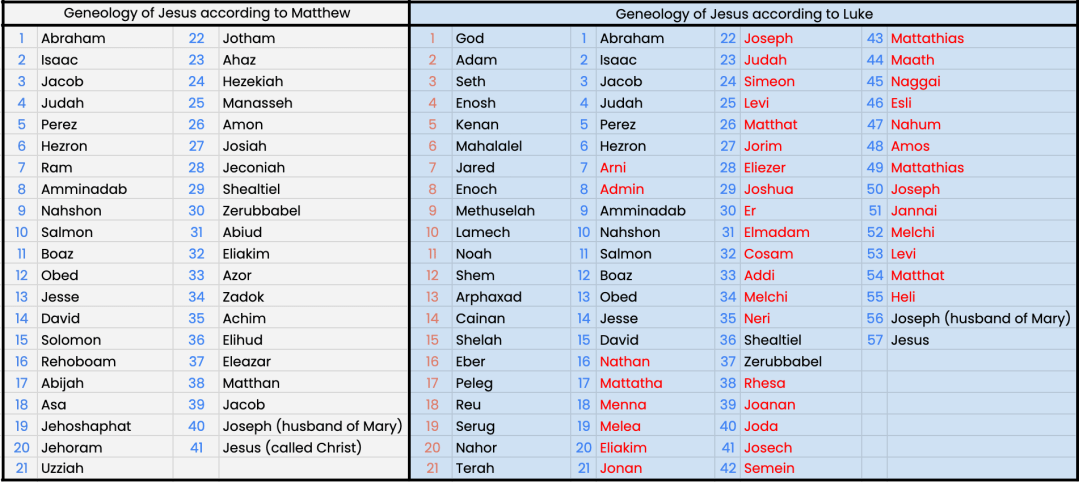
Jesus’ genealogy is given in the Gospels of Matthew and Luke, yet the two genealogies are vastly different. While Matthew records 41 generations between Abraham and Jesus, Luke records 57. Additionally, 39 names are found in Luke’s genealogy between Abraham and Jesus that are not found in Matthew.
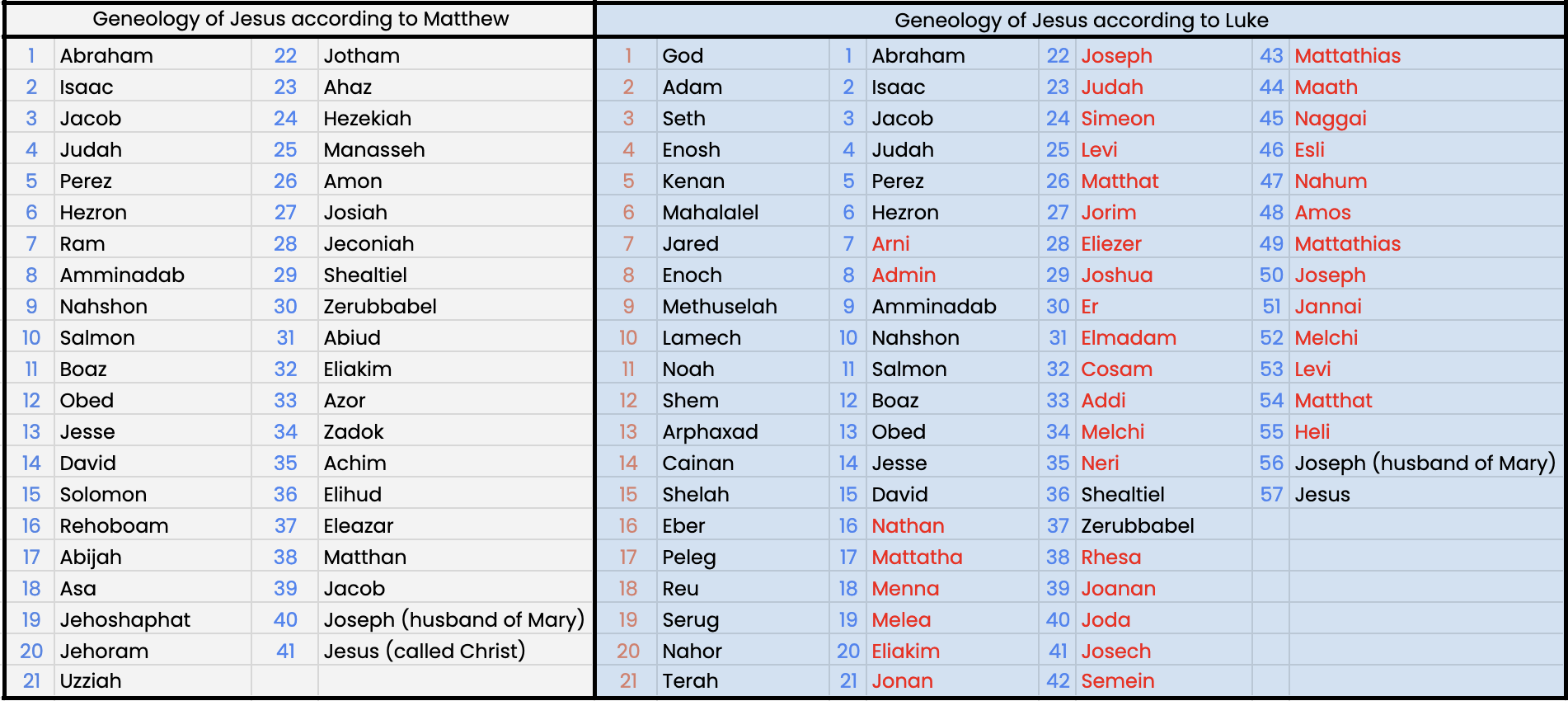
Even the father of Joseph, Mary’s husband, is contradictory, where Matthew says his name was Jacob, while Luke says it is Heli.
…and Jacob the father of Joseph the husband of Mary, of whom Jesus was born, who is called Christ. – Matthew 1:16
Jesus, when he began his ministry, was about thirty years of age, being the son (as was supposed) of Joseph, the son of Heli, – Luke 3:23
It is also noteworthy that when we compare Luke’s genealogy with the account in Genesis, a discrepancy emerges: Luke lists 21 generations from Adam to Abraham, while Genesis records only 20 generations. The difference lies in Luke’s inclusion of Cainan as the son of Arphaxad, which does not appear in Genesis.
| # | Genesis (OT) | Luke 3 |
|---|---|---|
| 1 | Adam | Adam |
| 2 | Seth | Seth |
| 3 | Enosh | Enosh |
| 4 | Kenan (Cainan) | Kenan |
| 5 | Mahalalel | Mahalalel |
| 6 | Jared | Jared |
| 7 | Enoch | Enoch |
| 8 | Methuselah | Methuselah |
| 9 | Lamech | Lamech |
| 10 | Noah | Noah |
| 11 | Shem | Shem |
| 12 | Arphaxad | Arphaxad |
| – | — | Cainan (extra in Luke) |
| 13 | Shelah | Shelah |
| 14 | Eber | Eber |
| 15 | Peleg | Peleg |
| 16 | Reu | Reu |
| 17 | Serug | Serug |
| 18 | Nahor | Nahor |
| 19 | Terah | Terah |
| 20 | Abraham | Abraham |
Jesus’ Birth
The narratives of the birth of Jesus in the Gospels of Matthew and Luke differ significantly in their details.
In Matthew, the birth story of Jesus includes the visit of the Magi, who follow a star to find the newborn king and bring gifts of gold, frankincense, and myrrh. King Herod was disturbed by the news of the birth of the Messiah and attempted to locate the child but was outwitted by the Magi (Matthew 2:1-12). Then he ordered to have the first born in Bethlehem killed as Jesus and his family fled to Egypt until his death.
13 When they had gone, an angel of the Lord appeared to Joseph in a dream. “Get up,” he said, “take the child and his mother and escape to Egypt. Stay there until I tell you, for Herod is going to search for the child to kill him.” 14 So he got up, took the child and his mother during the night and left for Egypt, 15 where he stayed until the death of Herod. And so was fulfilled what the Lord had said through the prophet: “Out of Egypt I called my son.” 16 When Herod realized that he had been outwitted by the Magi, he was furious, and he gave orders to kill all the boys in Bethlehem and its vicinity who were two years old and under, in accordance with the time he had learned from the Magi. – Matthew 2:13-16
19 After Herod died, an angel of the Lord appeared in a dream to Joseph in Egypt 20 and said, “Get up, take the child and his mother and go to the land of Israel, for those who were trying to take the child’s life are dead.” 21 So he got up, took the child and his mother and went to the land of Israel. 22 But when he heard that Archelaus was reigning in Judea in place of his father Herod, he was afraid to go there. Having been warned in a dream, he withdrew to the district of Galilee, 23 and he went and lived in a town called Nazareth. So was fulfilled what was said through the prophets, that he would be called a Nazarene. – Matthew 2:19-23
On the other hand, Luke’s account does not indicate King Herod or his plot, let alone that Mary and Joseph fled to Egypt. Instead, it states in Luke 2 that Jesus was born, circumcised on the eighth day, and brought to the Temple, and that he was taken to the Temple every year after that. Luke’s account does not have Jesus and his family fleeing for their lives in Egypt or any mention of persecution from King Herod.
1 In those days Caesar Augustus issued a decree that a census should be taken of the entire Roman world. 2 (This was the first census that took place while[a] Quirinius was governor of Syria.) 3 And everyone went to their own town to register. 4 So Joseph also went up from the town of Nazareth in Galilee to Judea, to Bethlehem the town of David, because he belonged to the house and line of David. 5 He went there to register with Mary, who was pledged to be married to him and was expecting a child. 6 While they were there, the time came for the baby to be born, 7 and she gave birth to her firstborn, a son. She wrapped him in cloths and placed him in a manger, because there was no guest room available for them. – Luke 2:1-7
21 On the eighth day, when it was time to circumcise the child, he was named Jesus, the name the angel had given him before he was conceived. 22 When the time came for the purification rites required by the Law of Moses, Joseph and Mary took him to Jerusalem to present him to the Lord 23 (as it is written in the Law of the Lord, “Every firstborn male is to be consecrated to the Lord”[b]), 24 and to offer a sacrifice in keeping with what is said in the Law of the Lord: “a pair of doves or two young pigeons.” – Luke 2:21-24
39 When Joseph and Mary had done everything required by the Law of the Lord, they returned to Galilee to their own town of Nazareth. 40 And the child grew and became strong; he was filled with wisdom, and the grace of God was on him. 41 Every year Jesus’ parents went to Jerusalem for the Festival of the Passover. 42 When he was twelve years old, they went up to the festival, according to the custom. – Luke 2:39-42
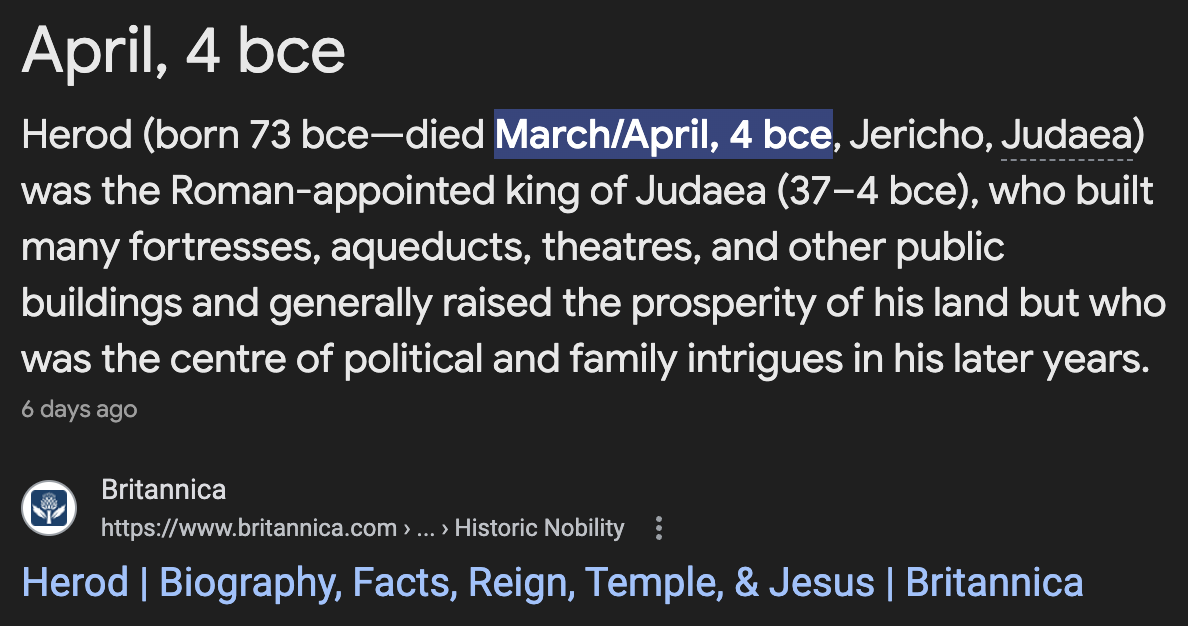
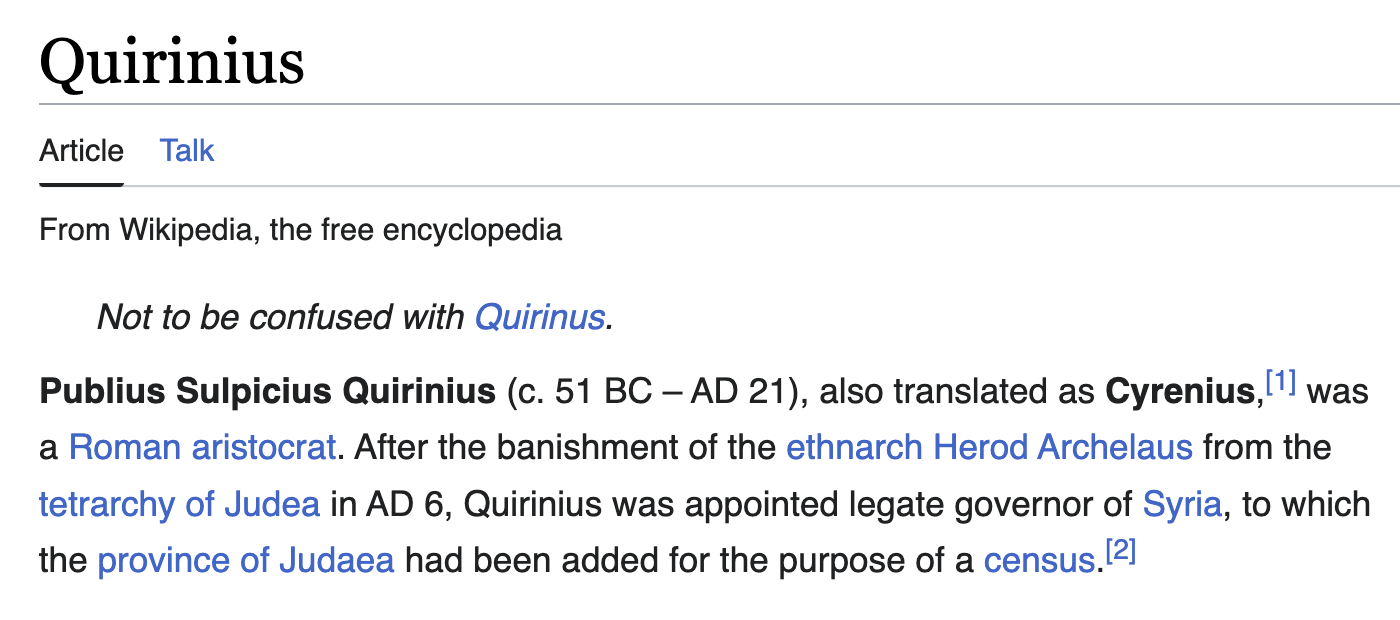
Not only are the accounts of Matthew and Luke contradictory, but their timelines do not even match. Matthew states that after Jesus’ birth, they fled to Egypt and did not return until Herod’s death. It is established that King Herod died in ~4 BCE. Luke states that Jesus’ birth was when Quirinius was appointed legate of Syria, which puts the date at ~6 AD. So, according to Matthew, Jesus was born sometime before 4 BCE, during the reign of King Herod. However, Luke suggests that Jesus was born around 6 CE, during the census conducted by Quirinius.
Death of Jarius’ Daughter
In Mark 5:21-24 a man named Jairus approaches Jesus in distress. His daughter is “very ill.” He wants Jesus to come and heal her so she doesn’t die. Jesus agrees to go, but before he can get to Jairus’s home, he is delayed by a woman who desperately needs to be healed herself (5:25-34). While Jesus is dealing with her – it takes a while – someone comes from Jairus’s house to tell him that it is too late; the girl has now died (5:35). Jesus comforts Jairus, goes, and raises her from the dead.
Matthew also tells the story (Matthew 9:18-26). But in this case, Jairus comes to Jesus to tell him that “My daughter has just now died” (9:18). He wants him to raise her from the dead. Jesus goes and does so.
So when Jairus comes to Jesus, does he want him to heal his sick daughter, who unfortunately dies before Jesus can get there? Or does Jairus come only after the girl is dead, wanting Jesus to raise her from the dead?
James and John or Mother’s Request
In the following example, there are two accounts of James and John requesting to sit in Jesus’s right and left hands. In Mark, it is James and John who directly ask Jesus for this, yet in Matthew, their mother requests this from Jesus.
35 And James and John, the sons of Zeb′edee, came forward to him, and said to him, “Teacher, we want you to do for us whatever we ask of you.” 36 And he said to them, “What do you want me to do for you?” 37 And they said to him, “Grant us to sit, one at your right hand and one at your left, in your glory.” 38 But Jesus said to them, “You do not know what you are asking. Are you able to drink the cup that I drink, or to be baptized with the baptism with which I am baptized?” 39 And they said to him, “We are able.” And Jesus said to them, “The cup that I drink you will drink; and with the baptism with which I am baptized, you will be baptized; 40 but to sit at my right hand or at my left is not mine to grant, but it is for those for whom it has been prepared.” – Mark 10
20 Then the mother of Zebedee’s sons came to Jesus with her sons and, kneeling down, asked a favor of him. 21 “What is it you want?” he asked. She said, “Grant that one of these two sons of mine may sit at your right and the other at your left in your kingdom.” 22 “You don’t know what you are asking,” Jesus said to them. “Can you drink the cup I am going to drink?” “We can,” they answered. 23 Jesus said to them, “You will indeed drink from my cup, but to sit at my right or left is not for me to grant. These places belong to those for whom they have been prepared by my Father.” – Matthew 20
Should Disciples Carry a Staff?
When Jesus commissions his disciples to proselytize, the Gospels differ on whether the disciples were commissioned to bring a staff.
Acquire no gold nor silver nor copper for your belts, no bag for your journey, nor two tunics nor sandals nor a staff, for the laborer deserves his food. – Matthew 10:9-10
And he said to them, “Take nothing for your journey, no staff, nor bag, nor bread, nor money; and do not have two tunics. – Luke 9:3-5
He charged them to take nothing for their journey except a staff–no bread, no bag, no money in their belts – Mark 6:8
Fig Tree Withered
According to the Gospels of Matthew and Mark, Jesus cursed a fig tree. However, the account of this event varies between the two gospels. In the Gospel of Matthew, the event happens right before the eyes of the disciples, while in the Gospel of Mark, the tree is found withered later.
In the morning, as he was returning to the city, he became hungry. And seeing a fig tree by the wayside, he went to it and found nothing on it but only leaves. And he said to it,“May no fruit ever come from you again!” And the fig tree withered at once. When the disciples saw it, they marveled, saying, “How did the fig tree wither at once?” – Matthew 21:18-20
And he said to it, “May no one ever eat fruit from you again.” And his disciples heard it. – Mark 11:14
As they passed by in the morning, they saw the fig tree withered away to its roots. And Peter remembered and said to him, “Rabbi, look! The fig tree that you cursed has withered.” – Mark 11:20-21
The Lord’s Prayer
It should be expected that a statement made by Jesus one time may have variations between authors, but what about a statement that must have been made by Jesus to his disciples thousands of times? Indeed, that statement should be consistent in the Gospels. Actually, we have such an example and we find this is not the case.
Both Matthew and Luke contain the Lord’s prayer, yet each is different. So if the Gospel fails to adequately capture the exact words for the Lord’s prayer as spoken by Jesus, which we should presume Jesus must have recited many times, how less reliable should we consider any statement attributed to Jesus in the Gospels?
| Matthew 6:9–13 (NIV) | Luke 11:2–4 (NIV) |
| Our Father in heaven, | Father, |
| hallowed be your name, | hallowed be your name, |
| your kingdom come, | your kingdom come. |
| your will be done, on earth as it is in heaven. | |
| Give us today our daily bread. | Give us each day our daily bread. |
| And forgive us our debts, as we also have forgiven our debtors. | Forgive us our sins, for we also forgive everyone who sins against us. |
| And lead us not into temptation, but deliver us from the evil one. | And lead us not into temptation. |
Crucifixion (Before or After Passover)
Christians today claim that the most significant event in all of history was the crucifixion and resurrection of Jesus, yet even according to their accounts, there are many discrepancies between the Gospels regarding these events.
For example, it is unclear when this event took place. Mark 14:12 indicates that the Last Supper, which occurs the evening before Jesus’ crucifixion, happens on the first day of the Festival of Unleavened Bread, when the Passover lamb is sacrificed. This suggests that Jesus was crucified on the day following the Passover meal, traditionally understood to be Friday. And Mark 15:25 states that Jesus was crucified around 9 in the morning.
On the first day of the Festival of Unleavened Bread, when it was customary to sacrifice the Passover lamb, Jesus’ disciples asked him, “Where do you want us to go and make preparations for you to eat the Passover?” – Mark 14:12
It was nine in the morning when they crucified him. – Mark 15:25
Yet, according to John 19:14 presents a different timeline. It states that Jesus’ trial before Pilate occurred on the “day of Preparation of the Passover,” which suggests that Jesus was crucified on the day of preparation for the Passover, traditionally understood to be the day before the Passover meal, which would be Thursday, and that Jesus was crucified around noon.
It was the day of Preparation of the Passover; it was about noon. “Here is your king,” Pilate said to the Jews. – John 19:14
Resurrection Account
The details regarding Jesus’s resurrection are found in Matthew 28, Mark 16, Luke 24, and John 20–21, and they are riddled with contradictions between these four narrations.
| Event/Detail | Matthew | Mark | Luke | John |
|---|---|---|---|---|
| Who was the first person to go to the tomb? | Mary Magdalene and the other Mary (28:1) | Mary Magdalene, Mary the mother of James, and Salome (16:1) | Mary Magdalene, Joanna, Mary the mother of James, and others (24:10) | Mary Magdalene (20:1) |
| Time of visit | At dawn (28:1) | Very early, just after sunrise (16:2) | Very early in the morning (24:1) | Early, while it was still dark (20:1) |
| Was the stone already rolled away when they arrived at the tomb? | Earthquake and stone rolled away by an angel (28:2) | Yes, already rolled away (16:4) | Yes, already rolled away (24:2) | Yes, already rolled away (20:1) |
| Who was in the tomb? | One angel (28:2-5) | One young man (16:5) | Two men in dazzling clothes (24:4) | Two angels later (20:12) |
| Message to the women | Jesus is risen, tell the disciples to go to Galilee (28:5-7) | Jesus is risen, tell Peter and disciples (16:6-7) | Jesus is risen, remember his words in Galilee (24:5-7) | Jesus is risen (20:13-17) |
| Women’s reaction and who did they tell? | Afraid yet joyful, ran to tell the disciples (28:8) | Trembling and bewildered, said nothing to anyone because they were afraid (16:8) | Told the apostles, who did not believe them (24:9-11) | Ran to tell Peter and the other disciple (20:2) |
| First appearance of Jesus | To Mary Magdalene and the other Mary (28:9-10) | To Mary Magdalene (16:9-11, longer ending) | To two disciples on the road to Emmaus (24:13-35) | To Mary Magdalene (20:14-17) |
| Instructions from Jesus | Tell my brothers to go to Galilee (28:10) | No specific instructions in the shorter ending (16:8); In the longer ending, preach to the world (16:15) | Stay in Jerusalem until you are clothed with power (24:49) | Do not hold on to me; go to my brothers (20:17) |
| Report to disciples | Women told the disciples (28:8-10) | Women did not tell anyone initially (16:8); In the longer ending, Mary Magdalene told the disciples (16:10) | Women told the apostles, who did not believe (24:9-11) | Mary told the disciples (20:18) |
| Appearance to disciples | On a mountain in Galilee (28:16-20) | Appears to the eleven as they were eating (16:14, longer ending) | In Jerusalem, to the Eleven and others (24:36-49) | In Jerusalem, to the disciples without Thomas, then with Thomas (20:19-29) |
| Great Commission | Yes, make disciples of all nations (28:18-20) | Yes, go into all the world and preach the gospel, speak in tongues, handle snakes, and drink poison(16:15, longer ending) | Yes, repentance and forgiveness of sins will be preached (24:46-48) | Implied in Jesus’ conversations and later in John 21 |
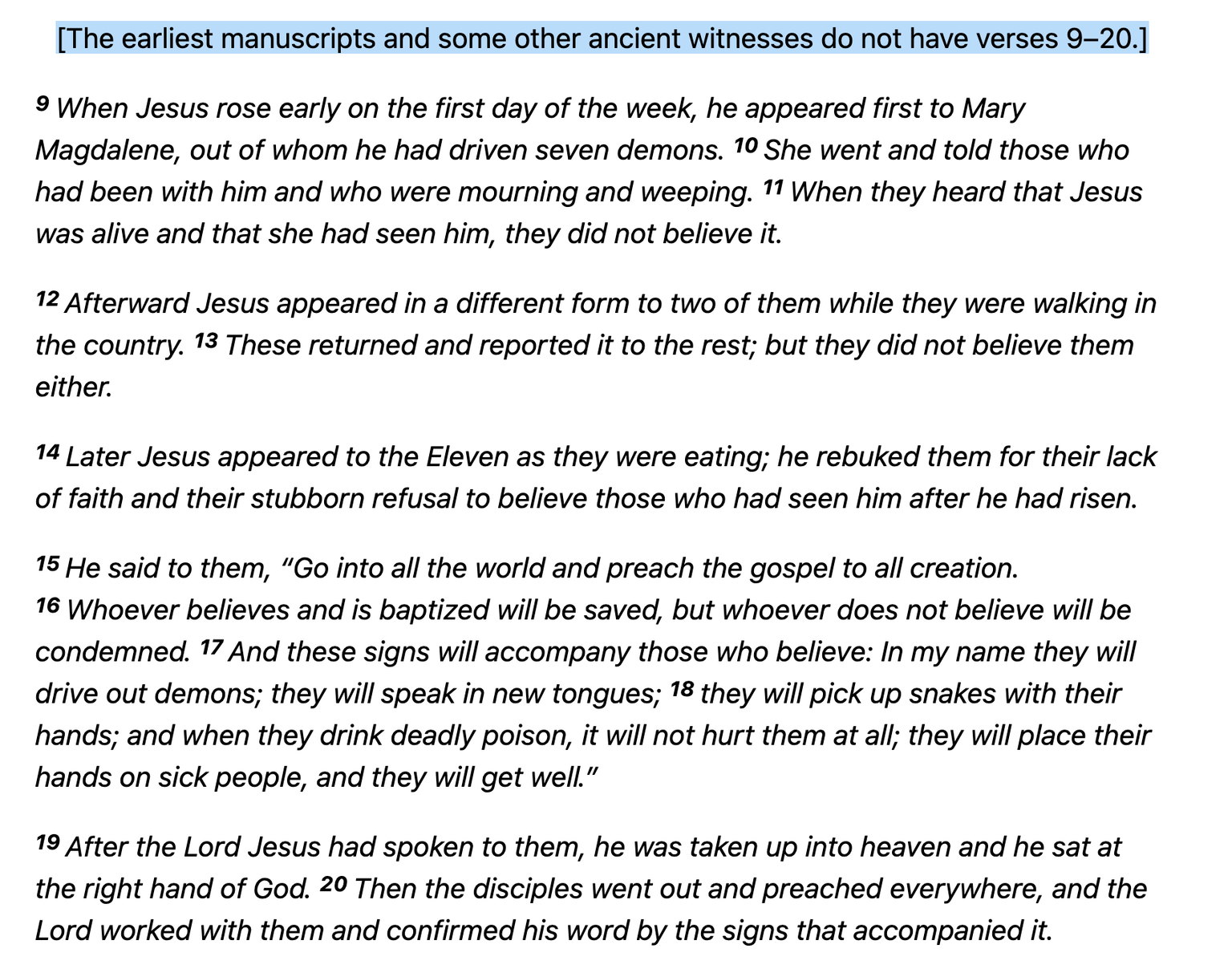
It is worth mentioning that Mark 16:9-20 does not exist in the older manuscripts. The earliest manuscripts of the Gospel of Mark end at verse 16:8. The longer ending, which includes Jesus’ appearances after his resurrection and his ascension into heaven, is not found in some of the oldest manuscripts.
Below is a screenshot from Biblegateway.com
Conclusion
Given the internal contradictions among the Gospel accounts, it is challenging to regard any statement attributed to Jesus as definitively true. At best, these accounts provide a general archetype of Jesus’ history and teachings. Interestingly, despite these inconsistencies, none of the four Gospels directly attribute to Jesus the claim that he is God or a part of the Trinity. Such theological claims are often read into the texts by individuals seeking to support a particular doctrinal perspective. Instead, the clear teachings of Jesus in the Gospels portray him not as establishing a new theology but as a messenger sent to guide the lost sheep of Israel back to the Law established in the Old Testament and away from traditions that had distorted its truth.

 Quran Talk Blog
I can start to refute your comments while I have time. I will start with Matthew 21:19. And the fig tree withered at once. When the disciples saw it, they marveled, saying, “How did the fig tree wither at once?” The Greek word parachrēma does mean immediately, forthwith, instantly. Interestingly a root word of this adverb is chrēma, meaning a thing, a matter, affair, event, business and is often referred to as in money or riches. So we could say ‘immediately what you possess with wither away’. We know from history that Israel, symbolically the fig tree, did wither away around AD 70 when the Roman General Titus sacked Jerusalem, desecrated the temple, and destroyed Judiasm at that time. What you are not seeing here is the cause and effect. Israel was withering away. Even in the natural, a cut limb off a tree takes a bit of time to show up but many times become evident the next day. Israel did wither away eventually but more slowly. In Hebrews 8:13 it says, “In speaking of a new covenant, he makes the first one obsolete. And what is becoming obsolete and growing old is ready to vanish away”. Hebrews was written decades after Christ but we still see Judiasm hanging on even though it had been cursed decades beforehand. Even today we see a form of rabbinic Judiasm hanging on. I however, have doubts that either Jehovah or Yeshua will ever let a temple be rebuilt to offer up sacrifices in place of what his son did for us upon the cross. It is possible to fufill prophesy but it really mocks at his blood sacrifice. So if you are in doubt, [O Muhammad], about that which We have revealed to you, then ask those who have been reading the Scripture before you. The truth has certainly come to you from your Lord, so never be among the doubters (Quran 10:94).
LikeLike
Addendum: I realized after my first post that Jesus first spoke to the tree and it withered at once. Then later, the disciples did see the results of it withered. (There can be a delay between speaking the word and seeing the results). I know this is a bit deep but it is a principle of faith. In Mark 11:24 it says ‘Therefore I say to you, that everything that you pray and ask, believe that you are receiving it and you shall have it’.
LikeLike