
The first revelation given to the prophet of the Quran were the following five verses from Sura 96, The Embryo ( Al-‘Alaq / الـعلق ).
[96:1] Read, in the name of your Lord, who created.
[96:2] He created man from an embryo.
[96:3] Read, and your Lord, Most Exalted.
[96:4] Teaches by means of the pen.
[96:5] He teaches man what he never knew.
(١) ٱقْرَأْ بِٱسْمِ رَبِّكَ ٱلَّذِى خَلَقَ
(٢) خَلَقَ ٱلْإِنسَٰنَ مِنْ عَلَقٍ
(٣) ٱقْرَأْ وَرَبُّكَ ٱلْأَكْرَمُ
(٤) ٱلَّذِى عَلَّمَ بِٱلْقَلَمِ
*(٥) عَلَّمَ ٱلْإِنسَٰنَ مَالَمْ يَعْلَمْ
These five verses contain 19 words and 76 (19×4) letters.

This Sura has 19 verses.
[96:6] Indeed, the human transgresses.
[96:7] When he becomes rich.
[96:8] To your Lord is the ultimate destiny.
[96:9] Have you seen the one who enjoins.
[96:10] Others from praying?
[96:11] Is it not better for him to follow the guidance?
[96:12] Or advocate righteousness?
[96:13] If he disbelieves and turns away.
[96:14] Does he not realize that GOD sees?
[96:15] Indeed, unless he refrains, we will take him by the forelock.
[96:16] A forelock that is disbelieving and sinful.
[96:17] Let him then call on his helpers.
[96:18] We will call the guardians of Hell.
[96:19] You shall not obey him; you shall fall prostrate and draw nearer.
(٦) كَلَّآ إِنَّ ٱلْإِنسَٰنَ لَيَطْغَىٰٓ
(٧) أَن رَّءَاهُ ٱسْتَغْنَىٰٓ
(٨) إِنَّ إِلَىٰ رَبِّكَ ٱلرُّجْعَىٰٓ
(٩) أَرَءَيْتَ ٱلَّذِى يَنْهَىٰ
(١٠) عَبْدًا إِذَا صَلَّىٰٓ
(١١) أَرَءَيْتَ إِن كَانَ عَلَى ٱلْهُدَىٰٓ
(١٢) أَوْ أَمَرَ بِٱلتَّقْوَىٰٓ
(١٣) أَرَءَيْتَ إِن كَذَّبَ وَتَوَلَّىٰٓ
(١٤) أَلَمْ يَعْلَم بِأَنَّ ٱللَّهَ يَرَىٰ
(١٥) كَلَّا لَئِن لَّمْ يَنتَهِ لَنَسْفَعًۢا بِٱلنَّاصِيَةِ
(١٦) نَاصِيَةٍ كَٰذِبَةٍ خَاطِئَةٍ
(١٧) فَلْيَدْعُ نَادِيَهُۥ
(١٨) سَنَدْعُ ٱلزَّبَانِيَةَ
(١٩) كَلَّا لَا تُطِعْهُ وَٱسْجُدْ وَٱقْتَرِب
From verse 1 to the last verse 19 of Sura 96, there are 285 letters (19×15).

Additionally, Sura 96 sits on top of the last 19 Suras of the Quran.

Ma-Lam
Despite these proofs, some argue that مَالَمْ (ma-lam) in verse 96:5 should be counted as two words instead of one, except there is plenty of evidence from the Quran and external sources as to why it is totally valid to count this expression as a single compound word.
For instance, we see the use of لَمْ (lam) most notably used in the compound word “awalam” ( أَوَلَمْ ), which would be translated as “Or did not.” This word is used in 2:260, 7:100, 7:184, 7:185, 13:41, 14:44, 15:70, 16:48, 17:99, and 20:133 and is considered a single word.
Additionally, the word مَا (ma) is commonly used as part of a compound word. For instance, the word مِمَّا (miima), which occurs some 123 times in the Quran, is a compound of مِنْ مَا (miin ma). Additionally, below are examples from the verses of the Quran where this occurs.

One would think that we can just look at old manuscripts of the Quran to settle this dispute, except there are two problems with this approach. Firstly the letters alif ( ا ) and lam ( ل ) do not connect in the word malam ( مَالَمْ ) because alif only connects to letters from the right. This means that the only determination will depend on the spacing between these two letters, except the oldest manuscripts of the Quran do not treat spacing like it is treated today where it can clearly be distinguished.
In these older manuscripts, oftentimes, one will find part of the word in one line and the remainder of the word in the other line or have the spacing between the letters of a single word just as spaced out as the spacing between two distinct words. Therefore trying to determine if malam ( مَالَمْ ) should be one word or two based on the spacing alone in the old manuscripts is not a feasible approach. For instance, the two manuscripts below is from the year 1203 and 1198, yet one cannot determine from the spacing alone if this should be treated as a single word or two.


Below is another manuscript dated around the 800s. Not only do we see that the spacing between the individual letters for a select word is just as wide as two separate words, but also that several words will start in one line and continue in the following line. This shows that spacing is not an indicator for distinguishing if a word should be treated as one or two.

That stated, can we go to other sources to see if these two words are ever treated as a single word?
Ahmad Deedat
The first example comes from a slide from Ahmad Deedat from a talk he gave discussing Code 19, and it is clear when he says, “One must be blind not to see this,” as he shows the 19-word count of Sura 96 verses 1-5.

Additionally, we can look at Classical Arabic dictionaries to see if ma-lam ( مَالَمْ ) is ever treated as a single word. Below are ten examples, along with their sources.
#1
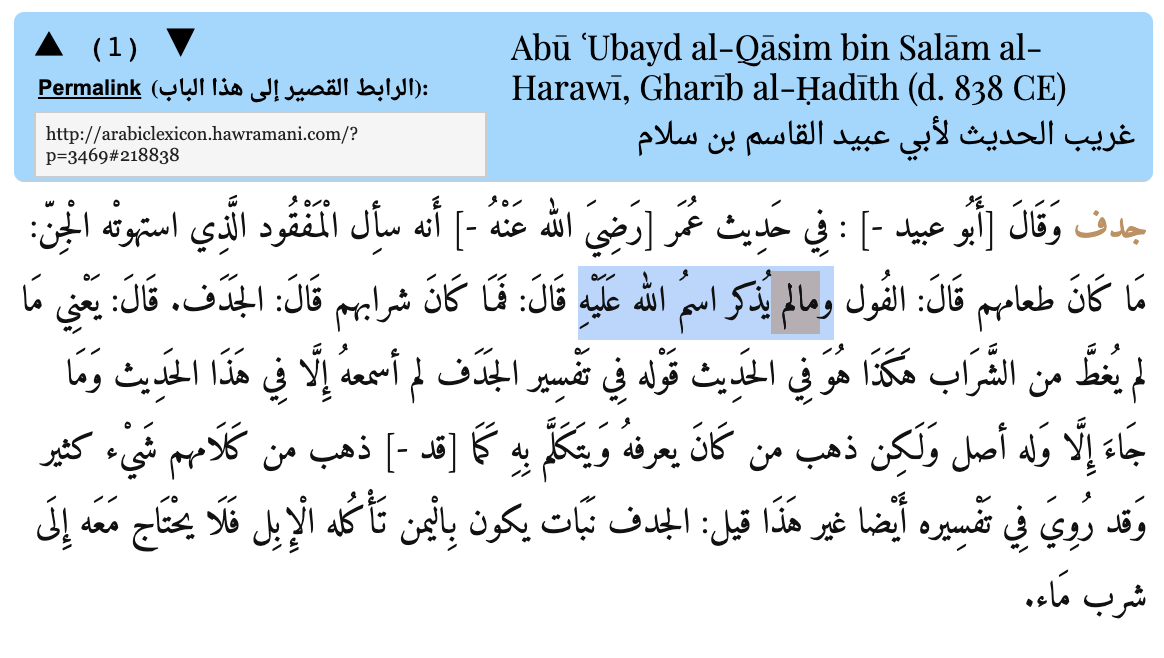
The first example is from Abū ʿUbayd al-Qāsim bin Salām, Gharīb al-Ḥadīth غريب الحديث لأبي عبيد القاسم بن سلام. Al-Qāsim bin Salām, often referred to as Abū ʿUbayd (d. c. 839 CE / 224 AH), spent forty years writing this book, which is concerned with difficult and unusual words found in the Hadith corpus.
This excerpt shows that ma-lam is spelled as a single word, with the highlighted portion stating: “And what not it mentions the name of Allah upon it.”
#2, #3, #4, & #5
The following three examples are from Murtaḍa al-Zabīdī, Tāj al-ʿArūs fī Jawāhir al-Qamūs تاج العروس لمرتضى الزبيدي, which is the largest dictionary of the Arabic language ever written, comprising 11,800 pages.
This excerpt shows that ma-lam is spelled as a single word, with the highlighted portion stating: “Shoot your arrow as long as you are not defeated.”

This excerpt shows that ma-lam is spelled as a single word, with the highlighted portion stating: “And as long as it is not licked from the bucket.”

This excerpt shows that ma-lam is spelled as a single word, with the highlighted portion stating: “Upon what is not named its doer.”

This excerpt shows that ma-lam is spelled as a single word, with the highlighted portion stating: “And other, upon what is not named its doer.”

#6
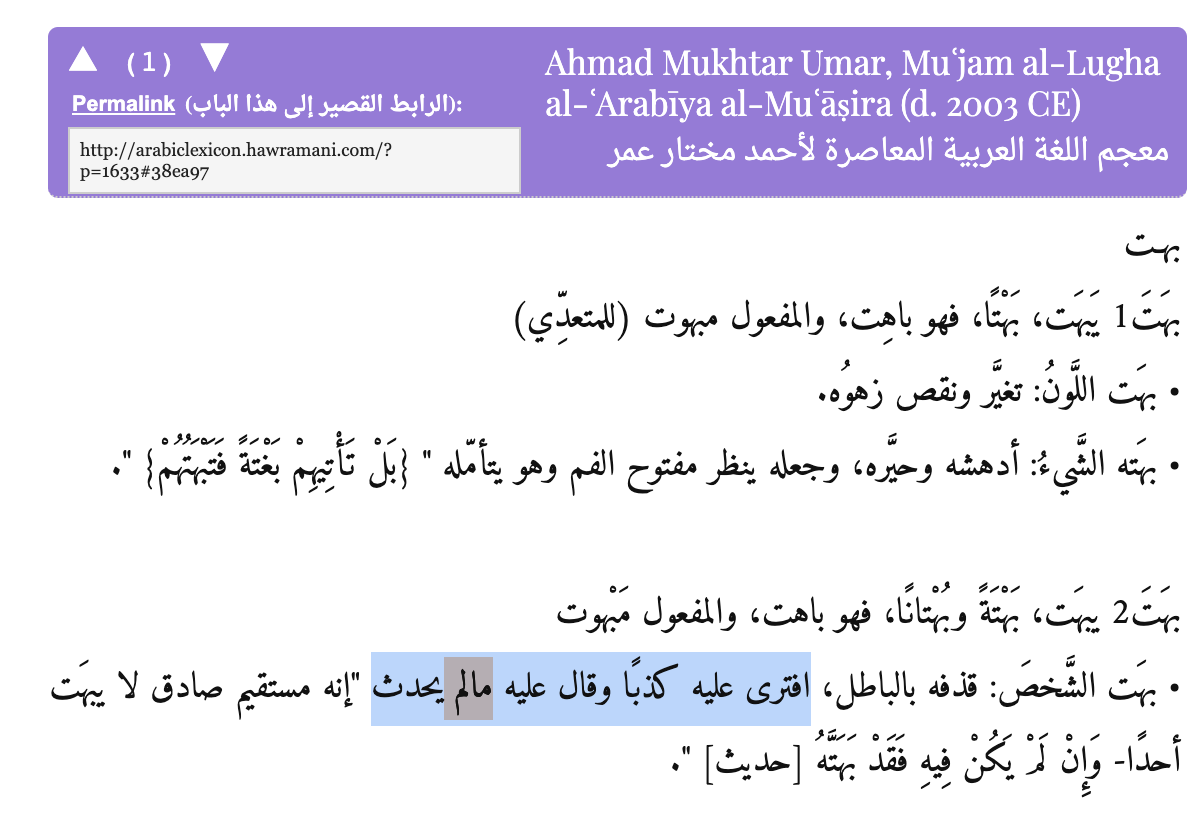
The fourth example is from Ahmad Mukhtar Umar, Muʿjam al-Lugha al-ʿArabīya al-Muʿāṣira معجم اللغة العربية المعاصرة لأحمد مختار عمر.
This excerpt shows that ma-lam is spelled as a single word, with the highlighted portion stating: “He fabricated a lie against him and said to him what he did not narrate.”
#7 #8
The next two examples are from Lanes Lexicon.


#9
The eighth example is from Ahmad Mukhtar Umar, Muʿjam al-Lugha al-ʿArabīya al-Muʿāṣira معجم اللغة العربية المعاصرة لأحمد مختار عمر.
This excerpt shows that ma-lam is spelled as a single word, with the highlighted portion stating: “What was not discovered from its regions.”

#10
The ninth example is from Al-Fattinī, Majmaʿ Biḥār al-Anwār fī Gharāʾib al-Tanzīl wa Laṭāʾif al-Akhbār مجمع بحار الأنوار للفَتِّنيّ
This excerpt shows that ma-lam is spelled as a single word, with the highlighted portion stating:
“Then, indeed, this man did not rule according to Islam until he acknowledged prophethood, but when he brought the ‘amda (official document), it became necessary to detain him until his situation is known.”

# 11 Risala al-Shafi
The next example is not from a dictionary, but from the Risalah of al-Shafi’i (d. 204AH/820AD) on page 512 of the digital copy.

Translation:
‘Abd al-‘Aziz from Muhammad ibn ‘Amr, from Abu Salamah, from Abu Hurayrah, that God’s messenger said: “Whoever attributes to me what not I said, then let him take his seat in the Hellfire.”
Conclusion
These facts and the examples provided show the awesome nature of Code 19 as well as definitive proof that representing ma-lam ( مَالَمْ ) as a single compound word in the counts of Sura 96 is a valid approach.

 Quran Talk Blog
Also, when we add the some of those 19 surat (96+97+98+99+100+101+102+103+104+105+106+107+108+109+110+111+112+113+114=1995 (19×105)
Praise God, Lord of the universe.
LikeLike