
Despite there not existing a single sermon transcribed from the prophet from start to finish in the entire Hadith corpus, the most narrated sermon we have attributed to the prophet is the sermon given during the Farewell Pilgrimage, Ḥijjatu Al-Wadāʿ ( حِجَّة ٱلْوَدَاع ), in the Islamic year 10 AH, following the Conquest of Mecca.
It is believed that there were over 10,000 people in the audience for this sermon. This would make this the most widely heard statement from the prophet in his entire life. Yet not only did not a single person fully document what was said, but the Hadith is even unsure regarding the exact location of the sermon, with some narrations claiming Mina while others Arafat.
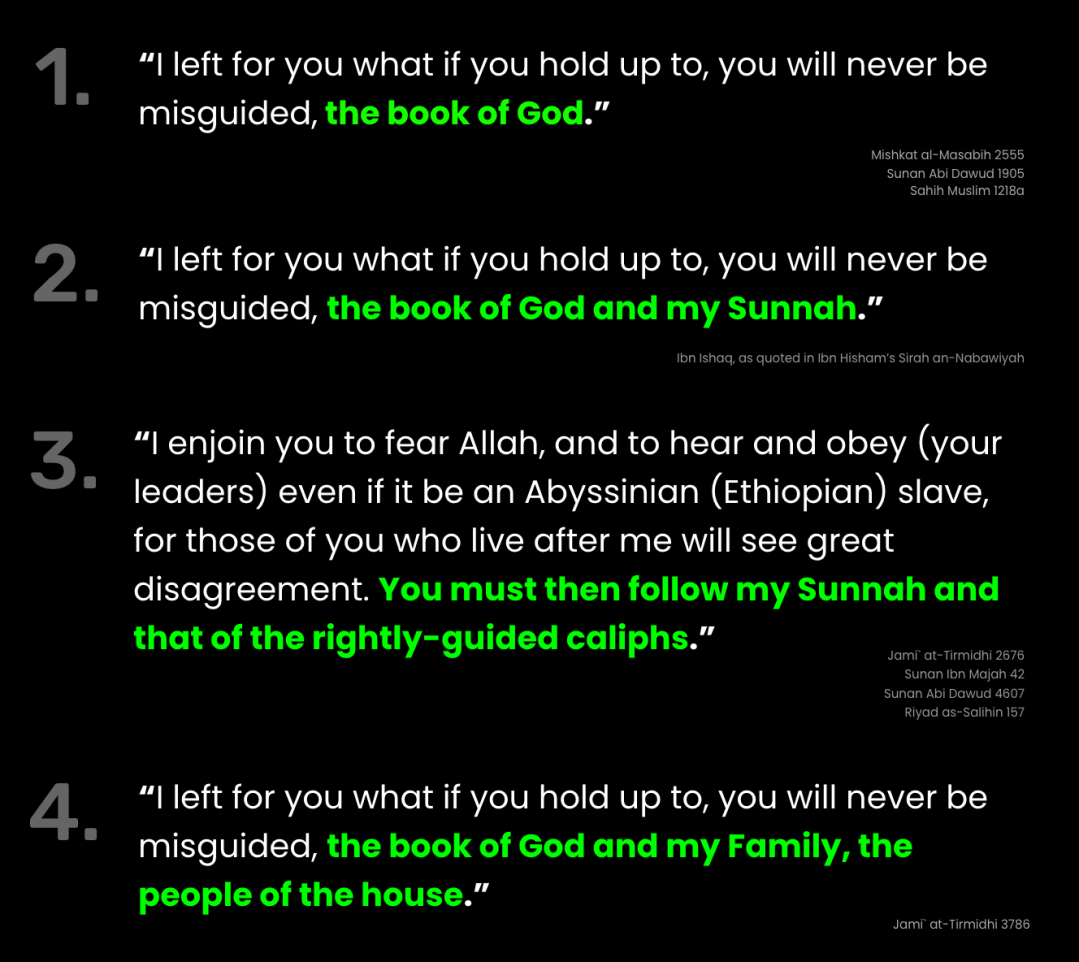
Instead, what we find regarding the sermon in the Hadith corpus, in addition to the confusion in location, are various narrations that conflict with one another regarding what was stated in this sermon. The critical difference between these narrations lies with what the prophet supposedly claimed to have left for the believers to keep them from being misguided. Depending on the narration, there are one of four options.
- “I left for you what if you hold up to, you will never be misguided, the book of God.”
- Sahih Muslim 1218a
- Al-Jahiz in the Kitāb al-Bayān wa-al-Tabyīn
- Musnad of Imam Ahmad (hadith no.19774)
- Mishkat al-Masabih 2555
- Sunan Abi Dawud 1905
- “I left for you what if you hold up to, you will never be misguided, the book of God and my Family, the people of the house.”
- “I left for you what if you hold up to, you will never be misguided, the book of God and my Sunnah.”
- Ibn Ishaq, as quoted in Ibn Hisham’s Sirah an-Nabawiyah (with no isnad)
- “I enjoin you to fear Allah, and to hear and obey (your leaders) even if it be an Abyssinian (Ethiopian) slave, for those of you who live after me will see great disagreement. You must then follow my Sunnah and that of the rightly-guided caliphs.”
Let’s look at these options and determine the likeliness of each based on what we know from history and the Quran.
My Family
If the prophet left the Book of God & his family as a mechanism to keep the believers from being misguided, this would not make sense as it was the prophet’s family, predominately ‘Aisha and ‘Ali, who were the key actors in the First Fitna that divided the believers and led to civil war among the umma causing believers to kill each other. Also, we have no reference in the Quran that the prophet’s family are to be a source to keep the believers on the right path and away from misguidance. Therefore, we can rule out option #2 from the list.
My Sunnah
The term Sunnah in reference to the traditions of the prophet is not how the word was used during the life of the prophet. If we look at the Quran we see that this word is used in reference to the precedents of the past generations, particularly the ones that were annihilated, as well as the Sunnah of God, which is unchangeable.
[3:137] Precedents have been set for you in the past; roam the earth and note the consequences for the unbelievers.
قَدْ خَلَتْ مِن قَبْلِكُمْ سُنَنٌ فَسِيرُوا۟ فِى ٱلْأَرْضِ فَٱنظُرُوا۟ كَيْفَ كَانَ عَـٰقِبَةُ ٱلْمُكَذِّبِينَ
[48:23] Such is GOD’s sunnah throughout history, and you will find that GOD’s sunnah is unchangeable.
سُنَّةَ ٱللَّهِ ٱلَّتِى قَدْ خَلَتْ مِن قَبْلُ وَلَن تَجِدَ لِسُنَّةِ ٱللَّهِ تَبْدِيلًا
Additionally, nowhere in the Quran do we see a reference to the word Sunnah as in tradition, and nowhere in the Quran do we see any reference to the Sunnah of the prophet. Because of these reasons, we can comfortably say that it would be an anachronism to insinuate that the prophet used the term Sunnah in reference to his traditions, as the word usage in this context did not exist when he was alive. This eliminates options #3 and #4.

The Book of Allah
Therefore by process of elimination, the only possible outcome is that the prophet said that he left only the Book of Allah, which, if the believers uphold, they will never go astray.
This also corresponds with the Hadith regarding the prophet on his deathbed when he asked for something to write so that the believers would never go astray, and Umar responded that they had the Quran and the Quran was sufficient for them.
Narrated ‘Ubaidullah bin Abdullah: IbnAbbas said, “When the ailment of the Prophet (ﷺ) became worse, he said, ‘Bring for me (writing) paper and I will write for you a statement after which you will not go astray.’ But Umar said, ‘The Prophet is seriously ill, and we have got Allah’s Book with us and that is sufficient for us.’ But the companions of the Prophet (ﷺ) differed about this and there was a hue and cry. On that the Prophet (ﷺ) said to them, ‘Go away (and leave me alone). It is not right that you should quarrel in front of me.” IbnAbbas came out saying, “It was most unfortunate (a great disaster) that Allah’s Messenger (ﷺ) was prevented from writing that statement for them because of their disagreement and noise. (Note: It is apparent from this Hadith that Ibn Abbas had witnessed the event and came out saying this statement. The truth is not so, for IbnAbbas used to say this statement on narrating the Hadith and he had not witnessed the event personally. See Fath Al-Bari Vol. 1, p.220 footnote.) (See Hadith No. 228, Vol. 4).
حَدَّثَنَا يَحْيَى بْنُ سُلَيْمَانَ، قَالَ حَدَّثَنِي ابْنُ وَهْبٍ، قَالَ أَخْبَرَنِي يُونُسُ، عَنِ ابْنِ شِهَابٍ، عَنْ عُبَيْدِ اللَّهِ بْنِ عَبْدِ اللَّهِ، عَنِ ابْنِ عَبَّاسٍ، قَالَ لَمَّا اشْتَدَّ بِالنَّبِيِّ صلى الله عليه وسلم وَجَعُهُ قَالَ ” ائْتُونِي بِكِتَابٍ أَكْتُبُ لَكُمْ كِتَابًا لاَ تَضِلُّوا بَعْدَهُ ”. قَالَ عُمَرُ إِنَّ النَّبِيَّ صلى الله عليه وسلم غَلَبَهُ الْوَجَعُ وَعِنْدَنَا كِتَابُ اللَّهِ حَسْبُنَا فَاخْتَلَفُوا وَكَثُرَ اللَّغَطُ. قَالَ ” قُومُوا عَنِّي، وَلاَ يَنْبَغِي عِنْدِي التَّنَازُعُ ”. فَخَرَجَ ابْنُ عَبَّاسٍ يَقُولُ إِنَّ الرَّزِيَّةَ كُلَّ الرَّزِيَّةِ مَا حَالَ بَيْنَ رَسُولِ اللَّهِ صلى الله عليه وسلم وَبَيْنَ كِتَابِهِ.
Sahih al-Bukhari 114
https://sunnah.com/bukhari:114
Additionally, we see another narration that when ibn ‘Abbas and Muhammad bin Al-Hanafiyya were each asked if the prophet left anything besides the Quran, their answer was, “No.”
Narrated Abdul Aziz bin Rufai’: Shaddad bin Ma’qil and I entered upon Ibn `Abbas. Shaddad bin Ma’qil asked him, “Did the Prophet (ﷺ) leave anything (besides the Qur’an)?” He replied. “He did not leave anything except what is Between the two bindings (of the Qur’an).” Then we visited Muhammad bin Al-Hanafiyya and asked him (the same question). He replied, “The Prophet (ﷺ) did not leave except what is between the bindings (of the Qur’an).
حَدَّثَنَا قُتَيْبَةُ بْنُ سَعِيدٍ، حَدَّثَنَا سُفْيَانُ، عَنْ عَبْدِ الْعَزِيزِ بْنِ رُفَيْعٍ، قَالَ دَخَلْتُ أَنَا وَشَدَّادُ بْنُ مَعْقِلٍ، عَلَى ابْنِ عَبَّاسٍ رضى الله عنهما فَقَالَ لَهُ شَدَّادُ بْنُ مَعْقِلٍ أَتَرَكَ النَّبِيُّ صلى الله عليه وسلم مِنْ شَىْءٍ قَالَ مَا تَرَكَ إِلاَّ مَا بَيْنَ الدَّفَّتَيْنِ. قَالَ وَدَخَلْنَا عَلَى مُحَمَّدِ ابْنِ الْحَنَفِيَّةِ فَسَأَلْنَاهُ فَقَالَ مَا تَرَكَ إِلاَّ مَا بَيْنَ الدَّفَّتَيْنِ.
Sahih al-Bukhari 5019
https://sunnah.com/bukhari:5019
But most importantly, this corresponds with the testimony the prophet will make on the Day of Judgment against his people when he will proclaim that his people deserted, not his Sunnah or family, but the Quran alone.
[25:27] The day will come when the transgressor will bite his hands (in anguish) and say, “Alas, I wish I had followed the path with the messenger.
وَيَوْمَ يَعَضُّ ٱلظَّالِمُ عَلَىٰ يَدَيْهِ يَقُولُ يَـٰلَيْتَنِى ٱتَّخَذْتُ مَعَ ٱلرَّسُولِ سَبِيلًا
[25:28] “Alas, woe to me, I wish I did not take that person as a friend.
يَـٰوَيْلَتَىٰ لَيْتَنِى لَمْ أَتَّخِذْ فُلَانًا خَلِيلًا
[25:29] “He has led me away from the message after it came to me. Indeed, the devil lets down his human victims.”
لَّقَدْ أَضَلَّنِى عَنِ ٱلذِّكْرِ بَعْدَ إِذْ جَآءَنِى وَكَانَ ٱلشَّيْطَـٰنُ لِلْإِنسَـٰنِ خَذُولًا
[25:30] The messenger said, “My Lord, my people have deserted this Quran.”
وَقَالَ ٱلرَّسُولُ يَـٰرَبِّ إِنَّ قَوْمِى ٱتَّخَذُوا۟ هَـٰذَا ٱلْقُرْءَانَ مَهْجُورًا
For an isnad analysis showing the origins of these four narrations and the political motivations for each of these narrations check out the following thread.

 Quran Talk Blog
2 thoughts on “The Prophet’s Farewell Sermon: What He Left Behind”