
One of the verses in the Quran that is commonly misunderstood is the following.
[8:35] Their Contact Prayers (Salat) at the shrine (Ka’bah) were no more than mukāan wataṣdiyatan ( مُكَاءً وَتَصْدِيَةً ). Therefore, suffer the retribution for your disbelief.
وَمَا كَانَ صَلَاتُهُمْ عِنْدَ الْبَيْتِ إِلَّا مُكَاءً وَتَصْدِيَةً فَذُوقُوا الْعَذَابَ بِمَا كُنْتُمْ تَكْفُرُونَ
The confusion in understanding stems from the two words “mukāan wataṣdiyatan” ( مُكَاءً وَتَصْدِيَةً ), which are often wrongly understood as simply “whistling and clapping.”
Context
To properly understand the context of the verse, let’s look at the verse in its context.
[8:30] The disbelievers plot and scheme to neutralize you, or kill you, or banish you. However, they plot and scheme, but so does GOD. GOD is the best schemer.
[8:31] When our revelations are recited to them, they say, “We have heard. If we wanted to, we could have said the same things. These are no more than tales from the past!”
[8:32] They also said, “Our god, if this is really the truth from You, then shower us with rocks from the sky, or pour upon us a painful punishment.”
[8:33] However, GOD is not to punish them while you are in their midst; GOD is not to punish them while they are seeking forgiveness.
[8:34] Have they not deserved GOD’s retribution, by repelling others from the Sacred Masjid, even though they are not the custodians thereof? The true custodians thereof are the righteous, but most of them do not know.
[8:35] Their Contact Prayers (Salat) at the shrine (Ka’bah) were no more than “mukāan wataṣdiyatan” ( مُكَاءً وَتَصْدِيَةً ). Therefore, suffer the retribution for your disbelief.
[8:36] Those who disbelieve spend their money to repel others from the way of GOD. They will spend it, then it will turn into sorrow and remorse for them. Ultimately, they will be defeated, and all disbelievers will be summoned to Hell.
وَإِذْ يَمْكُرُ بِكَ الَّذِينَ كَفَرُوا لِيُثْبِتُوكَ أَوْ يَقْتُلُوكَ أَوْ يُخْرِجُوكَ وَيَمْكُرُونَ وَيَمْكُرُ اللَّهُ وَاللَّهُ خَيْرُ الْمَاكِرِينَ
وَإِذَا تُتْلَىٰ عَلَيْهِمْ ءَايَـٰتُنَا قَالُوا۟ قَدْ سَمِعْنَا لَوْ نَشَآءُ لَقُلْنَا مِثْلَ هَـٰذَآ إِنْ هَـٰذَآ إِلَّآ أَسَـٰطِيرُ ٱلْأَوَّلِينَ
وَإِذْ قَالُوا اللَّهُمَّ إِنْ كَانَ هَٰذَا هُوَ الْحَقَّ مِنْ عِنْدِكَ فَأَمْطِرْ عَلَيْنَا حِجَارَةً مِنَ السَّمَاءِ أَوِ ائْتِنَا بِعَذَابٍ أَلِيمٍ
وَمَا كَانَ اللَّهُ لِيُعَذِّبَهُمْ وَأَنْتَ فِيهِمْ وَمَا كَانَ اللَّهُ مُعَذِّبَهُمْ وَهُمْ يَسْتَغْفِرُونَ
وَمَا لَهُمْ أَلَّا يُعَذِّبَهُمُ اللَّهُ وَهُمْ يَصُدُّونَ عَنِ الْمَسْجِدِ الْحَرَامِ وَمَا كَانُوا أَوْلِيَاءَهُ إِنْ أَوْلِيَاؤُهُ إِلَّا الْمُتَّقُونَ وَلَٰكِنَّ أَكْثَرَهُمْ لَا يَعْلَمُونَ
وَمَا كَانَ صَلَاتُهُمْ عِنْدَ الْبَيْتِ إِلَّا مُكَاءً وَتَصْدِيَةً فَذُوقُوا الْعَذَابَ بِمَا كُنْتُمْ تَكْفُرُونَ
إِنَّ الَّذِينَ كَفَرُوا يُنْفِقُونَ أَمْوَالَهُمْ لِيَصُدُّوا عَنْ سَبِيلِ اللَّهِ فَسَيُنْفِقُونَهَا ثُمَّ تَكُونُ عَلَيْهِمْ حَسْرَةً ثُمَّ يُغْلَبُونَ وَالَّذِينَ كَفَرُوا إِلَىٰ جَهَنَّمَ يُحْشَرُونَ
A Means of Repulsion
Verse 8:35 refers to the idol-worshipping Quraysh at the time of the Prophet, who were the false custodians of the Sacred Masjid, and actively repelled people from it. This theme of repulsion is made clear in the surrounding context: the verse before (8:34) and the verse after (8:36) both emphasize their efforts to obstruct others from God’s path and the Sacred Masjid. Sandwiched between them, 8:35. These three verses together clarify that their Salat was actually utilized to repel people from the Sacred Masjid.
Mukāan مُكَاءً
The first word in this phrase is mukāan ( مُكَاءً ). As mentioned above, this word in many translations is translated as “whistling,” but this does not convey the proper meaning of the word in the context of the verse. The word mukāan ( مُكَاءً ) can be connected to one of two possible roots. The first possible root is “mim-kaf-alif” ( م ك ا ), and according to Lanes, this root has the following derivative meanings.

http://lexicon.quranic-research.net/pdf/Page_2727.pdf
The other possible root is “mim-kaf-waw” ( م ك و ), which we find in Lane’s with the following derivative meanings.

http://www.studyquran.org/LaneLexicon/Volume8/00000276.pdf
Interestingly, you will not find this root in connection with whistling in Lane’s or in the Hadith literature. This interpretation seems to have been attributed to this word and root at a later date, and it is unclear if this interpretation was formed based on the first root “mim-kaf-alif” ( م ك ا ) such that one’s mouth makes a hole to whistle or the second root “mim-kaf-waw” ( م ك و ) in connection to a bird. For instance, the following two Classical Arabic dictionaries show both roots used interchangeably, with the newly added understanding as a whistle or chirp.
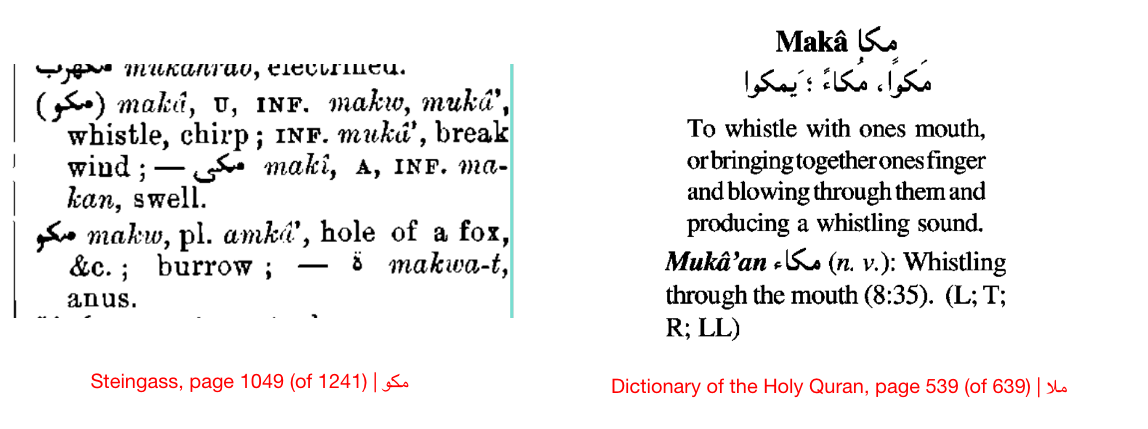
Since it seems apparent that there was some influence on the meaning of this word later in time, let’s stick with what we find in Lane’s for the time being. Lanes show a connection between the root and the colors of a bird. From this, and what we know from nature, it is clear that birds use their colors and calls to attract attention. When we apply this connection to the context of this verse, we can understand that it indicates idol worshipers performed Salat to draw attention to themselves. This is much like a bird which, through its colors and its loud calls, seeks to garner attention for itself.
If we consult Ibn Manẓūr’s Lisān al-ʿArab, we find that the term mukāan ( مُكَاءً ), while often translated narrowly as “whistling,” carries a much broader semantic field that includes connotations of puffing up, swelling, and things bursting or gushing outward.
While one interpretation describes mukāʾ as the act of placing joined fingers into the mouth to produce a high-pitched sound, Ibn Manẓūr also records other meanings tied to exaggerated and exposed display. For example:
مَكَتِ اسْتُه تَمْكُو مُكاءً: نَفَخَتْ، ولا يكون ذلك إِلا وهي مَكْشُوفة مفتوحة، وخص بعضهم به اسْتَ الدّابَّة.
“Makāt istuhā tamkū mukāʾ” — “Her buttocks inflated or puffed out”—this only happens when they are exposed and opened, and some specified this especially for the rear of an animal.
This points to more than just sound—it evokes a sense of immodest swelling or display, suggestive of theatricality rather than reverence.
Likewise, another word from the same root is:
والمَكْوةُ: الاست، سميت بذلك لصفيرها.
Al-makwah — “buttocks,” said to be named so because of their whistling or hissing sound, again linking the term to a kind of vulgar or bodily display, not just to auditory action.
Consider also this vivid line from ʿAntarah describing a gaping wound:
تَمْكُو فَريصَتُه كشِدْقِ الأَعْلَمِ
“Tamkū farīṣatuhu kashidq al-aʿlam” — “His wound gushed like the mouth of a fierce beast.”
This use of tamkū shows the root also implies rupturing, gushing, or erupting with force—in this case, blood—completely unrelated to any controlled act like whistling.
These examples show that mukāʾ, far from being limited to birdlike sounds or whistling with fingers, can signify ostentation, inflated presence, and even obscene exposure or spectacle. When the Qur’an in 8:35 condemns the Quraysh’s “prayer” at the Kaʿbah as nothing but mukāʾ and taṣdiyah, it is not simply mocking odd ritual noises. It is unmasking a performance—an empty, arrogant, and repulsive display masquerading as worship.
In this light, the meaning of mukāʾ aligns with Quraysh’s larger behavior throughout the surah: they were obstructing truth, clinging to prestige, and turning religion into theater. Their prayer was not a spiritual act—it was a show of puffed-up pretense and noisy diversion.
Additionally, this understanding corresponds with another verse in the Quran regarding the Salat of hypocrites who performed their Salat only to show off in front of others.
[4:142] The hypocrites think that they are deceiving GOD, but He is the One who leads them on. When they get up for the Contact Prayer (Salat), they get up lazily. That is because they only show off in front of the people, and rarely do they think of GOD.
إِنَّ الْمُنَافِقِينَ يُخَادِعُونَ اللَّهَ وَهُوَ خَادِعُهُمْ وَإِذَا قَامُوا إِلَى الصَّلَاةِ قَامُوا كُسَالَىٰ يُرَاءُونَ النَّاسَ وَلَا يَذْكُرُونَ اللَّهَ إِلَّا قَلِيلًا
Wataṣdiyatan وَتَصْدِيَةً
Now let’s try to understand the meaning of wataṣdiyatan ( وَتَصْدِيَةً ). As stated previously, most translators translate this word as clapping, but as we will see, this is not an accurate translation based on the context of the verse.
The word wataṣdiyatan ( وَتَصْدِيَةً ) comes from the root “sad-dal-ya” ( ص د ي ). This root occurs only one other time in the Quran, in 80:6, and can help shed some light on its meaning.
[80:1] He (Muhammad) frowned and turned away.
[80:2] When the blind man came to him.
[80:3] How do you know? He may purify himself.
[80:4] Or he may take heed, and benefit from the message.
[80:5] As for the rich man.
[80:6] Then to him you paid attention ( تَصَدَّىٰ ).
(٨٠:٢) أَنْ جَاءَهُ الْأَعْمَىٰ
(٨٠:٣) وَمَا يُدْرِيكَ لَعَلَّهُ يَزَّكَّىٰ
(٨٠:٤) أَوْ يَذَّكَّرُ فَتَنْفَعَهُ الذِّكْرَىٰ
(٨٠:٥) أَمَّا مَنِ اسْتَغْنَىٰ
(٨٠:٦) فَأَنْتَ لَهُ تَصَدَّىٰ
We see in the above verses that the word “taṣaddā” ( تَصَدَّىٰ ), used in 80:6, means that the prophet gave his attention to the rich man over the blind man. This informs us that one of the meanings of the root of this word is “attention.” This implies that the meaning in 8:35 for the word “wataṣdiyatan” ( وَتَصْدِيَةً ) is a “means of seeking attention.”
Lanes also specifies some other derivative meanings for this root that can help give more color to the meaning of this word in the context. One of these derivative meanings from this root is the word “echo.” It indicates that this is understood as one who hears the sound of their voice and calls, which could symbolize that the people enjoyed hearing the sound of their own voice. Additionally, Lanes indicates that this word is connected with being inconsiderate and heedless. This corresponds with the other verses regarding the Salat of the non-believers.
[107:4] And woe to those who observe the contact prayers (Salat)—
[107:5] who are totally heedless of their prayers.
[107:6] They only show off.
(١٠٧:٤) فَوَيْلٌ لِلْمُصَلِّينَ
(١٠٧:٥) الَّذِينَ هُمْ عَنْ صَلَاتِهِمْ سَاهُونَ
(١٠٧:٦) الَّذِينَ هُمْ يُرَاءُونَ
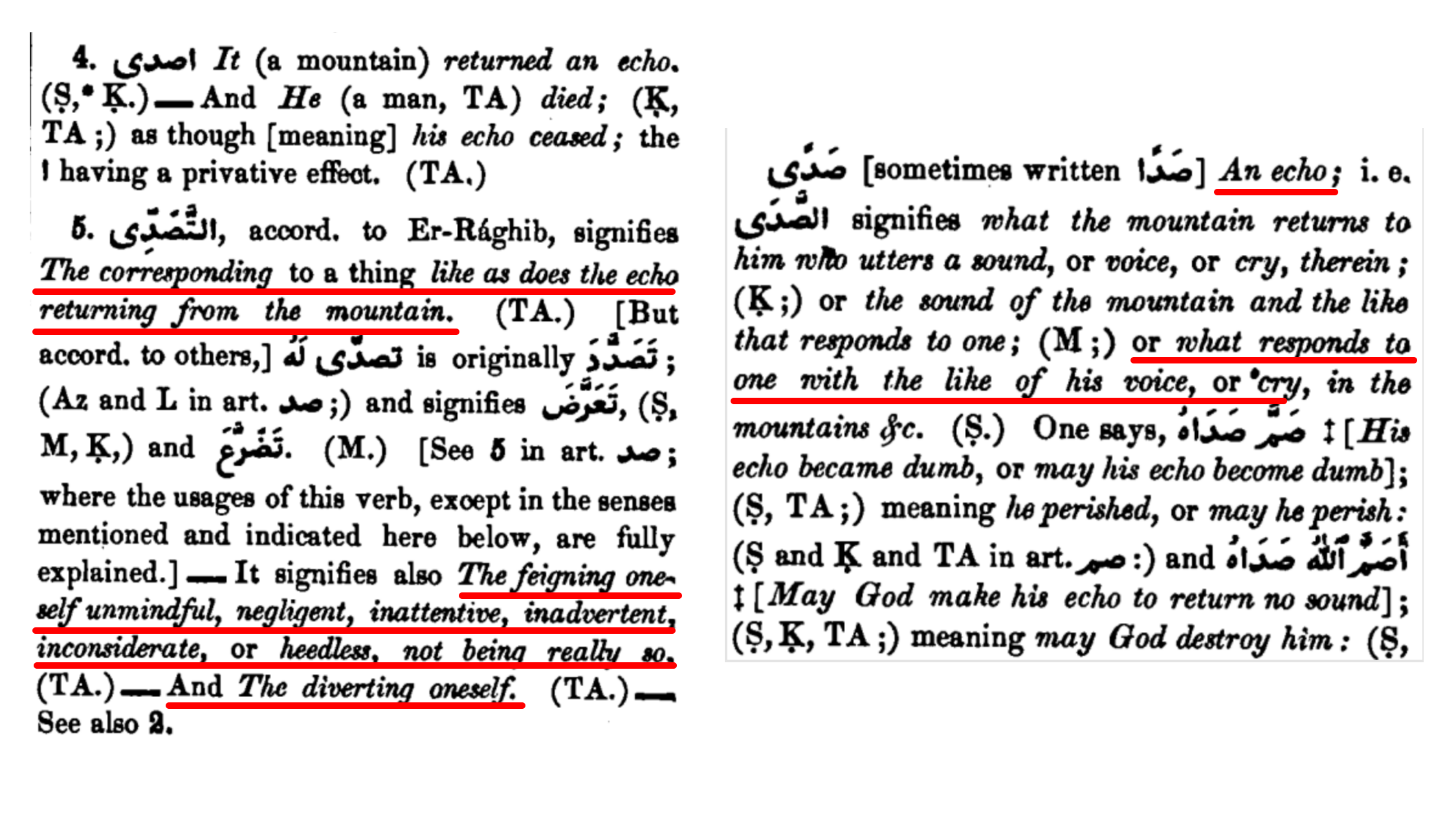
There is also a third connection that Lanes points to for this root, which is that it connects the root with the root “sad-dal-dal” (ص د د ), which means to repel or hinder. This word is used repeatedly in the Quran towards people who repel from the path of God, including in both verses preceding and following 8:35.
[8:34] Have they not deserved GOD’s retribution, by repelling ( يَصُدُّونَ ) others from the Sacred Masjid, even though they are not the custodians thereof? The true custodians thereof are the righteous, but most of them do not know.
[8:35] Their Contact Prayers (Salat) at the shrine (Ka’bah) were no more than “mukāan wataṣdiyatan” ( مُكَاءً وَتَصْدِيَةً ). Therefore, suffer the retribution for your disbelief.
[8:36] Those who disbelieve spend their money to repel ( لِيَصُدُّوا ) others from the way of GOD. They will spend it, then it will turn into sorrow and remorse for them. Ultimately, they will be defeated, and all disbelievers will be summoned to Hell.
وَمَا لَهُمْ أَلَّا يُعَذِّبَهُمُ اللَّهُ وَهُمْ يَصُدُّونَ عَنِ الْمَسْجِدِ الْحَرَامِ وَمَا كَانُوا أَوْلِيَاءَهُ إِنْ أَوْلِيَاؤُهُ إِلَّا الْمُتَّقُونَ وَلَٰكِنَّ أَكْثَرَهُمْ لَا يَعْلَمُونَ
وَمَا كَانَ صَلَاتُهُمْ عِنْدَ الْبَيْتِ إِلَّا مُكَاءً وَتَصْدِيَةً فَذُوقُوا الْعَذَابَ بِمَا كُنْتُمْ تَكْفُرُونَ
إِنَّ الَّذِينَ كَفَرُوا يُنْفِقُونَ أَمْوَالَهُمْ لِيَصُدُّوا عَنْ سَبِيلِ اللَّهِ فَسَيُنْفِقُونَهَا ثُمَّ تَكُونُ عَلَيْهِمْ حَسْرَةً ثُمَّ يُغْلَبُونَ وَالَّذِينَ كَفَرُوا إِلَىٰ جَهَنَّمَ يُحْشَرُونَ
[3:99] Say, “O followers of the scripture, why do you repel ( تَصُدُّونَ ) from the path of GOD those who wish to believe, and seek to distort it, even though you are witnesses?” GOD is never unaware of anything you do.
قُلْ يَاأَهْلَ الْكِتَابِ لِمَ تَصُدُّونَ عَنْ سَبِيلِ اللَّهِ مَنْ آمَنَ تَبْغُونَهَا عِوَجًا وَأَنْتُمْ شُهَدَاءُ وَمَا اللَّهُ بِغَافِلٍ عَمَّا تَعْمَلُونَ

Based on this information, the takeaway of using the word “wataṣdiyatan” ( وَتَصْدِيَةً ) in the context of 8:35, could be understood that the people were seeking attention, that they liked to hear the sound of their own voice, that they were inconsiderate and heedless, and at the same time, they were repelling people from the path of God.
Conclusion
Applying the above understanding, it becomes obvious that to translate mukāan wataṣdiyatan ( مُكَاءً وَتَصْدِيَةً ) as simply “whistling and clapping” is an inaccurate take on what the verse is actually conveying. When we look at this verse in context to the previous verse (8:34) and the following verse (8:36), we see that the Salat performed by the idol worshipers was repelling individuals from the Sacred Masjid. They did this by means of being loud and flamboyant, seeking attention, being full of themselves, inconsiderate, and heedless. This understanding corresponds with (1) the other depictions of these individuals regarding their Salat in the Quran, (2) how the word is used elsewhere in the Quran, and (3) the meanings found in Classical Arabic sources.
[8:34] Have they not deserved GOD’s retribution, by repelling others from the Sacred Masjid, even though they are not the custodians thereof? The true custodians thereof are the righteous, but most of them do not know.
[8:35] Their Contact Prayers (Salat) at the shrine (Ka’bah) were no more than a mockery and a means of repelling the people (by crowding them out). Therefore, suffer the retribution for your disbelief.
[8:36] Those who disbelieve spend their money to repel others from the way of GOD. They will spend it, then it will turn into sorrow and remorse for them. Ultimately, they will be defeated, and all disbelievers will be summoned to Hell.
وَمَا لَهُمْ أَلَّا يُعَذِّبَهُمُ اللَّهُ وَهُمْ يَصُدُّونَ عَنِ الْمَسْجِدِ الْحَرَامِ وَمَا كَانُوا أَوْلِيَاءَهُ إِنْ أَوْلِيَاؤُهُ إِلَّا الْمُتَّقُونَ وَلَٰكِنَّ أَكْثَرَهُمْ لَا يَعْلَمُونَ
وَمَا كَانَ صَلَاتُهُمْ عِنْدَ الْبَيْتِ إِلَّا مُكَاءً وَتَصْدِيَةً فَذُوقُوا الْعَذَابَ بِمَا كُنْتُمْ تَكْفُرُونَ
إِنَّ الَّذِينَ كَفَرُوا يُنْفِقُونَ أَمْوَالَهُمْ لِيَصُدُّوا عَنْ سَبِيلِ اللَّهِ فَسَيُنْفِقُونَهَا ثُمَّ تَكُونُ عَلَيْهِمْ حَسْرَةً ثُمَّ يُغْلَبُونَ وَالَّذِينَ كَفَرُوا إِلَىٰ جَهَنَّمَ يُحْشَرُونَ
| وَمَا | And not | wamā | م ا |
| كَانَ | [it] was | kāna | ك و ن |
| صَلَاتُهُمْ | their Contact Prayers (Salat) | ṣalātuhum | و ص ل |
| عِنْدَ | at | ʿinda | ع ن د |
| الْبَيْتِ | the House (Ka’bah) | l-bayti | ب ي ت |
| إِلَّا | except | illā | ا ل ل ا |
| مُكَاءً | flamboyancy | mukāan | م ك و |
| وَتَصْدِيَةً | and a means of attention seeking / repelling | wataṣdiyatan | ص د ي |
| فَذُوقُوا | So taste [you all] | fadhūqū | ذ و ق |
| الْعَذَابَ | the retribution | l-ʿadhāba | ع ذ ب |
| بِمَا | because | bimā | ب م ا |
| كُنْتُمْ | you [all] used to | kuntum | ك و ن |
| تَكْفُرُونَ | [you all] disbelieve. | takfurūna | ك ف ر |

 Quran Talk Blog